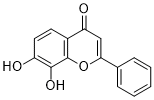
Physicochemical Properties
| Molecular Formula | C15H10O4 |
| Molecular Weight | 254.2375 |
| Exact Mass | 254.057 |
| CAS # | 38183-03-8 |
| PubChem CID | 1880 |
| Appearance | Light yellow to yellow solid powder |
| Density | 1.4±0.1 g/cm3 |
| Boiling Point | 494.4±45.0 °C at 760 mmHg |
| Melting Point | 243-246°C |
| Flash Point | 193.5±22.2 °C |
| Vapour Pressure | 0.0±1.3 mmHg at 25°C |
| Index of Refraction | 1.699 |
| LogP | 2.51 |
| Hydrogen Bond Donor Count | 2 |
| Hydrogen Bond Acceptor Count | 4 |
| Rotatable Bond Count | 1 |
| Heavy Atom Count | 19 |
| Complexity | 384 |
| Defined Atom Stereocenter Count | 0 |
| SMILES | O1C(=C([H])C(C2C([H])=C([H])C(=C(C1=2)O[H])O[H])=O)C1C([H])=C([H])C([H])=C([H])C=1[H] |
| InChi Key | COCYGNDCWFKTMF-UHFFFAOYSA-N |
| InChi Code | InChI=1S/C15H10O4/c16-11-7-6-10-12(17)8-13(19-15(10)14(11)18)9-4-2-1-3-5-9/h1-8,16,18H |
| Chemical Name | 7,8-Dihydroxy-2-phenyl-chromen-4-one |
| Synonyms | DHF 7,8-DHF 7,8-Dihydroxyflavone |
| HS Tariff Code | 2934.99.9001 |
| Storage |
Powder-20°C 3 years 4°C 2 years In solvent -80°C 6 months -20°C 1 month Note: Please store this product in a sealed and protected environment (e.g. under nitrogen), avoid exposure to moisture. |
| Shipping Condition | Room temperature (This product is stable at ambient temperature for a few days during ordinary shipping and time spent in Customs) |
Biological Activity
| ln Vitro | 7,8-Dihydroxyflavone (500 nM) protects primary cortical neurons and locus coeruleus (LC) neuron shells from Aβ-induced toxicity and stimulates dendritic development and synapse formation [1]. |
| ln Vivo | In Alzheimer's disease models, 7,8-Dihydroxyflavone (5 mg/kg/day) protects synapse loss and memory deficits [1]. Application of 7,8-dihydroxyflavone to the model has neuroprotective benefits in animal models of Parkinson's disease and activates TrkB in the brain center, suppresses toxicity generated by red algae toxin, and lowers infarct volume in stroke in a TrkB-dependent way [2]. |
| References |
[1]. 7,8-dihydroxyflavone prevents synaptic loss and memory deficits in a mouse model of Alzheimer's disease. Neuropsychopharmacology. 2014 Feb;39(3):638-50. |
| Additional Infomation | 7,8-dihydroxyflavone is a dihydroxyflavone that is flavone substituted by hydroxy groups at positions 7 and 8. A dihydroxyflavone that is flavone substituted by hydroxy groups at positions 7 and 8. A naturally occurring flavonoid produced by several plants, including the weed Tridax procumbens (coalbuttons or tridax daisy) and the tree Godmania aesculifolia, In animal models, it has shown efficacy against several diseases of the nervous system, including Alzheimer's, Parkinson's, and Huntington's. It has a role as a plant metabolite, a tropomyosin-related kinase B receptor agonist, an antidepressant, an antioxidant and an antineoplastic agent. |
Solubility Data
| Solubility (In Vitro) | DMSO : ≥ 100 mg/mL (~393.33 mM) |
| Solubility (In Vivo) |
Solubility in Formulation 1: ≥ 2.5 mg/mL (9.83 mM) (saturation unknown) in 10% DMSO + 40% PEG300 + 5% Tween80 + 45% Saline (add these co-solvents sequentially from left to right, and one by one), clear solution. For example, if 1 mL of working solution is to be prepared, you can add 100 μL of 25.0 mg/mL clear DMSO stock solution to 400 μL PEG300 and mix evenly; then add 50 μL Tween-80 to the above solution and mix evenly; then add 450 μL normal saline to adjust the volume to 1 mL. Preparation of saline: Dissolve 0.9 g of sodium chloride in 100 mL ddH₂ O to obtain a clear solution. Solubility in Formulation 2: ≥ 2.5 mg/mL (9.83 mM) (saturation unknown) in 10% DMSO + 90% (20% SBE-β-CD in Saline) (add these co-solvents sequentially from left to right, and one by one), clear solution. For example, if 1 mL of working solution is to be prepared, you can add 100 μL of 25.0 mg/mL clear DMSO stock solution to 900 μL of 20% SBE-β-CD physiological saline solution and mix evenly. Preparation of 20% SBE-β-CD in Saline (4°C,1 week): Dissolve 2 g SBE-β-CD in 10 mL saline to obtain a clear solution. Solubility in Formulation 3: ≥ 2.5 mg/mL (9.83 mM) (saturation unknown) in 10% DMSO + 90% Corn Oil (add these co-solvents sequentially from left to right, and one by one), clear solution. For example, if 1 mL of working solution is to be prepared, you can add 100 μL of 25.0 mg/mL clear DMSO stock solution to 900 μL of corn oil and mix evenly. (Please use freshly prepared in vivo formulations for optimal results.) |
| Preparing Stock Solutions | 1 mg | 5 mg | 10 mg | |
| 1 mM | 3.9333 mL | 19.6665 mL | 39.3329 mL | |
| 5 mM | 0.7867 mL | 3.9333 mL | 7.8666 mL | |
| 10 mM | 0.3933 mL | 1.9666 mL | 3.9333 mL |