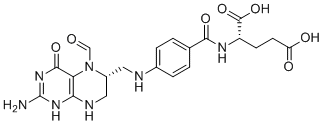
6R-Leucovorin, an analog of Folic Acid, is a vitamin necessary for the synthesis of DNA, conduct DNA repair and methylate DNA, it also acts as a cofactor in biological reactions involving folate. Levoleucovorin impurity.
Physicochemical Properties
| Molecular Formula | C20H23N7O7 |
| Molecular Weight | 473.43932 |
| Exact Mass | 473.165 |
| CAS # | 73951-54-9 |
| PubChem CID | 135484651 |
| Appearance | Crystals from water with 3 mol of water of crystallization. |
| Melting Point | 245 °C (decomp) |
| LogP | -1.2 |
| Hydrogen Bond Donor Count | 7 |
| Hydrogen Bond Acceptor Count | 10 |
| Rotatable Bond Count | 9 |
| Heavy Atom Count | 34 |
| Complexity | 911 |
| Defined Atom Stereocenter Count | 2 |
| SMILES | C1[C@H](N(C2=C(N1)N=C(NC2=O)N)C=O)CNC3=CC=C(C=C3)C(=O)N[C@@H](CCC(=O)O)C(=O)O |
| InChi Key | VVIAGPKUTFNRDU-OLZOCXBDSA-N |
| InChi Code | InChI=1S/C20H23N7O7/c21-20-25-16-15(18(32)26-20)27(9-28)12(8-23-16)7-22-11-3-1-10(2-4-11)17(31)24-13(19(33)34)5-6-14(29)30/h1-4,9,12-13,22H,5-8H2,(H,24,31)(H,29,30)(H,33,34)(H4,21,23,25,26,32)/t12-,13+/m1/s1 |
| Chemical Name | (4-((((R)-2-amino-5-formyl-4-oxo-1,4,5,6,7,8-hexahydropteridin-6-yl)methyl)amino)benzoyl)-L-glutamic acid |
| Synonyms | 6R-Leucovorin (6R,2'S)-Folinic acid Dextrofolinic acid |
| HS Tariff Code | 2934.99.9001 |
| Storage |
Powder-20°C 3 years 4°C 2 years In solvent -80°C 6 months -20°C 1 month |
| Shipping Condition | Room temperature (This product is stable at ambient temperature for a few days during ordinary shipping and time spent in Customs) |
Biological Activity
| ADME/Pharmacokinetics |
Absorption, Distribution and Excretion Duration of action: All routes: 3 to 6 hours. Onset of action: Oral: 20 to 30 minutes. Intramuscular: 10 to 20 minutes. Intravenous: Less than 5 minutes. Crosses blood-brain barrier in moderate amounts; largely concentrated in liver. Elimination: Renal: 80-90%. Fecal: 5-8%. For more Absorption, Distribution and Excretion (Complete) data for LEUCOVORIN (10 total), please visit the HSDB record page. Metabolism / Metabolites In vivo, leucovorin calcium is rapidly and extensively converted to other tetrahydrofolic acid derivatives including 5-methyl tetrahydrofolate, which is the major transport and storage form of folate in the body. /Leucovorin calcium/ Hepatic and intestinal mucosal, mainly to 5-methyltetrahydrofolate (active). After oral administration, leucovorin is substantially (greater than 90%) and rapidly (within 30 minutes) metabolized. Metabolism is less extensive (about 66% after intravenous and 72% after intramuscular administration) and slower with parenteral administration. Biological Half-Life Terminal half-life for total reduced folates: 6.2 hours. |
| Toxicity/Toxicokinetics |
Effects During Pregnancy and Lactation ◉ Summary of Use during Lactation Leucovorin (folinic acid; 5-formyltetrahydrofolic acid) and its levo- isomer, levoleucovorin, are folic acid derivatives that are normal components of breastmilk. Because leucovorin and levoleucovorin are used as therapeutic agents with potentially toxic drugs such as fluorouracil or methotrexate, the LactMed record of the drug it is used with should be consulted. ◉ Effects in Breastfed Infants Relevant published information was not found as of the revision date. ◉ Effects on Lactation and Breastmilk Relevant published information was not found as of the revision date. |
| References | Liu K, Dai X, Zhong D, Deng P, Ma J, Chen X. Simultaneous determination of 6R-leucovorin, 6S-leucovorin and 5-methyltetrahydrofolate in human plasma using solid phase extraction and chiral liquid chromatography-tandem mass spectrometry. J Chromatogr B Analyt Technol Biomed Life Sci. 2009 Apr 1;877(10):902-10. |
| Additional Infomation |
Mechanism of Action Leucovorin is a derivative of tetrahydrofolic acid, the reduced form of folic acid, which is involved as a cofactor for 1-carbon transfer reactions in the biosynthesis of purines and pyrimidines of nucleic acids. Impairment of thymidylate synthesis in patients with folic acid deficiency is thought to account for the defective DNA synthesis that leads to megaloblast formation and megaloblastic and macrocytic anemias. Because of its ready conversion to other tetrahydrofolic acid derivatives, leucovorin is a potent antidote for both the hematopoietic and reticuloendothelial toxic effects of folic acid antagonists (eg, methotrexate, pyrimethamine, trimethoprim). It is postulated that in some cancers leucovorin enters and rescues normal cells from the toxic effects of folic acid antagonists, in preference to tumor cells, because of a difference in membrane transport mechanisms; this principle is the basis of high dose methotrexate therapy with leucovorin rescue. |
Solubility Data
| Solubility (In Vitro) | May dissolve in DMSO (in most cases), if not, try other solvents such as H2O, Ethanol, or DMF with a minute amount of products to avoid loss of samples |
| Solubility (In Vivo) |
Note: Listed below are some common formulations that may be used to formulate products with low water solubility (e.g. < 1 mg/mL), you may test these formulations using a minute amount of products to avoid loss of samples. Injection Formulations (e.g. IP/IV/IM/SC) Injection Formulation 1: DMSO : Tween 80: Saline = 10 : 5 : 85 (i.e. 100 μL DMSO stock solution → 50 μL Tween 80 → 850 μL Saline) *Preparation of saline: Dissolve 0.9 g of sodium chloride in 100 mL ddH ₂ O to obtain a clear solution. Injection Formulation 2: DMSO : PEG300 :Tween 80 : Saline = 10 : 40 : 5 : 45 (i.e. 100 μL DMSO → 400 μLPEG300 → 50 μL Tween 80 → 450 μL Saline) Injection Formulation 3: DMSO : Corn oil = 10 : 90 (i.e. 100 μL DMSO → 900 μL Corn oil) Example: Take the Injection Formulation 3 (DMSO : Corn oil = 10 : 90) as an example, if 1 mL of 2.5 mg/mL working solution is to be prepared, you can take 100 μL 25 mg/mL DMSO stock solution and add to 900 μL corn oil, mix well to obtain a clear or suspension solution (2.5 mg/mL, ready for use in animals). Injection Formulation 4: DMSO : 20% SBE-β-CD in saline = 10 : 90 [i.e. 100 μL DMSO → 900 μL (20% SBE-β-CD in saline)] *Preparation of 20% SBE-β-CD in Saline (4°C,1 week): Dissolve 2 g SBE-β-CD in 10 mL saline to obtain a clear solution. Injection Formulation 5: 2-Hydroxypropyl-β-cyclodextrin : Saline = 50 : 50 (i.e. 500 μL 2-Hydroxypropyl-β-cyclodextrin → 500 μL Saline) Injection Formulation 6: DMSO : PEG300 : castor oil : Saline = 5 : 10 : 20 : 65 (i.e. 50 μL DMSO → 100 μLPEG300 → 200 μL castor oil → 650 μL Saline) Injection Formulation 7: Ethanol : Cremophor : Saline = 10: 10 : 80 (i.e. 100 μL Ethanol → 100 μL Cremophor → 800 μL Saline) Injection Formulation 8: Dissolve in Cremophor/Ethanol (50 : 50), then diluted by Saline Injection Formulation 9: EtOH : Corn oil = 10 : 90 (i.e. 100 μL EtOH → 900 μL Corn oil) Injection Formulation 10: EtOH : PEG300:Tween 80 : Saline = 10 : 40 : 5 : 45 (i.e. 100 μL EtOH → 400 μLPEG300 → 50 μL Tween 80 → 450 μL Saline) Oral Formulations Oral Formulation 1: Suspend in 0.5% CMC Na (carboxymethylcellulose sodium) Oral Formulation 2: Suspend in 0.5% Carboxymethyl cellulose Example: Take the Oral Formulation 1 (Suspend in 0.5% CMC Na) as an example, if 100 mL of 2.5 mg/mL working solution is to be prepared, you can first prepare 0.5% CMC Na solution by measuring 0.5 g CMC Na and dissolve it in 100 mL ddH2O to obtain a clear solution; then add 250 mg of the product to 100 mL 0.5% CMC Na solution, to make the suspension solution (2.5 mg/mL, ready for use in animals). Oral Formulation 3: Dissolved in PEG400 Oral Formulation 4: Suspend in 0.2% Carboxymethyl cellulose Oral Formulation 5: Dissolve in 0.25% Tween 80 and 0.5% Carboxymethyl cellulose Oral Formulation 6: Mixing with food powders Note: Please be aware that the above formulations are for reference only. InvivoChem strongly recommends customers to read literature methods/protocols carefully before determining which formulation you should use for in vivo studies, as different compounds have different solubility properties and have to be formulated differently. (Please use freshly prepared in vivo formulations for optimal results.) |
| Preparing Stock Solutions | 1 mg | 5 mg | 10 mg | |
| 1 mM | 2.1122 mL | 10.5610 mL | 21.1220 mL | |
| 5 mM | 0.4224 mL | 2.1122 mL | 4.2244 mL | |
| 10 mM | 0.2112 mL | 1.0561 mL | 2.1122 mL |