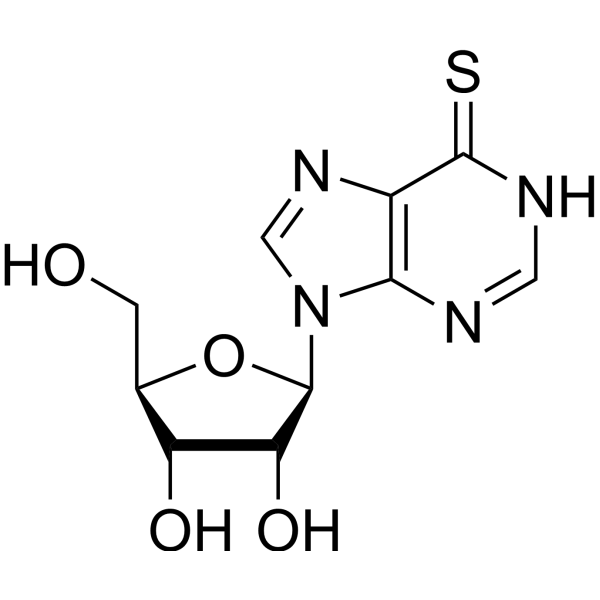
6-Thioinosine (6-Mercaptopurine riboside; 6TI) is a purine antimetabolite, acts as an anti-adipogenesis agent, which downregulates mRNA levels of PPAR γ and C/EBPα, as well as PPAR γ target protein such as LPL, CD36, aP2, and LXRα.
Physicochemical Properties
| Molecular Formula | C10H11N4O4S- |
| Molecular Weight | 283.28374 |
| Exact Mass | 284.058 |
| CAS # | 574-25-4 |
| PubChem CID | 676166 |
| Appearance | White to off-white solid powder |
| Density | 2.02g/cm3 |
| Boiling Point | 714.7ºC at 760mmHg |
| Melting Point | 220-223ºC(lit.) |
| Flash Point | 386ºC |
| Index of Refraction | 1.6270 (estimate) |
| LogP | -0.6 |
| Hydrogen Bond Donor Count | 4 |
| Hydrogen Bond Acceptor Count | 6 |
| Rotatable Bond Count | 2 |
| Heavy Atom Count | 19 |
| Complexity | 409 |
| Defined Atom Stereocenter Count | 4 |
| SMILES | C1=NC(=S)C2=C(N1)N(C=N2)[C@H]3[C@@H]([C@@H]([C@H](O3)CO)O)O |
| InChi Key | NKGPJODWTZCHGF-KQYNXXCUSA-N |
| InChi Code | InChI=1S/C10H12N4O4S/c15-1-4-6(16)7(17)10(18-4)14-3-13-5-8(14)11-2-12-9(5)19/h2-4,6-7,10,15-17H,1H2,(H,11,12,19)/t4-,6-,7-,10-/m1/s1 |
| Chemical Name | 9-[(2R,3R,4S,5R)-3,4-dihydroxy-5-(hydroxymethyl)oxolan-2-yl]-3H-purine-6-thione |
| HS Tariff Code | 2934.99.9001 |
| Storage |
Powder-20°C 3 years 4°C 2 years In solvent -80°C 6 months -20°C 1 month Note: Please store this product in a sealed and protected environment (e.g. under nitrogen), avoid exposure to moisture. |
| Shipping Condition | Room temperature (This product is stable at ambient temperature for a few days during ordinary shipping and time spent in Customs) |
Biological Activity
| Targets |
The targets of 6-Thioinosine include c-Jun N-terminal kinase (JNK), inducible nitric oxide synthase (iNOS), and peroxisome proliferator-activated receptor gamma (PPARγ) [1] |
| ln Vitro |
1. Anti-adipogenic activity in 3T3-L1 preadipocytes (Reference [1]): 6-Thioinosine (10, 20, 40 μM) was added to 3T3-L1 cells at the start of adipogenic induction (IBMX + dexamethasone + insulin). After 8 days, oil red O staining showed concentration-dependent reduced adipocyte differentiation: 10 μM reduced positive cells by 30%, 20 μM by 48%, 40 μM by 65%. Western blot showed 40 μM 6-Thioinosine downregulated PPARγ (58%), upregulated iNOS (2.3-fold), and increased JNK phosphorylation (1.8-fold) [1] 2. Downregulation of adipogenic genes (Reference [1]): qPCR showed 40 μM 6-Thioinosine reduced PPARγ mRNA (62%), C/EBPα (55%), and adiponectin (50%). Inhibiting iNOS (L-NAME, 1 mM) or JNK (SP600125, 20 μM) reversed its anti-adipogenic effect [1] 3. Interference with mouse embryonic limb differentiation (Reference [2]): 11-day-old mouse embryo forelimbs were cultured with 6-Thioinosine (10, 50, 100 μg/mL) for 6 days. 100 μg/mL reduced limb length by 40% and cartilage area (alcian blue staining) by 55%; ≤50 μg/mL had no significant cytotoxicity (MTT) [2] |
| ln Vivo |
1. Disruption of mouse fetal limb development (Reference [2]): Pregnant ICR mice (gestation day 10) received 6-Thioinosine (50/100 mg/kg, intraperitoneal, 3 days). On day 18, 100 mg/kg caused 70% limb malformation (shortening, missing digits) and 35% reduced limb length; 50 mg/kg caused 35% malformation [2] |
| Enzyme Assay |
1. iNOS activity assay (Reference [1]): 3T3-L1 cells treated with 40 μM 6-Thioinosine for 48 hours were lysed. Supernatant was mixed with reaction buffer (Tris-HCl + NADPH + tetrahydrobiopterin + L-arginine) and incubated at 37°C for 30 minutes. Nitrite (iNOS product) was detected via Griess reagent (540 nm absorbance), with iNOS activity increased by 2.1-fold [1] 2. JNK kinase activity assay (Reference [1]): JNK was immunoprecipitated from 40 μM 6-Thioinosine-treated 3T3-L1 lysates. Precipitate was mixed with kinase buffer (Tris-HCl + MgCl₂ + ATP) and c-Jun substrate, incubated at 30°C for 60 minutes. Phosphorylated c-Jun (Western blot) showed JNK activity increased by 1.7-fold [1] |
| Cell Assay |
1. 3T3-L1 preadipocyte culture and induction (Reference [1]): 3T3-L1 cells were cultured in DMEM + 10% FBS. At 80% confluence, induction medium (DMEM + 10% FBS + IBMX + dexamethasone + insulin) was added, with 6-Thioinosine (10-40 μM) in induction and subsequent maintenance medium (DMEM + 10% FBS + insulin) for 8 days total [1] 2. Oil red O staining (Reference [1]): Differentiated 3T3-L1 cells were fixed with 4% paraformaldehyde, stained with 0.5% oil red O (isopropanol) for 30 minutes. Stain was eluted with isopropanol, and absorbance at 510 nm quantified lipid accumulation [1] 3. Mouse embryonic limb organ culture (Reference [2]): 11-day-old mouse embryo forelimbs were cultured in BGJb medium + 10% FBS + 6-Thioinosine (10-100 μg/mL) at 37°C, 5% CO₂ for 6 days (medium changed every 2 days). Limbs were fixed, stained with alcian blue (cartilage), and length/cartilage area measured [2] |
| Animal Protocol |
1. Mouse fetal limb experiment (Reference [2]): Pregnant ICR mice (gestation day 10) were grouped: control (saline), 50 mg/kg 6-Thioinosine, 100 mg/kg 6-Thioinosine (n=6 each). 6-Thioinosine was dissolved in saline (5/10 mg/mL) and injected intraperitoneally (0.1 mL/10 g body weight) for 3 days. On day 18, fetal limbs were examined for malformations, length measured, and malformation rate calculated [2] |
| References |
[1]. Anti-adipogenesis by 6-thioinosine is mediated by downregulation of PPAR gamma through JNK-dependent upregulation of iNOS. Cell Mol Life Sci. 2010 Feb;67(3):467-81. [2]. Interference of 6-mercaptopurine riboside, 6-methylmercaptopurine riboside and azathioprine with the morphogenetic differentiation of mouse extremities in vivo and in organ culture. Naunyn Schmiedebergs Arch Pharmacol. 1977 Jun;298(2):93-105. |
| Additional Infomation |
Thioinosine is a sulfhydryl analog of inosine and an antimetabolite with potential antineoplastic and immunosuppressive properties. Thioinosine interferes with de novo purine synthesis and perturbs the pool of nucleotides necessary for DNA replication. As a result, this agent inhibits DNA synthesis, blocks cellular proliferation and induces apoptosis. Sulfhydryl analog of INOSINE that inhibits nucleoside transport across erythrocyte plasma membranes, and has immunosuppressive properties. It has been used similarly to MERCAPTOPURINE in the treatment of leukemia. (From Martindale, The Extra Pharmacopoeia, 30th ed, p503) 1. Anti-adipogenic mechanism (Reference [1]): 6-Thioinosine activates JNK (increased phosphorylation) to upregulate iNOS, which downregulates PPARγ (key adipogenic factor), inhibiting 3T3-L1 differentiation [1] 2. Chemical category (Reference [1][2]): 6-Thioinosine is a purine nucleoside analog, with 6-position oxygen replaced by sulfur [1][2] 3. Embryonic effect (Reference [2]): 6-Thioinosine interferes with mouse embryonic limb morphogenesis, possibly via disrupting cell proliferation and extracellular matrix formation [2] |
Solubility Data
| Solubility (In Vitro) | DMSO : ~83.33 mg/mL (~293.12 mM) |
| Solubility (In Vivo) |
Solubility in Formulation 1: ≥ 2.08 mg/mL (7.32 mM) (saturation unknown) in 10% DMSO + 40% PEG300 + 5% Tween80 + 45% Saline (add these co-solvents sequentially from left to right, and one by one), clear solution. For example, if 1 mL of working solution is to be prepared, you can add 100 μL of 20.8 mg/mL clear DMSO stock solution to 400 μL PEG300 and mix evenly; then add 50 μL Tween-80 to the above solution and mix evenly; then add 450 μL normal saline to adjust the volume to 1 mL. Preparation of saline: Dissolve 0.9 g of sodium chloride in 100 mL ddH₂ O to obtain a clear solution. Solubility in Formulation 2: ≥ 2.08 mg/mL (7.32 mM) (saturation unknown) in 10% DMSO + 90% (20% SBE-β-CD in Saline) (add these co-solvents sequentially from left to right, and one by one), clear solution. For example, if 1 mL of working solution is to be prepared, you can add 100 μL of 20.8 mg/mL clear DMSO stock solution to 900 μL of 20% SBE-β-CD physiological saline solution and mix evenly. Preparation of 20% SBE-β-CD in Saline (4°C,1 week): Dissolve 2 g SBE-β-CD in 10 mL saline to obtain a clear solution. Solubility in Formulation 3: ≥ 2.08 mg/mL (7.32 mM) (saturation unknown) in 10% DMSO + 90% Corn Oil (add these co-solvents sequentially from left to right, and one by one), clear solution. For example, if 1 mL of working solution is to be prepared, you can add 100 μL of 20.8 mg/mL clear DMSO stock solution to 900 μL of corn oil and mix evenly. (Please use freshly prepared in vivo formulations for optimal results.) |
| Preparing Stock Solutions | 1 mg | 5 mg | 10 mg | |
| 1 mM | 3.5301 mL | 17.6504 mL | 35.3008 mL | |
| 5 mM | 0.7060 mL | 3.5301 mL | 7.0602 mL | |
| 10 mM | 0.3530 mL | 1.7650 mL | 3.5301 mL |