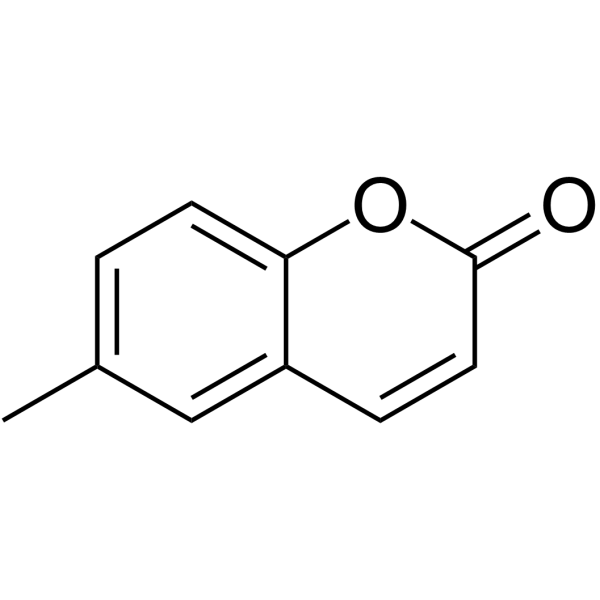
Physicochemical Properties
| Molecular Formula | C10H8O2 |
| Molecular Weight | 160.1693 |
| Exact Mass | 160.052 |
| CAS # | 92-48-8 |
| PubChem CID | 7092 |
| Appearance |
White, crystalline solid White needles from benzene |
| Density | 1.2±0.1 g/cm3 |
| Boiling Point | 304.6±21.0 °C at 760 mmHg |
| Melting Point | 73-76 °C(lit.) |
| Flash Point | 124.3±19.5 °C |
| Vapour Pressure | 0.0±0.6 mmHg at 25°C |
| Index of Refraction | 1.583 |
| LogP | 1.85 |
| Hydrogen Bond Donor Count | 0 |
| Hydrogen Bond Acceptor Count | 2 |
| Rotatable Bond Count | 0 |
| Heavy Atom Count | 12 |
| Complexity | 220 |
| Defined Atom Stereocenter Count | 0 |
| SMILES | O1C(C([H])=C([H])C2C([H])=C(C([H])([H])[H])C([H])=C([H])C1=2)=O |
| InChi Key | FXFYOPQLGGEACP-UHFFFAOYSA-N |
| InChi Code | InChI=1S/C10H8O2/c1-7-2-4-9-8(6-7)3-5-10(11)12-9/h2-6H,1H3 |
| Chemical Name | 6-methylchromen-2-one |
| HS Tariff Code | 2934.99.9001 |
| Storage |
Powder-20°C 3 years 4°C 2 years In solvent -80°C 6 months -20°C 1 month |
| Shipping Condition | Room temperature (This product is stable at ambient temperature for a few days during ordinary shipping and time spent in Customs) |
Biological Activity
| ln Vitro | According to reports, 6-methylcoumarin exhibits nearly negligible phototoxicity in test models for phototoxicity using epidermal tissue and cell culture. Four hours after treating HaCaT cells with 6-methylcoumarin (1-105 nM) and/or UVA (5 J cm-2), γ-H2AX was found using immunofluorescence labeling and Western blotting. Under UVA irradiation, 6-Methylcoumarin at a dose of 100 nM significantly generated γ-H2AX-positive cells [1]. |
| Toxicity/Toxicokinetics |
Interactions The following drugs ... may increase ... response to coumarin or indandione derivatives: alcohol (acute intoxication), allopurinol, aminosalicylic acid, amiodarone, anabolic steroids, chloral hydrate, chloramphenicol, cimetidine, clofibrate, co-trimoxazole, danazol, dextrothyroxine sodium, diazoxide, diflunisal, disulfiram, erythromycin, ethacrynic acid, fenoprofen calcium, glucagon, ibuprofen, indomethacin, influenza virus vaccine, isoniazid, meclofenamate, mefenamic acid, methylthiouracil, metronidazole, miconazole, nalidixic acid, neomycin (oral), pentoxifylline, phenylbutazone, propoxyphene, propylthiouracil, quinidine, quinine, salicylates, streptokinase, sulfinpyrazone, sulfonamides, sulindac, tetracyclines, thiazides, thyroid drugs, tricyclic antidepressants, urokinase, vitamin E. /Coumarin & indandione derivatives/ The following drugs ... may ... decrease ... response to coumarin or indandione derivatives: alcohol (chronic alcoholism), barbiturates, carbamazepine, corticosteroids, corticotropin, ethchlorvynol, glutethimide, griseofulvin, mercaptopurine, methaqualone, oral contraceptives containing estrogen, rifampin, spironolactone, vitamin K. /Coumarin & indandione derivatives/ Non-Human Toxicity Values LD50 Rat oral 1,680 mg/kg LD50 Mouse subcutaneous 253 mg/kg |
| References |
[1]. Phosphorylation of histone H2AX is a powerful tool for detecting chemical photogenotoxicity. J Invest Dermatol. 2011 Jun;131(6):1313-21. |
| Additional Infomation |
6-methylcoumarin appears as white crystals with a flavor of vanilla. Insoluble in water. (NTP, 1992) 6-methylcoumarin is a member of the class of coumarins that is coumarin in which the hydrogen at position 6 is replaced by a methyl group. It has a role as a fragrance and an allergen. Mechanism of Action ...6-Methylcoumarin... undergoes direct photolysis with an estimated half-life of 83 min when illuminated with mid-latitude U.S., noon-centered, equinox sunlight and a quantum yield for photolysis at 313 nm of phi=3 x 10(-3). .../There is/ evidence that singlet molecular oxygen ((1)O2) is formed in illuminated solns containing 6-MC. An estimated value of phi=0.01 is reported for the (1)O2 quantum yield at 313 nm. Formation of (1)O2 is significant because it is known to react with a variety of biomolecules and it is possible that (1)O2 formation is at least partially responsible for reports of 6-MC photoallergenicity and phototoxicity. Both 4-hydroxycoumarin derivatives and indandiones (also known as oral anticoagulants) are antagonists of vitamin K. Their use as rodenticides is based on the inhibition of the vitamin K-dependent step in the synthesis of a number of blood coagulation factors. The vitamin K-dependent proteins ...in the coagulation cascade... are the procoagulant factors II (prothrombin), VII (proconvertin), IX (Christmas factor) and X (Stuart-Prower factor), and the coagulation-inhibiting proteins C and S. All these proteins are synthesized in the liver. Before they are released into the circulation the various precursor proteins undergo substantial (intracellular) post-translational modification. Vitamin K functions as a co-enzyme in one of these modifications, namely the carboxylation at well-defined positions of 10-12 glutamate residues into gamma-carboxyglutamate (Gla). The presence of these Gla residues is essential for the procoagulant activity of the various coagulations factors. Vitamin K hydroquinone (KH2) is the active co-enzyme, and its oxidation to vitamin K 2,3-epoxide (KO) provides the energy required for the carboxylation reaction. The epoxide is than recycled in two reduction steps mediated by the enzyme KO reductase... . The latter enzyme is the target enzyme for coumarin anticoagulants. Their blocking of the KO reductase leads to a rapid exhaustion of the supply of KH2, and thus to an effective prevention of the formation of Gla residues. This leads to an accumulation of non-carboxylated coagulation factor precursors in the liver. In some cases these precursors are processed further without being carboxylated, and (depending on the species) may appear in the circulation. At that stage the under-carboxylated proteins are designated as descarboxy coagulation factors. Normal coagulation factors circulate in the form of zymogens, which can only participate in the coagulation cascade after being activated by limited proteolytic degradation. Descarboxy coagulation factors have no procoagulant activity (i.e. they cannot be activated) and neither they can be converted into the active zymogens by vitamin K action. Whereas in anticoagulated humans high levels of circulating descarboxy coagulation factors are detectable, these levels are negligible in warfarin-treated rats and mice. /Anticoagulant rodenticides/ |
Solubility Data
| Solubility (In Vitro) | DMSO : ~50 mg/mL (~312.17 mM) |
| Solubility (In Vivo) |
Solubility in Formulation 1: ≥ 2.5 mg/mL (15.61 mM) (saturation unknown) in 10% DMSO + 40% PEG300 + 5% Tween80 + 45% Saline (add these co-solvents sequentially from left to right, and one by one), clear solution. For example, if 1 mL of working solution is to be prepared, you can add 100 μL of 25.0 mg/mL clear DMSO stock solution to 400 μL PEG300 and mix evenly; then add 50 μL Tween-80 to the above solution and mix evenly; then add 450 μL normal saline to adjust the volume to 1 mL. Preparation of saline: Dissolve 0.9 g of sodium chloride in 100 mL ddH₂ O to obtain a clear solution. Solubility in Formulation 2: ≥ 2.5 mg/mL (15.61 mM) (saturation unknown) in 10% DMSO + 90% (20% SBE-β-CD in Saline) (add these co-solvents sequentially from left to right, and one by one), clear solution. For example, if 1 mL of working solution is to be prepared, you can add 100 μL of 25.0 mg/mL clear DMSO stock solution to 900 μL of 20% SBE-β-CD physiological saline solution and mix evenly. Preparation of 20% SBE-β-CD in Saline (4°C,1 week): Dissolve 2 g SBE-β-CD in 10 mL saline to obtain a clear solution. Solubility in Formulation 3: ≥ 2.5 mg/mL (15.61 mM) (saturation unknown) in 10% DMSO + 90% Corn Oil (add these co-solvents sequentially from left to right, and one by one), clear solution. For example, if 1 mL of working solution is to be prepared, you can add 100 μL of 25.0 mg/mL clear DMSO stock solution to 900 μL of corn oil and mix evenly. (Please use freshly prepared in vivo formulations for optimal results.) |
| Preparing Stock Solutions | 1 mg | 5 mg | 10 mg | |
| 1 mM | 6.2434 mL | 31.2168 mL | 62.4337 mL | |
| 5 mM | 1.2487 mL | 6.2434 mL | 12.4867 mL | |
| 10 mM | 0.6243 mL | 3.1217 mL | 6.2434 mL |