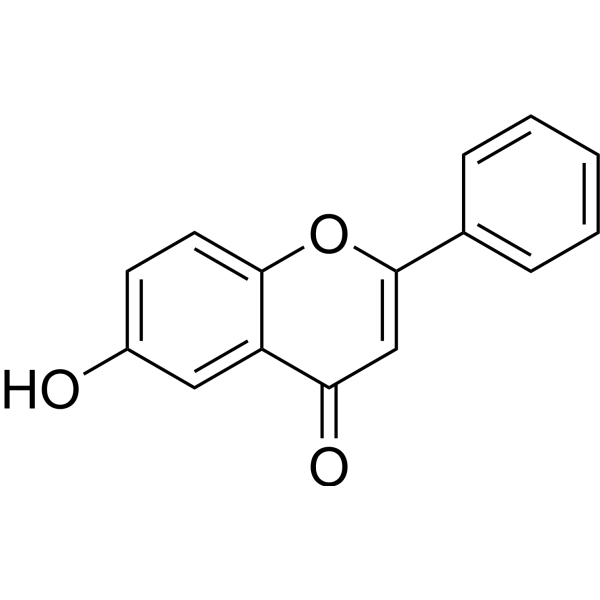
6-Hydroxyflavone is a naturally occurring flavonoid with anti-inflammatory activity, inhibiting the LPS-induced NO production. It has inhibitory effect towards bovine hemoglobin (BHb) glycation and can activate AKT, ERK 1/2, and JNK signaling pathways to effectively promote osteoblastic differentiation.
Physicochemical Properties
| Molecular Formula | C15H10O3 |
| Molecular Weight | 238.2381 |
| Exact Mass | 238.062 |
| CAS # | 6665-83-4 |
| PubChem CID | 72279 |
| Appearance | Light yellow to yellow solid powder |
| Density | 1.3±0.1 g/cm3 |
| Boiling Point | 450.1±45.0 °C at 760 mmHg |
| Melting Point | 234-236 °C(lit.) |
| Flash Point | 176.3±22.2 °C |
| Vapour Pressure | 0.0±1.1 mmHg at 25°C |
| Index of Refraction | 1.666 |
| LogP | 3.72 |
| Hydrogen Bond Donor Count | 1 |
| Hydrogen Bond Acceptor Count | 3 |
| Rotatable Bond Count | 1 |
| Heavy Atom Count | 18 |
| Complexity | 355 |
| Defined Atom Stereocenter Count | 0 |
| InChi Key | GPZYYYGYCRFPBU-UHFFFAOYSA-N |
| InChi Code | InChI=1S/C15H10O3/c16-11-6-7-14-12(8-11)13(17)9-15(18-14)10-4-2-1-3-5-10/h1-9,16H |
| Chemical Name | 6-hydroxy-2-phenylchromen-4-one |
| Synonyms | 6-Hydroxyflavone; 6665-83-4; 6-hydroxy-2-phenylchromen-4-one; 6-Hydroxy-2-phenyl-4-benzopyrone; 6-Hydroxy-2-phenyl-4H-chromen-4-one; 6-Monohydroxyflavone; 6-Hydroxy-2-phenyl-chromen-4-one; NSC-26744; |
| HS Tariff Code | 2934.99.9001 |
| Storage |
Powder-20°C 3 years 4°C 2 years In solvent -80°C 6 months -20°C 1 month Note: This product requires protection from light (avoid light exposure) during transportation and storage. |
| Shipping Condition | Room temperature (This product is stable at ambient temperature for a few days during ordinary shipping and time spent in Customs) |
Biological Activity
| Targets | Natural flavonoid; antioxidative; anti-inflammatory; anti-viral; anti-tumor |
| ln Vitro | Osteoblast differentiation plays an essential role in bone integrity. Isoflavones and some flavonoids are reported to have osteogenic activity and potentially possess the ability to treat osteoporosis. However, limited information concerning the osteogenic characteristics of hydroxyflavones is available. This study investigates the effects of various hydroxyflavones on osteoblast differentiation in MC3T3-E1 cells. The results showed that 6-hydroxyflavone (6-OH-F) and 7-hydroxyflavone (7-OH-F) stimulated ALP activity. However, baicalein and luteolin inhibited ALP activity and flavone showed no effect. Up to 50 μ M of each compound was used for cytotoxic effects study; flavone, 6-OH-F, and 7-OH-F had no cytotoxicity on MC3T3-E1 cells. Moreover, 6-OH-F activated AKT and serine/threonine kinases (also known as protein kinase B or PKB), extracellular signal-regulated kinases (ERK 1/2), and the c-Jun N-terminal kinase (JNK) signaling pathways. On the other hand, 7-OH-F promoted osteoblast differentiation mainly by activating ERK 1/ 2 signaling pathways. Finally, after 5 weeks of 6-OH-F induction, MC3T3-E1 cells showed a significant increase in the calcein staining intensity relative to merely visible mineralization observed in cells cultured in the osteogenic medium only. These results suggested that 6-OH-F could activate AKT, ERK 1/2, and JNK signaling pathways to effectively promote osteoblastic differentiation[2]. |
| Enzyme Assay | Flavonoids are biologically imperative compounds used as anti-oxidants, anti-cancer, anti-bacterial agents etc. The current work reports comprehensive binding studies of two important flavonoids, 6-hydroxyflavone and 5,7-dihydroxyflavone (chrysin) with bovine hemoglobin (BHb) at 298K and 308K, in aqueous medium using UV-vis spectroscopy, steady state fluorescence, circular dichroism (CD) measurements, Fourier Transform infrared spectroscopy (FT-IR) and molecular docking studies. Both 6-hydroxyflavone and chrysin can quench the intrinsic fluorescence intensity of BHb via static quenching mechanism. The values of binding constant (Kb) for BHb-chrysin complex (3.177±0.992×10⁴M-1, at 298K) was found to be greater than that of BHb-6-hydroxyflavone complex (2.874±0.863×10⁴M-1, at 298K) and the Kb values decreased with the rise in temperature. The thermodynamic parameters indicated that hydrophobic forces and H-bonding play crucial role in BHb-6-hydroxyflavone complexation whereas electrostatic interaction plays the major role in the binding of BHb and chrysin. The binding distances from donor BHb to the acceptor ligands (6-hydroxyflavone and chrysin) were estimated using the Föster's theory and the possibility of non-radiative energy transfer from BHb to 6-hydroxyflavone/chrysin was observed. The ligands, 6-hydroxyflavone and chrysin induced conformational change around Trp residues in BHb as confirmed by synchronous and 3D fluorescence results. CD and FT-IR studies indicated that the % α-helicity of BHb was enhanced due to 6-hydroxyflavone/chrysin binding. Both the flavonoids showed remarkable inhibitory effect towards BHb glycation. Hydrophobic probe (8-anilino-1-naphthalenesulfonic acid, ANS) displacement and molecular docking studies revealed that the ligands bind within the hydrophobic pocket of BHb[1]. |
| Cell Assay | Inflammatory responses by kidney mesangial cells play a critical role in the glomerulonephritis. The anti-inflammatory potential of nineteen mono-, di- and polyhydroxylated flavones including fisetin, quercetin, morin, tricetin, gossypetin, apigenin and myricetin were investigated on rat mesangial cells with lipopolysaccharide (LPS) as the inflammatory stimuli. 6-Hydroxyflavone and 4',6-dihydroxyflavone exhibited high activity with IC50 in the range of 2.0 μM, a much better inhibition potential in comparison to the well-studied polyhydroxylated flavones. Interestingly, the anti-inflammatory activity was not due to direct quenching of NO radicals. Investigation on derivatives with methylation, acetylation or sulfation of 6-hydroxyl group revealed that 6-methoxyflavone was the most potent with an IC50 of 192 nM. Mechanistic study indicated that the anti-inflammatory activity of 6-methoxyflavone arose via the inhibition of LPS-induced downstream inducible NO synthase in mesangial cells. The identification of 6-hydroxyflavone and 6-methoxyflavone with potent anti-inflammatory activity in kidney mesangial cells provides a new flavone scaffold and direction to develop naturally derived products for potential nephritis prevention and treatment[3]. |
| ADME/Pharmacokinetics |
Metabolism / Metabolites 6-Hydroxyflavone has known human metabolites that include (2S,3S,4S,5R)-3,4,5-trihydroxy-6-(4-oxo-2-phenylchromen-6-yl)oxyoxane-2-carboxylic acid. |
| References |
[1]. Characterization of non-covalent binding of 6-hydroxyflavone and 5,7-dihydroxyflavone with bovine hemoglobin: Multi-spectroscopic and molecular docking analyses. J Photochem Photobiol B. 2018 Jan;178:40-52. [2]. Effects of 6-Hydroxyflavone on Osteoblast Differentiation in MC3T3-E1 Cells. Evid Based Complement Alternat Med. 2014;2014:924560. [3]. 6-Hydroxyflavone and derivatives exhibit potent anti-inflammatory activity among mono-, di- and polyhydroxylated flavones in kidney mesangial cells. PLoS One. 2015 Mar 19;10(3):e0116409. |
| Additional Infomation |
6-Hydroxyflavone is a hydroxyflavonoid. 6-Hydroxyflavone has been reported in Scutellaria baicalensis with data available. |
Solubility Data
| Solubility (In Vitro) | DMSO : ~125 mg/mL (~524.68 mM) |
| Solubility (In Vivo) |
Solubility in Formulation 1: ≥ 2.08 mg/mL (8.73 mM) (saturation unknown) in 10% DMSO + 40% PEG300 + 5% Tween80 + 45% Saline (add these co-solvents sequentially from left to right, and one by one), clear solution. For example, if 1 mL of working solution is to be prepared, you can add 100 μL of 20.8 mg/mL clear DMSO stock solution to 400 μL PEG300 and mix evenly; then add 50 μL Tween-80 to the above solution and mix evenly; then add 450 μL normal saline to adjust the volume to 1 mL. Preparation of saline: Dissolve 0.9 g of sodium chloride in 100 mL ddH₂ O to obtain a clear solution. Solubility in Formulation 2: ≥ 2.08 mg/mL (8.73 mM) (saturation unknown) in 10% DMSO + 90% Corn Oil (add these co-solvents sequentially from left to right, and one by one), clear solution. For example, if 1 mL of working solution is to be prepared, you can add 100 μL of 20.8 mg/mL clear DMSO stock solution to 900 μL of corn oil and mix evenly. (Please use freshly prepared in vivo formulations for optimal results.) |
| Preparing Stock Solutions | 1 mg | 5 mg | 10 mg | |
| 1 mM | 4.1974 mL | 20.9872 mL | 41.9745 mL | |
| 5 mM | 0.8395 mL | 4.1974 mL | 8.3949 mL | |
| 10 mM | 0.4197 mL | 2.0987 mL | 4.1974 mL |