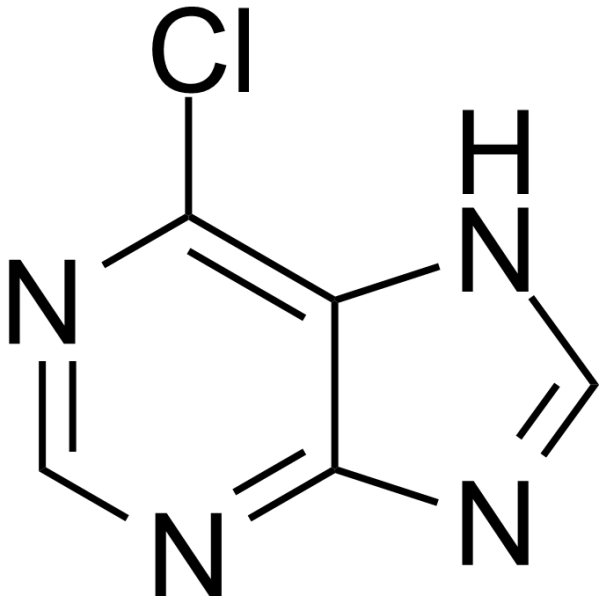
Physicochemical Properties
| Molecular Formula | C5H3CLN4 |
| Molecular Weight | 154.5571 |
| Exact Mass | 154.004 |
| CAS # | 87-42-3 |
| PubChem CID | 5359277 |
| Appearance | Yellow to brown solid powder |
| Density | 1.7±0.1 g/cm3 |
| Boiling Point | 449.6±25.0 °C at 760 mmHg |
| Melting Point | >300 °C (dec.)(lit.) |
| Flash Point | 258.2±8.8 °C |
| Vapour Pressure | 0.0±1.1 mmHg at 25°C |
| Index of Refraction | 1.740 |
| LogP | 0.13 |
| Hydrogen Bond Donor Count | 1 |
| Hydrogen Bond Acceptor Count | 3 |
| Rotatable Bond Count | 0 |
| Heavy Atom Count | 10 |
| Complexity | 131 |
| Defined Atom Stereocenter Count | 0 |
| InChi Key | ZKBQDFAWXLTYKS-UHFFFAOYSA-N |
| InChi Code | InChI=1S/C5H3ClN4/c6-4-3-5(9-1-7-3)10-2-8-4/h1-2H,(H,7,8,9,10) |
| Chemical Name | 6-chloro-7H-purine |
| HS Tariff Code | 2934.99.9001 |
| Storage |
Powder-20°C 3 years 4°C 2 years In solvent -80°C 6 months -20°C 1 month |
| Shipping Condition | Room temperature (This product is stable at ambient temperature for a few days during ordinary shipping and time spent in Customs) |
Biological Activity
| ln Vivo | The process by which 6-chloropurine transforms into S-(6-punnyl)glutathione and then further breaks down into 6-mercaptopurine could be a contributing factor to the anticancer activity of 6-chloropurine. [1]. 6-It has been demonstrated that when given together, chloropurine and diazaserine exhibit synergistic anticancer effects against a range of mice cancers [1]. |
| References |
[1]. Detection and mechanisms of formation of S-(6-purinyl)glutathione and 6-mercaptopurine in rats given 6-chloropurine. J Pharmacol Exp Ther. 1993 Jan;264(1):41-6. [2]. Comparative studies on the in vivo action of 6-chloropurine, 6-chloropurine ribonucleoside, and 6-chloro-9-ethylpurine on sarcoma 180 ascites cells. J Pharmacol Exp Ther. 1961 Oct;134:123-8. |
| Additional Infomation | 6-Chloro-1H-purine is a member of purines. |
Solubility Data
| Solubility (In Vitro) |
DMSO : ~27.5 mg/mL (~177.92 mM) H2O : ~3 mg/mL (~19.41 mM) |
| Solubility (In Vivo) |
Solubility in Formulation 1: ≥ 2.75 mg/mL (17.79 mM) (saturation unknown) in 10% DMSO + 40% PEG300 + 5% Tween80 + 45% Saline (add these co-solvents sequentially from left to right, and one by one), clear solution. For example, if 1 mL of working solution is to be prepared, you can add 100 μL of 27.5 mg/mL clear DMSO stock solution to 400 μL PEG300 and mix evenly; then add 50 μL Tween-80 to the above solution and mix evenly; then add 450 μL normal saline to adjust the volume to 1 mL. Preparation of saline: Dissolve 0.9 g of sodium chloride in 100 mL ddH₂ O to obtain a clear solution. Solubility in Formulation 2: ≥ 2.75 mg/mL (17.79 mM) (saturation unknown) in 10% DMSO + 90% (20% SBE-β-CD in Saline) (add these co-solvents sequentially from left to right, and one by one), clear solution. For example, if 1 mL of working solution is to be prepared, you can add 100 μL of 27.5 mg/mL clear DMSO stock solution to 900 μL of 20% SBE-β-CD physiological saline solution and mix evenly. Preparation of 20% SBE-β-CD in Saline (4°C,1 week): Dissolve 2 g SBE-β-CD in 10 mL saline to obtain a clear solution. Solubility in Formulation 3: ≥ 2.75 mg/mL (17.79 mM) (saturation unknown) in 10% DMSO + 90% Corn Oil (add these co-solvents sequentially from left to right, and one by one), clear solution. For example, if 1 mL of working solution is to be prepared, you can add 100 μL of 27.5 mg/mL clear DMSO stock solution to 900 μL of corn oil and mix evenly. Solubility in Formulation 4: 2 mg/mL (12.94 mM) in PBS (add these co-solvents sequentially from left to right, and one by one), clear solution; with ultrasonication (<60°C). (Please use freshly prepared in vivo formulations for optimal results.) |
| Preparing Stock Solutions | 1 mg | 5 mg | 10 mg | |
| 1 mM | 6.4700 mL | 32.3499 mL | 64.6998 mL | |
| 5 mM | 1.2940 mL | 6.4700 mL | 12.9400 mL | |
| 10 mM | 0.6470 mL | 3.2350 mL | 6.4700 mL |