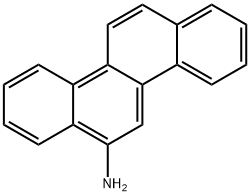
Physicochemical Properties
| Molecular Formula | C18H13N |
| Molecular Weight | 243.30300 |
| Exact Mass | 243.104 |
| CAS # | 2642-98-0 |
| PubChem CID | 17534 |
| Appearance | Light yellow to yellow solid powder |
| Density | 1.3±0.1 g/cm3 |
| Boiling Point | 501.2±19.0 °C at 760 mmHg |
| Melting Point | 209-211 °C(lit.) |
| Flash Point | 286.9±16.8 °C |
| Vapour Pressure | 0.0±1.3 mmHg at 25°C |
| Index of Refraction | 1.814 |
| LogP | 4.63 |
| Hydrogen Bond Donor Count | 1 |
| Hydrogen Bond Acceptor Count | 1 |
| Rotatable Bond Count | 0 |
| Heavy Atom Count | 19 |
| Complexity | 326 |
| Defined Atom Stereocenter Count | 0 |
| InChi Key | KIVUHCNVDWYUNP-UHFFFAOYSA-N |
| InChi Code | InChI=1S/C18H13N/c19-18-11-17-13-6-2-1-5-12(13)9-10-15(17)14-7-3-4-8-16(14)18/h1-11H,19H2 |
| Chemical Name | chrysen-6-amine |
| HS Tariff Code | 2934.99.9001 |
| Storage |
Powder-20°C 3 years 4°C 2 years In solvent -80°C 6 months -20°C 1 month |
| Shipping Condition | Room temperature (This product is stable at ambient temperature for a few days during ordinary shipping and time spent in Customs) |
Biological Activity
| ln Vitro |
6-Aminochrysene inhibits the hydroxylation of aniline, the O-demethylation of p-nitroanisole, and the N-demethylation of aminopyrine in rat liver microsomes. Pretreatment of rats with 6-amino groups in vitro greatly reduced N-demethylation, but dramatically increased hydroxylation and O-demethylation [1]. Incubation of liver microsomes with 6-Aminochrysene at concentrations up to 100 μM significantly induced the activity of aryl hydrocarbon hydroxylase (AHH) in vitro, with a dose-dependent increase observed in enzyme activity compared to the control group. [1] 6-Aminochrysene treatment did not show significant effects on the activity of NADPH-cytochrome c reductase in liver microsomal preparations, with enzyme activity remaining comparable to the untreated control. [1] |
| ln Vivo |
6-Aminochrysene has a tumor suppressor effect on human breast cancer and inhibits the growth of a variety of solid experimental tumors in vivo [1]. When mice were given 6-amino topically over an extended period of time, they developed benign skin tumors after three months and malignant skin tumors after seven months. Compared to male mice, female mice replied first. When 6-amino was given ventrally as opposed to dorsally, skin cancers were generated more quickly. Following cutaneous application, urinary excretion is around twice as high as following oral treatment [2]. Administration of 6-Aminochrysene to mice via intraperitoneal injection at doses of 20, 40, and 80 mg/kg body weight, once weekly for 16 weeks, resulted in a dose-dependent increase in the incidence of hepatocellular carcinomas, with the highest dose group showing a tumor incidence of approximately 80%. [2] Oral administration of 6-Aminochrysene to mice at a dose of 100 mg/kg body weight, once weekly for 20 weeks, induced the formation of lung adenomas and carcinomas, as well as liver tumors, with a tumor incidence of ~65% in the treated group compared to 0% in the control group. [2] 6-Aminochrysene exposure via subcutaneous injection (50 mg/kg, once weekly for 18 weeks) in mice led to the development of skin papillomas and squamous cell carcinomas at the injection site, with a latency period of 12–14 weeks. [2] |
| Enzyme Assay |
Liver microsomes were isolated from untreated mice, suspended in an appropriate buffer, and adjusted to a specific protein concentration. [1] For AHH activity assay: Microsomal suspensions were incubated with 6-Aminochrysene at different concentrations (10, 50, 100 μM) in the presence of NADPH regenerating system at 37°C for 30 minutes. The reaction was terminated by adding a cold organic solvent, and the formation of hydroxylated metabolites was quantified using a spectrophotometric method at a specific wavelength to determine enzyme activity. [1] For NADPH-cytochrome c reductase assay: Microsomal preparations were mixed with 6-Aminochrysene (10–100 μM) and cytochrome c substrate, and the reaction was initiated by adding NADPH. The rate of cytochrome c reduction was measured spectrophotometrically at 550 nm over 5 minutes to calculate enzyme activity. [1] |
| Animal Protocol |
Female and male Swiss mice (6–8 weeks old) were randomly divided into control and treatment groups (15 mice per group). [2] Intraperitoneal injection group: 6-Aminochrysene was dissolved in corn oil, and administered at doses of 20, 40, or 80 mg/kg body weight once weekly for 16 weeks; control mice received an equivalent volume of corn oil. [2] Oral gavage group: 6-Aminochrysene was suspended in 0.5% carboxymethylcellulose, and administered at 100 mg/kg body weight once weekly for 20 weeks; control mice received the vehicle alone. [2] Subcutaneous injection group: 6-Aminochrysene was dissolved in dimethyl sulfoxide (DMSO) and diluted with saline (DMSO final concentration ≤5%), administered at 50 mg/kg body weight once weekly for 18 weeks at the dorsal skin; control mice received the solvent mixture. [2] Mice were monitored weekly for body weight changes and clinical signs of toxicity, and sacrificed at the end of the treatment period for pathological examination of major organs (liver, lung, skin). [2] |
| ADME/Pharmacokinetics |
Metabolism / Metabolites 6-chrysenamine has known human metabolites that include N-Hydroxychrysene and 6-MeC-1,2-diol. |
| Toxicity/Toxicokinetics |
6-Aminochrysene exhibited strong carcinogenic toxicity in mice, with the liver, lung, and skin being the primary target organs for tumor induction, depending on the route of administration. [2] High-dose intraperitoneal administration (80 mg/kg/week) of 6-Aminochrysene caused mild to moderate hepatomegaly in mice, with histological changes including hepatocellular hypertrophy and hyperplasia prior to tumor formation. [2] |
| References |
[1]. Effects of 6-aminochrysene on liver microsomal enzyme activity. Xenobiotica. 1976 Apr;6(4):201-5. [2]. Carcinogenicity of 6-aminochrysene in mice. Eur J Cancer. 1975 May;11(5):327-34. |
| Additional Infomation |
6-chrysenamine is a carbopolycyclic compound. 6-Aminochrysene is a derivative of chrysene, a polycyclic aromatic hydrocarbon (PAH) with known environmental and toxicological relevance. [1][2] The induction of liver microsomal AHH activity by 6-Aminochrysene suggests its metabolism via the cytochrome P450 enzyme system, which may be involved in the activation of the compound to reactive intermediates with carcinogenic potential. [1] The carcinogenic effect of 6-Aminochrysene in mice is dependent on the administration route, dose, and duration of exposure, with intraperitoneal injection showing the most potent hepatocarcinogenic activity. [2] |
Solubility Data
| Solubility (In Vitro) | DMSO : ~100 mg/mL (~411.02 mM) |
| Solubility (In Vivo) |
Solubility in Formulation 1: ≥ 2.08 mg/mL (8.55 mM) (saturation unknown) in 10% DMSO + 40% PEG300 +5% Tween-80 + 45% Saline (add these co-solvents sequentially from left to right, and one by one), clear solution. For example, if 1 mL of working solution is to be prepared, you can add 100 μL of 20.8 mg/mL clear DMSO stock solution to 400 μL PEG300 and mix evenly; then add 50 μL Tween-80 + to the above solution and mix evenly; then add 450 μL normal saline to adjust the volume to 1 mL. Preparation of saline: Dissolve 0.9 g of sodium chloride in 100 mL ddH₂ O to obtain a clear solution. (Please use freshly prepared in vivo formulations for optimal results.) |
| Preparing Stock Solutions | 1 mg | 5 mg | 10 mg | |
| 1 mM | 4.1102 mL | 20.5508 mL | 41.1015 mL | |
| 5 mM | 0.8220 mL | 4.1102 mL | 8.2203 mL | |
| 10 mM | 0.4110 mL | 2.0551 mL | 4.1102 mL |