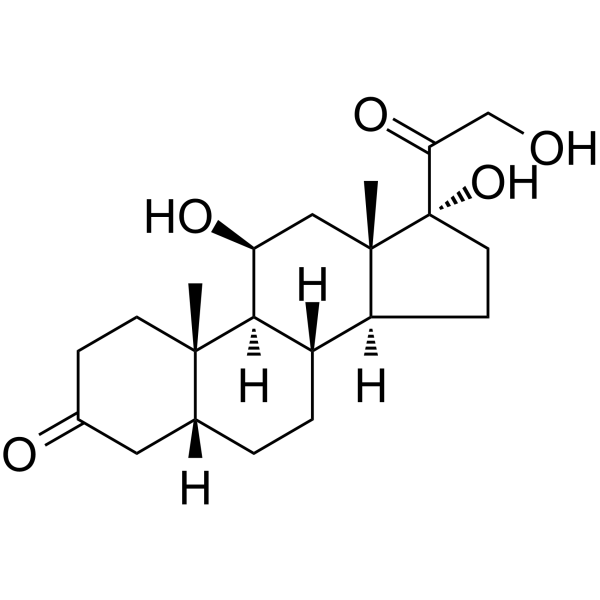
Physicochemical Properties
| Molecular Formula | C21H32O5 |
| Molecular Weight | 364.48 |
| Exact Mass | 364.225 |
| CAS # | 1482-50-4 |
| PubChem CID | 164838 |
| Appearance | White to off-white solid powder |
| Density | 1.249g/cm3 |
| Boiling Point | 544.5ºC at 760mmHg |
| Flash Point | 297.1ºC |
| Index of Refraction | 1.569 |
| LogP | 1.861 |
| Hydrogen Bond Donor Count | 3 |
| Hydrogen Bond Acceptor Count | 5 |
| Rotatable Bond Count | 2 |
| Heavy Atom Count | 26 |
| Complexity | 632 |
| Defined Atom Stereocenter Count | 8 |
| SMILES | C[C@]12CCC(=O)C[C@H]1CC[C@@H]3[C@@H]2[C@H](C[C@]4([C@H]3CC[C@@]4(C(=O)CO)O)C)O |
| InChi Key | ACSFOIGNUQUIGE-AIPUTVCKSA-N |
| InChi Code | InChI=1S/C21H32O5/c1-19-7-5-13(23)9-12(19)3-4-14-15-6-8-21(26,17(25)11-22)20(15,2)10-16(24)18(14)19/h12,14-16,18,22,24,26H,3-11H2,1-2H3/t12-,14+,15+,16+,18-,19+,20+,21+/m1/s1 |
| Chemical Name | (5R,8S,9S,10S,11S,13S,14S,17R)-11,17-dihydroxy-17-(2-hydroxyacetyl)-10,13-dimethyl-2,4,5,6,7,8,9,11,12,14,15,16-dodecahydro-1H-cyclopenta[a]phenanthren-3-one |
| HS Tariff Code | 2934.99.9001 |
| Storage |
Powder-20°C 3 years 4°C 2 years In solvent -80°C 6 months -20°C 1 month |
| Shipping Condition | Room temperature (This product is stable at ambient temperature for a few days during ordinary shipping and time spent in Customs) |
Biological Activity
| ln Vitro | 5β-Dihydrocortisol (10-100 μM; 48 h) reduces the viability of MCF-7 cells with an IC50 of 27.59 μM[2]. In MCF-7 cells, 5β-Dihydrocortisol (14 μM; 24 h) causes 2.5% late and 35.6% early apoptosis[2]. Human serum albumin (HAS) exhibits intrinsic fluorescence with a maximum emission peak at 360 nm. It can be quenched with 5β-Dihydrocortisol (1-10 μM; 48 h) without causing any change in the fluorescence peak. |
| ln Vivo | In juvenile rabbits, the intraocular pressure (IOP) is raised by topical application of Dexamethasone (0.06%) more effectively when 5β-Dihydrocortisol (0.1-1.0%; 18 d) is used[3]. |
| Cell Assay |
Cell Viability Assay[2] Cell Types: MCF-7 and HEK 293 cells Tested Concentrations: 10, 20, 40, 60, 80, 100 μM Incubation Duration: 48 hrs (hours) Experimental Results: Inhibited the viability of MCF-7 cells in a dose -dependent manner. No toxicity in terms of cell viability was observed with HEK293 cell line. Apoptosis Analysis[2] Cell Types: MCF-7 cells Tested Concentrations: 14 μM Incubation Duration: 24 hrs (hours) Experimental Results: Induced 35.6% and 2.5% of early and late apoptosis. |
| References |
[1]. Dihydrocortisol: a potential mineralocorticoid. J Steroid Biochem. 1978 Jan;9(1):1-7. [2]. Spectroscopic evaluation of synthesized 5β-dihydrocortisol and 5β-dihydrocortisol acetate binding mechanism with human serum albumin and their role in anticancer activity. J Biomol Struct Dyn. 2019 Feb;37(3):623-640. [3]. 5 beta-Dihydrocortisol: possible mediator of the ocular hypertension in glaucoma. Invest Ophthalmol Vis Sci. 1985 Mar;26(3):393-5. [4]. Differential activity and expression of human 5β-reductase (AKR1D1) splice variants. J Mol Endocrinol. 2021 Mar;66(3):181-194. [5]. Potentiation of glucocorticoid activity by 5 beta-dihydrocortisol: its role in glaucoma. Science. 1983 Oct 14;222(4620):172-3. |
| Additional Infomation | 5beta-dihydrocortisol is a 17alpha-hydroxy-C21-steroid that is cortisol in which the 4-5 double bond has undergone formal hydrogenation to give the corresponding 5beta- steroid. It is a 21-hydroxy steroid, a 17alpha-hydroxy-C21-steroid, an 11beta-hydroxy steroid, a 3-oxo-5beta-steroid, a primary alpha-hydroxy ketone, a triol, a secondary alcohol, a diketone, a 20-oxo steroid and a tertiary alpha-hydroxy ketone. |
Solubility Data
| Solubility (In Vitro) | DMSO: 125 mg/mL (342.95 mM) |
| Solubility (In Vivo) |
Solubility in Formulation 1: ≥ 2.08 mg/mL (5.71 mM) (saturation unknown) in 10% DMSO + 40% PEG300 + 5% Tween80 + 45% Saline (add these co-solvents sequentially from left to right, and one by one), clear solution. For example, if 1 mL of working solution is to be prepared, you can add 100 μL of 20.8 mg/mL clear DMSO stock solution to 400 μL PEG300 and mix evenly; then add 50 μL Tween-80 to the above solution and mix evenly; then add 450 μL normal saline to adjust the volume to 1 mL. Preparation of saline: Dissolve 0.9 g of sodium chloride in 100 mL ddH₂ O to obtain a clear solution. Solubility in Formulation 2: ≥ 2.08 mg/mL (5.71 mM) (saturation unknown) in 10% DMSO + 90% (20% SBE-β-CD in Saline) (add these co-solvents sequentially from left to right, and one by one), clear solution. For example, if 1 mL of working solution is to be prepared, you can add 100 μL of 20.8 mg/mL clear DMSO stock solution to 900 μL of 20% SBE-β-CD physiological saline solution and mix evenly. Preparation of 20% SBE-β-CD in Saline (4°C,1 week): Dissolve 2 g SBE-β-CD in 10 mL saline to obtain a clear solution. Solubility in Formulation 3: ≥ 2.08 mg/mL (5.71 mM) (saturation unknown) in 10% DMSO + 90% Corn Oil (add these co-solvents sequentially from left to right, and one by one), clear solution. For example, if 1 mL of working solution is to be prepared, you can add 100 μL of 20.8 mg/mL clear DMSO stock solution to 900 μL of corn oil and mix evenly. (Please use freshly prepared in vivo formulations for optimal results.) |
| Preparing Stock Solutions | 1 mg | 5 mg | 10 mg | |
| 1 mM | 2.7436 mL | 13.7182 mL | 27.4363 mL | |
| 5 mM | 0.5487 mL | 2.7436 mL | 5.4873 mL | |
| 10 mM | 0.2744 mL | 1.3718 mL | 2.7436 mL |