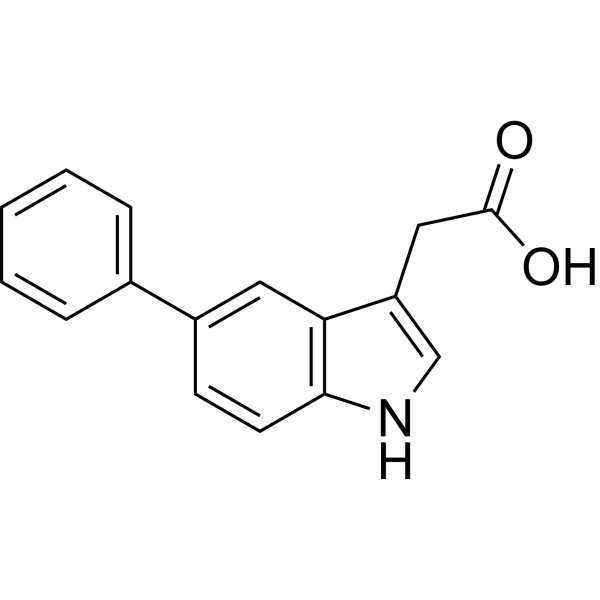
Physicochemical Properties
| Molecular Formula | C16H13NO2 |
| Molecular Weight | 251.28 |
| Exact Mass | 251.095 |
| CAS # | 168649-23-8 |
| PubChem CID | 15207491 |
| Appearance | White to light yellow solid powder |
| LogP | 3.462 |
| Hydrogen Bond Donor Count | 2 |
| Hydrogen Bond Acceptor Count | 2 |
| Rotatable Bond Count | 3 |
| Heavy Atom Count | 19 |
| Complexity | 325 |
| Defined Atom Stereocenter Count | 0 |
| InChi Key | ACCCWYHBDGKDKN-UHFFFAOYSA-N |
| InChi Code | InChI=1S/C16H13NO2/c18-16(19)9-13-10-17-15-7-6-12(8-14(13)15)11-4-2-1-3-5-11/h1-8,10,17H,9H2,(H,18,19) |
| Chemical Name | 2-(5-phenyl-1H-indol-3-yl)acetic acid |
| HS Tariff Code | 2934.99.9001 |
| Storage |
Powder-20°C 3 years 4°C 2 years In solvent -80°C 6 months -20°C 1 month |
| Shipping Condition | Room temperature (This product is stable at ambient temperature for a few days during ordinary shipping and time spent in Customs) |
Biological Activity
| ln Vitro | In HCT116 cells constitutively expressing OsTIR1 (F74G), 5-Ph-IAA (1 μM; 6 hours) promotes DHC1-mac degradation, suggesting that the AID2 system is more effective than the original AID system at producing conditionally altered cell lines [1]. |
| ln Vivo | Tumor suppression results from 5-Ph-IAA (0-10 mg/kg; i.p.; daily; 7 days) administration to the AID2 system, which is sufficient to deplete mAID-BRD4 and TOP2A-mAC[1]. |
| Cell Assay |
Western Blot Analysis[1] Cell Types: HCT116 cells Tested Concentrations: 1 µM Incubation Duration: 6 hrs (hours) Experimental Results: Depleted DHC1-mAC efficiently in HCT116 cells constitutively expressing OsTIR1(F74G). |
| Animal Protocol |
Animal/Disease Models: Balb/c-nu female mice (7 weeks old; 16–20 g ) bearing mAID-BRD4 and TOP2A-mAC xenograft tumours cells[1] Doses: 0 mg/kg, 1 mg/kg, 3 mg/kg and 10 mg/kg Route of Administration: intraperitoneally (ip) injection; every day; 7 days Experimental Results: Displayed significant tumor suppression of mAID-BRD4 xenografts and TOP2A-mAC xenografts. |
| References |
[1]. The auxin-inducible degron 2 technology provides sharp degradation control in yeast, mammalian cells, and mice. Nat Commun. 2020 Nov 11;11(1):5701. |
Solubility Data
| Solubility (In Vitro) | DMSO: 100 mg/mL (397.96 mM) |
| Solubility (In Vivo) |
Solubility in Formulation 1: ≥ 2.08 mg/mL (8.28 mM) (saturation unknown) in 10% DMSO + 40% PEG300 + 5% Tween80 + 45% Saline (add these co-solvents sequentially from left to right, and one by one), clear solution. For example, if 1 mL of working solution is to be prepared, you can add 100 μL of 20.8 mg/mL clear DMSO stock solution to 400 μL PEG300 and mix evenly; then add 50 μL Tween-80 to the above solution and mix evenly; then add 450 μL normal saline to adjust the volume to 1 mL. Preparation of saline: Dissolve 0.9 g of sodium chloride in 100 mL ddH₂ O to obtain a clear solution. Solubility in Formulation 2: ≥ 2.08 mg/mL (8.28 mM) (saturation unknown) in 10% DMSO + 90% (20% SBE-β-CD in Saline) (add these co-solvents sequentially from left to right, and one by one), clear solution. For example, if 1 mL of working solution is to be prepared, you can add 100 μL of 20.8 mg/mL clear DMSO stock solution to 900 μL of 20% SBE-β-CD physiological saline solution and mix evenly. Preparation of 20% SBE-β-CD in Saline (4°C,1 week): Dissolve 2 g SBE-β-CD in 10 mL saline to obtain a clear solution. Solubility in Formulation 3: ≥ 2.08 mg/mL (8.28 mM) (saturation unknown) in 10% DMSO + 90% Corn Oil (add these co-solvents sequentially from left to right, and one by one), clear solution. For example, if 1 mL of working solution is to be prepared, you can add 100 μL of 20.8 mg/mL clear DMSO stock solution to 900 μL of corn oil and mix evenly. Solubility in Formulation 4: 1 mg/mL (3.98 mM) in PBS (add these co-solvents sequentially from left to right, and one by one), clear solution; with ultrasonication (<60°C). (Please use freshly prepared in vivo formulations for optimal results.) |
| Preparing Stock Solutions | 1 mg | 5 mg | 10 mg | |
| 1 mM | 3.9796 mL | 19.8981 mL | 39.7962 mL | |
| 5 mM | 0.7959 mL | 3.9796 mL | 7.9592 mL | |
| 10 mM | 0.3980 mL | 1.9898 mL | 3.9796 mL |