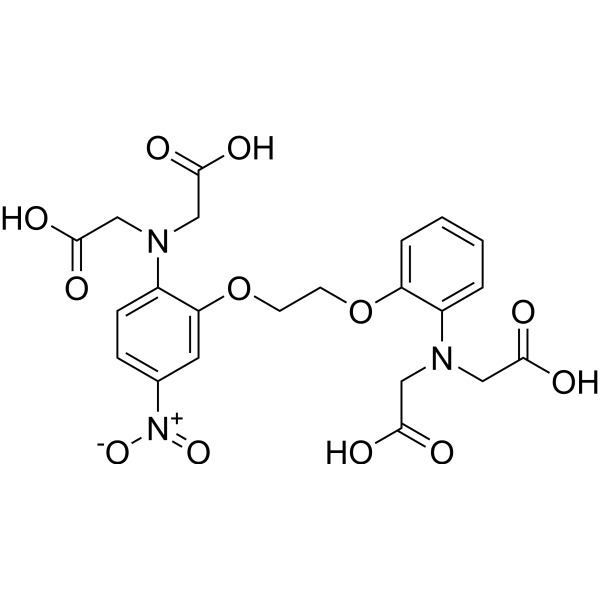
Physicochemical Properties
| Molecular Formula | C22H23N3O12 |
| Molecular Weight | 521.430926561356 |
| Exact Mass | 521.128 |
| CAS # | 124251-83-8 |
| PubChem CID | 53971220 |
| Appearance | Typically exists as solid at room temperature |
| LogP | 1.527 |
| Hydrogen Bond Donor Count | 4 |
| Hydrogen Bond Acceptor Count | 14 |
| Rotatable Bond Count | 15 |
| Heavy Atom Count | 37 |
| Complexity | 787 |
| Defined Atom Stereocenter Count | 0 |
| SMILES | C(O)(=O)CN(C1=CC=CC=C1OCCOC1=CC([N+]([O-])=O)=CC=C1N(CC(O)=O)CC(O)=O)CC(O)=O |
| InChi Key | JRTCJLPFWVGNQV-UHFFFAOYSA-N |
| InChi Code | InChI=1S/C22H23N3O12/c26-19(27)10-23(11-20(28)29)15-3-1-2-4-17(15)36-7-8-37-18-9-14(25(34)35)5-6-16(18)24(12-21(30)31)13-22(32)33/h1-6,9H,7-8,10-13H2,(H,26,27)(H,28,29)(H,30,31)(H,32,33) |
| Chemical Name | 2-[2-[2-[2-[bis(carboxymethyl)amino]phenoxy]ethoxy]-N-(carboxymethyl)-4-nitroanilino]acetic acid |
| HS Tariff Code | 2934.99.9001 |
| Storage |
Powder-20°C 3 years 4°C 2 years In solvent -80°C 6 months -20°C 1 month |
| Shipping Condition | Room temperature (This product is stable at ambient temperature for a few days during ordinary shipping and time spent in Customs) |
Biological Activity
| ln Vitro | 5-Nitro BAPTA is a red fluorescent probe with high emission in the long wavelength region that is intended to measure cytoplasmic Ca2+ [1]. The general process for fluorescent imaging of HeLa cells in culture is as follows: 1. Cells are plated into 35 mm glass-bottom culture dishes (Matsunami) covered with poly-L-lysine. The plates are then incubated in a solution containing 10% (v/v) fetal calf serum in DMEM, 1% penicillin, and 1% streptomycin. 2. After removing the DMEM and washing the dish three times with HBSS, add CaTM-2 AM (3 μM) to the 0.3% DMSO co-solvent in Hanks' Balanced Salt Solution (HBSS). 3. After 30 minutes of incubation at 37°C and removal of the culture medium, repeat three HBSS washes on the dish. It is possible to see cells in HBSS. 4. Take pictures of fluorescence at wavelengths of excitation and emission 590/610–680 nm. Standard protocol for sectional fluorescence imaging [1]: 1. For forty minutes, incubate the slide culture at 37°C with 2 mL of dye solution. Artificial cerebrospinal fluid (aCSF) containing 10 μM CaTM-2 AM, 0.01% Pluronic F-127, and 0.005% Cremophor EL was used as the dye solution. 126 mM NaCl, 26 mM NaHCO3, 3.5 mM KCl, 1.24 mM NaH2PO4, 1.3 mM MgSO4, 1.2 mM CaCl2, and 10 glucose make up the makeup of the CSF. 2. After washing the slides three times with aCSF, let them recover in 2 mL of aCSF at 37°C for 45 minutes. At 40 minutes, add 2 µL of 1 mM Acridine Orange to the aCSF. 3. After moving the slice culture to a recording chamber that has been heated to 35°C, continuously infuse it with CSF at a rate of 2 mL/min. 4. Using a cooled CCD camera (iXon DU897, Andor, Belfast, UK), a Nipkowdisk confocal device (CSUX-1, Yokogawa Electric, Tokyo, Japan), a water immersion objective (16×, 0. NA, Nikon, Tokyo, Japan), and image acquisition software (Solis, Andor Technology, Belfast, UK). 5. The excitation wavelengths of acridine orange and CaTM-2 were set to 488 nm (7 mW) and 568 nm (15 mW) respectively, using an argon-krypton laser (641-YB-A01; Melles Griot, Carlsbad, CA, USA). The wavelengths were set to 520-535 nm and 617-673 nm bandpass emission filters. 6. Apply bespoke Microsoft Visual Basic applications to the data analysis. 7. Utilizing Ft as the fluorescence intensity at frame time t and F0 as the average baseline, compute the fluorescence change ΔF/F as (Ft-F0)/F0. |
| References |
[1]. Red Fluorescent Probe for Monitoring the Dynamics of Cytoplasmic Calcium Ions†. Angew Chem Int Ed. 2013, 52(14):3874-3877. [2]. Purification and labeling of extracellular vesicles using a mixed mode resin composition: World Intellectual Property Organization, WO2019133842[P]. 2019-07-04. |
Solubility Data
| Solubility (In Vitro) | May dissolve in DMSO (in most cases), if not, try other solvents such as H2O, Ethanol, or DMF with a minute amount of products to avoid loss of samples |
| Solubility (In Vivo) |
Note: Listed below are some common formulations that may be used to formulate products with low water solubility (e.g. < 1 mg/mL), you may test these formulations using a minute amount of products to avoid loss of samples. Injection Formulations (e.g. IP/IV/IM/SC) Injection Formulation 1: DMSO : Tween 80: Saline = 10 : 5 : 85 (i.e. 100 μL DMSO stock solution → 50 μL Tween 80 → 850 μL Saline) *Preparation of saline: Dissolve 0.9 g of sodium chloride in 100 mL ddH ₂ O to obtain a clear solution. Injection Formulation 2: DMSO : PEG300 :Tween 80 : Saline = 10 : 40 : 5 : 45 (i.e. 100 μL DMSO → 400 μLPEG300 → 50 μL Tween 80 → 450 μL Saline) Injection Formulation 3: DMSO : Corn oil = 10 : 90 (i.e. 100 μL DMSO → 900 μL Corn oil) Example: Take the Injection Formulation 3 (DMSO : Corn oil = 10 : 90) as an example, if 1 mL of 2.5 mg/mL working solution is to be prepared, you can take 100 μL 25 mg/mL DMSO stock solution and add to 900 μL corn oil, mix well to obtain a clear or suspension solution (2.5 mg/mL, ready for use in animals). Injection Formulation 4: DMSO : 20% SBE-β-CD in saline = 10 : 90 [i.e. 100 μL DMSO → 900 μL (20% SBE-β-CD in saline)] *Preparation of 20% SBE-β-CD in Saline (4°C,1 week): Dissolve 2 g SBE-β-CD in 10 mL saline to obtain a clear solution. Injection Formulation 5: 2-Hydroxypropyl-β-cyclodextrin : Saline = 50 : 50 (i.e. 500 μL 2-Hydroxypropyl-β-cyclodextrin → 500 μL Saline) Injection Formulation 6: DMSO : PEG300 : castor oil : Saline = 5 : 10 : 20 : 65 (i.e. 50 μL DMSO → 100 μLPEG300 → 200 μL castor oil → 650 μL Saline) Injection Formulation 7: Ethanol : Cremophor : Saline = 10: 10 : 80 (i.e. 100 μL Ethanol → 100 μL Cremophor → 800 μL Saline) Injection Formulation 8: Dissolve in Cremophor/Ethanol (50 : 50), then diluted by Saline Injection Formulation 9: EtOH : Corn oil = 10 : 90 (i.e. 100 μL EtOH → 900 μL Corn oil) Injection Formulation 10: EtOH : PEG300:Tween 80 : Saline = 10 : 40 : 5 : 45 (i.e. 100 μL EtOH → 400 μLPEG300 → 50 μL Tween 80 → 450 μL Saline) Oral Formulations Oral Formulation 1: Suspend in 0.5% CMC Na (carboxymethylcellulose sodium) Oral Formulation 2: Suspend in 0.5% Carboxymethyl cellulose Example: Take the Oral Formulation 1 (Suspend in 0.5% CMC Na) as an example, if 100 mL of 2.5 mg/mL working solution is to be prepared, you can first prepare 0.5% CMC Na solution by measuring 0.5 g CMC Na and dissolve it in 100 mL ddH2O to obtain a clear solution; then add 250 mg of the product to 100 mL 0.5% CMC Na solution, to make the suspension solution (2.5 mg/mL, ready for use in animals). Oral Formulation 3: Dissolved in PEG400 Oral Formulation 4: Suspend in 0.2% Carboxymethyl cellulose Oral Formulation 5: Dissolve in 0.25% Tween 80 and 0.5% Carboxymethyl cellulose Oral Formulation 6: Mixing with food powders Note: Please be aware that the above formulations are for reference only. InvivoChem strongly recommends customers to read literature methods/protocols carefully before determining which formulation you should use for in vivo studies, as different compounds have different solubility properties and have to be formulated differently. (Please use freshly prepared in vivo formulations for optimal results.) |
| Preparing Stock Solutions | 1 mg | 5 mg | 10 mg | |
| 1 mM | 1.9178 mL | 9.5890 mL | 19.1780 mL | |
| 5 mM | 0.3836 mL | 1.9178 mL | 3.8356 mL | |
| 10 mM | 0.1918 mL | 0.9589 mL | 1.9178 mL |