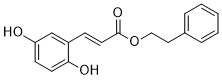
Physicochemical Properties
| Molecular Formula | C17H16O4 |
| Molecular Weight | 284.31 |
| Exact Mass | 284.104 |
| Elemental Analysis | C, 71.82; H, 5.67; O, 22.51 |
| CAS # | 179691-97-5 |
| PubChem CID | 5909099 |
| Appearance | Off-white to light yellow solid powder |
| Density | 1.3±0.1 g/cm3 |
| Boiling Point | 515.5±50.0 °C at 760 mmHg |
| Flash Point | 192.2±23.6 °C |
| Vapour Pressure | 0.0±1.4 mmHg at 25°C |
| Index of Refraction | 1.646 |
| LogP | 3.7 |
| Hydrogen Bond Donor Count | 2 |
| Hydrogen Bond Acceptor Count | 4 |
| Rotatable Bond Count | 6 |
| Heavy Atom Count | 21 |
| Complexity | 347 |
| Defined Atom Stereocenter Count | 0 |
| SMILES | C1=CC=C(C=C1)CCOC(=O)/C=C/C2=C(C=CC(=C2)O)O |
| InChi Key | OQKRMXDGEFRBAJ-RMKNXTFCSA-N |
| InChi Code | InChI=1S/C17H16O4/c18-15-7-8-16(19)14(12-15)6-9-17(20)21-11-10-13-4-2-1-3-5-13/h1-9,12,18-19H,10-11H2/b9-6+ |
| Chemical Name | phenethyl (E)-3-(2,5-dihydroxyphenyl)acrylate |
| Synonyms | NSC666588; CHEMBL131678; NSC-666588; 5LOX-IN-2; 5-LOX-IN2; 5-LOX-IN-2 |
| HS Tariff Code | 2934.99.9001 |
| Storage |
Powder-20°C 3 years 4°C 2 years In solvent -80°C 6 months -20°C 1 month |
| Shipping Condition | Room temperature (This product is stable at ambient temperature for a few days during ordinary shipping and time spent in Customs) |
Biological Activity
| ln Vitro | 5-LOX-IN-2 (Compound 10b) has a cytotoxic effect on renal cancer cells and is specific to RCC4 and 786.0 cells that lack the Von Hippel-Lindau (VHL) inhibitory oncogene. In RCC4 cells, 5-LOX-IN-2 (Compound 10b) (0-10 μM; 24 hours) can also upregulate p62 and LC3B expression, inhibit autophagy carriers, and promote cell proliferation through activation of the caspase-3 pathway. 1]. |
| Cell Assay |
Cell viability assay [1] Cell Types: RCC4, RCC10, 786.0 Cell Tested Concentrations: 0-100 μM Incubation Duration: 4 days Experimental Results: The cell viability of renal cancer cells is diminished and the selectivity is stronger. RCC4 and 786.0 cells lack the Von Hippel-Lindau (VHL) tumor suppressor gene. Western Blot Analysis[1] Cell Types: RCC4, RCC10, 786.0 Cell Tested Concentrations: 0-10 μM Incubation Duration: 24 hrs (hours) Experimental Results: LC3B and p62 expression increased and autophagy flow was blocked in RCC4 cells. Cleavage of caspase-3 precursors was stimulated in a dose-dependent manner only in RCC4 cells lacking the VHL tumor suppressor. |
| References |
[1]. Selka A, et.al. Discovery of a novel 2,5-dihydroxycinnamic acid-based 5-lipoxygenase inhibitor that induces apoptosis and may impair autophagic flux in RCC4 renal cancer cells. Eur J Med Chem. 2019 Oct 1;179:347-357. |
Solubility Data
| Solubility (In Vitro) | DMSO : ~100 mg/mL (~351.73 mM) |
| Solubility (In Vivo) |
Solubility in Formulation 1: ≥ 2.5 mg/mL (8.79 mM) (saturation unknown) in 10% DMSO + 40% PEG300 +5% Tween-80 + 45% Saline (add these co-solvents sequentially from left to right, and one by one), clear solution. For example, if 1 mL of working solution is to be prepared, you can add 100 μL of 25.0 mg/mL clear DMSO stock solution to 400 μL PEG300 and mix evenly; then add 50 μL Tween-80 + to the above solution and mix evenly; then add 450 μL normal saline to adjust the volume to 1 mL. Preparation of saline: Dissolve 0.9 g of sodium chloride in 100 mL ddH₂ O to obtain a clear solution. (Please use freshly prepared in vivo formulations for optimal results.) |
| Preparing Stock Solutions | 1 mg | 5 mg | 10 mg | |
| 1 mM | 3.5173 mL | 17.5864 mL | 35.1729 mL | |
| 5 mM | 0.7035 mL | 3.5173 mL | 7.0346 mL | |
| 10 mM | 0.3517 mL | 1.7586 mL | 3.5173 mL |