|
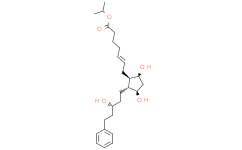
5-trans Latanoprost is a derivative of the FP receptor agonist latanoprost (free acid) and the trans isomer of latanoprost. Like other trans isomers of F-type prostaglandins, 5-trans latanoprost may have similar FP receptor activation and intraocular pressure reduction activities as the cis isomer. 5-trans Latanoprost is a potential impurity in commercial preparations of latanoprost. This product is intended as an analytical standard for the detection and quantification of this impurity.
|
Physicochemical Properties
| Molecular Formula |
C26H40O5
|
| Molecular Weight |
432.5928
|
| Exact Mass |
432.287
|
| CAS # |
913258-34-1
|
| PubChem CID |
5282380
|
| Appearance |
Typically exists as solid at room temperature
|
| Density |
1.1±0.1 g/cm3
|
| Boiling Point |
583.8±50.0 °C at 760 mmHg
|
| Flash Point |
188.3±23.6 °C
|
| Vapour Pressure |
0.0±1.7 mmHg at 25°C
|
| Index of Refraction |
1.538
|
| LogP |
3.65
|
| Hydrogen Bond Donor Count |
3
|
| Hydrogen Bond Acceptor Count |
5
|
| Rotatable Bond Count |
14
|
| Heavy Atom Count |
31
|
| Complexity |
526
|
| Defined Atom Stereocenter Count |
5
|
| SMILES |
CC(C)OC(=O)CCC/C=C/C[C@@H]1[C@@H](CC[C@H](CCC2=CC=CC=C2)O)[C@@H](C[C@@H]1O)O
|
| InChi Key |
GGXICVAJURFBLW-RDSJPUOVSA-N
|
| InChi Code |
InChI=1S/C26H40O5/c1-19(2)31-26(30)13-9-4-3-8-12-22-23(25(29)18-24(22)28)17-16-21(27)15-14-20-10-6-5-7-11-20/h3,5-8,10-11,19,21-25,27-29H,4,9,12-18H2,1-2H3/b8-3+/t21-,22+,23+,24-,25+/m0/s1
|
| Chemical Name |
(5E)-7-[(1R,2R,3R,5S)-3,5-dihydroxy-2-[(3R)-3-hydroxy-5-phenylpentyl]cyclopentyl]-5-heptenoic acid, 1-methylethyl ester
|
| Synonyms |
trans-Latanoprost; 5,6-trans-Latanoprost; 913258-34-1; Isopropyl 7-((1R,2R,3R,5S)-3,5-dihydroxy-2-((R)-3-hydroxy-5-phenylpentyl)cyclopentyl)hept-5-enoate; Latanoprost, (5E)-; ZC39I2T1VW; CHEMBL364375; propan-2-yl (E)-7-[(1R,2R,3R,5S)-3,5-dihydroxy-2-[(3R)-3-hydroxy-5-phenylpentyl]cyclopentyl]hept-5-enoate;
|
| HS Tariff Code |
2934.99.9001
|
| Shipping Condition |
Room temperature (This product is stable at ambient temperature for a few days during ordinary shipping and time spent in Customs)
|
|
Biological Activity
| ln Vitro |
The ocular delivery route presents a number of challenges in terms of drug administration and bioavailability. The low bioavailability following topical ophthalmic administration shows that there is a clear need for in-depth research aimed at finding both more efficacious molecules and formulations precisely targeted at the site of action. Continuous technological development will eventually result in improved bioavailability, lower dosages, reduced toxicity, fewer adverse effects, and thus better patient compliance and treatment efficacy. Technological development, as well as increasingly stringent quality requirements, help stimulate analytical progress. This is also clearly evident in the case of medicinal products used in the treatment of glaucoma, which are the subject of this review. Impurity profiling of PGF2α analogues, either in the pure substance or in the finished formulation, is a crucial step in assessing their quality. The development of specific, accurate and precise stability-indicating analytical methods for determining the content and related substances seems to be an important issue in relation to this tasks. A total of 27 official and in-house analytical methods are presented that are used for the analysis of latanoprost, travoprost and bimatoprost. The conditions for chromatographic separation with UV or MS/MS detection and the available results obtained during method validation are described. In addition, several aspects are discussed, with particular emphasis on the instability of the analogues in aqueous solution and the phenomenon of isomerism, which affects a potentially large number of degradation products[1].
|
| References |
[1]. Trends in development and quality assessment of pharmaceutical formulations - F2α analogues in the glaucoma treatment. Eur. J. Pharm. Sci. 180, 106315 (2023).
|
| Additional Infomation |
7-[(1R,2R,3R,5S)-3,5-dihydroxy-2-[(3R)-3-hydroxy-5-phenylpentyl]cyclopentyl]-5-heptenoic acid propan-2-yl ester is a prostanoid and an isopropyl ester.
See also: Latanoprost (annotation moved to).
|
|
Solubility Data
| Solubility (In Vitro) |
May dissolve in DMSO (in most cases), if not, try other solvents such as H2O, Ethanol, or DMF with a minute amount of products to avoid loss of samples
|
| Preparing Stock Solutions |
|
1 mg |
5 mg |
10 mg |
| 1 mM |
2.3117 mL |
11.5583 mL |
23.1166 mL |
| 5 mM |
0.4623 mL |
2.3117 mL |
4.6233 mL |
| 10 mM |
0.2312 mL |
1.1558 mL |
2.3117 mL |
*Note: Please select an appropriate solvent for the preparation of stock solution based on your experiment needs. For most products, DMSO can be used for preparing stock solutions (e.g. 5 mM, 10 mM, or 20 mM concentration); some products with high aqueous solubility may be dissolved in water directly. Solubility information is available at the above Solubility Data section. Once the stock solution is prepared, aliquot it to routine usage volumes and store at -20°C or -80°C. Avoid repeated freeze and thaw cycles. |