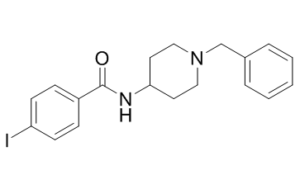
4-IBP is a novel and selective σ1 (sigma1) agonist with high affinity for the σ1 receptor with Ki of 1.7 nM and a moderate affinity for the σ2 receptor (Ki = 25.2 nM). Although the molecular function of sigma receptors has not been fully defined and the natural ligand(s) is still not known, there is increasing evidence that these receptors and their ligands might play a significant role in cancer biology. 4-IBP has revealed weak antiproliferative effects on human U373-MG glioblastoma and C32 melanoma cells but induced marked concentration-dependent decreases in the growth of human A549 NSCLC and PC3 prostate cancer cells. The compound was also significantly antimigratory in all four cancer cell lines. This may result, at least in U373-MG cells, from modifications to the actin cytoskeleton. 4-IBP modified the sensitivity of U373-MG cells in vitro to proapoptotic lomustin and proautophagic temozolomide, and markedly decreased the expression of two proteins involved in drug resistance: glucosylceramide synthase and Rho guanine nucleotide dissociation inhibitor. In vivo, 4-IBP increased the antitumor effects of temozolomide and irinotecan in immunodeficient mice that were orthotopically grafted with invasive cancer cells.
Physicochemical Properties
| Molecular Formula | C₁₉H₂₁IN₂O | |
| Molecular Weight | 420.29 | |
| Exact Mass | 420.07 | |
| CAS # | 155798-08-6 | |
| Related CAS # |
|
|
| PubChem CID | 132995 | |
| Appearance | White to off-white solid powder | |
| LogP | 4.014 | |
| Hydrogen Bond Donor Count | 1 | |
| Hydrogen Bond Acceptor Count | 2 | |
| Rotatable Bond Count | 4 | |
| Heavy Atom Count | 23 | |
| Complexity | 368 | |
| Defined Atom Stereocenter Count | 0 | |
| InChi Key | HELCSESNNDZLFM-UHFFFAOYSA-N | |
| InChi Code | InChI=1S/C19H21IN2O/c20-17-8-6-16(7-9-17)19(23)21-18-10-12-22(13-11-18)14-15-4-2-1-3-5-15/h1-9,18H,10-14H2,(H,21,23) | |
| Chemical Name |
|
|
| Synonyms |
|
|
| HS Tariff Code | 2934.99.9001 | |
| Storage |
Powder-20°C 3 years 4°C 2 years In solvent -80°C 6 months -20°C 1 month |
|
| Shipping Condition | Room temperature (This product is stable at ambient temperature for a few days during ordinary shipping and time spent in Customs) |
Biological Activity
| ln Vitro |
4-IBP exhibited weak antiproliferative effects on human U373-MG glioblastoma and C32 melanoma cells, with only up to 10% growth inhibition observed even at 10 µM after 3 days of treatment. In contrast, it induced a concentration-dependent decrease in the growth of human A549 non-small cell lung carcinoma (NSCLC) and PC3 prostate cancer cells. [1] 4-IBP demonstrated significant antimigratory activity at concentrations between 1 and 100 nM in all four tested human cancer cell lines (U373-MG glioblastoma, C32 melanoma, A549 NSCLC, and PC3 prostate cancer), as quantified by a decrease in the maximum relative distance from the origin (MRDO) of individual cell trajectories. [1] In U373-MG glioblastoma cells, 4-IBP (1 and 10 nM) induced transient increases in fibrillar actin levels and decreased the fibrillar/globular actin ratio, correlating with reduced cell motility. It did not significantly alter intracellular calcium concentration ([Ca²⁺]ᵢ) at these concentrations. [1] 4-IBP (10 nM) sensitized apoptosis-resistant U373-MG glioblastoma cells to the cytotoxic effects of proapoptotic lomustine (10 µM) and proautophagic temozolomide (1 and 10 µM) in a scratch wound assay, particularly when pre-treated for 1 to 7 hours. This sensitization was lost with a 24-hour pre-treatment. [1] 4-IBP did not induce apoptosis in U373-MG cells, as evidenced by no significant PARP cleavage, unchanged p53 expression, and no modification in the expression/phosphorylation patterns of p85-PI3K and Akt at 10 nM. [1] 4-IBP did not induce autophagy in U373-MG cells, as shown by no increase in acidic vesicular organelles (acridine orange staining), and no marked changes in the expression levels of LC3, Beclin-1, or Hsp70. [1] 4-IBP did not interfere with endoplasmic reticulum stress (ERS) responses, as it did not modify the expression levels of GRP78, Gadd153, or ORP150 in U373-MG cells. [1] Genomic and proteomic analyses revealed that treatment of U373-MG cells with 10 nM 4-IBP for 12-72 hours led to a 30-50% decrease in the expression of Rho guanine nucleotide dissociation inhibitor (Rho GDI) and glucosylceramide synthase (GCS), two proteins implicated in drug resistance. [1] |
| ln Vivo |
In an orthotopic U373-MG glioblastoma xenograft model in immunodeficient mice, continuous intracerebroventricular infusion of 4-IBP (2 mg/kg/day via osmotic minipump) alone significantly increased mouse survival. Furthermore, this treatment regimen significantly enhanced the therapeutic benefit of intravenously administered temozolomide (40 mg/kg, thrice weekly). [1] In an orthotopic A549 NSCLC xenograft model in immunodeficient mice, intravenous administration of 4-IBP (2 mg/kg, thrice weekly) alone did not significantly increase survival. However, it significantly enhanced the therapeutic benefit of intravenously administered irinotecan (10 mg/kg, thrice weekly). [1] |
| Cell Assay |
For the assessment of antiproliferative activity, the influence of 4-IBP on the overall growth rates of human cancer cell lines (U373-MG, C32, A549, PC3) was determined using a colorimetric MTT assay. Cells were incubated with nine concentrations of 4-IBP ranging from 10⁻⁹ M to 10⁻⁵ M (with semilog increases) for 3 days before measurement. Each experiment was conducted in sextuplicate. [1] For the characterization of antimigratory activity, human cell motility was quantified using computer-assisted phase-contrast microscopy to track individual cancer cells. The effect of 4-IBP at 1, 10, and 100 nM on cell motility was investigated. Cell trajectories were established by a tracking algorithm, and the maximum relative distance from the origin (MRDO) was used as the quantitative variable. One hundred cells were quantified per condition. [1] To assess effects on the actin cytoskeleton, U373-MG cells were cultured on coverslips with or without 1 and 10 nM 4-IBP. Fibrillar actin was labeled with fluorescent phallacidin, and globular actin was stained with fluorescent DNaseI. Fluorescence intensity was quantified using a computer-assisted fluorescent microscope. [1] The scratch wound assay was performed to evaluate sensitization to cytotoxic drugs. U373-MG cells were grown to confluence, pre-treated with 10 nM 4-IBP for 1, 3, 7, or 24 hours in serum-restricted medium. A linear scratch was made, and cells were then incubated with lomustine or temozolomide (1 or 10 µM) for 16 hours. Wound area filled by cells was quantified daily using specialized software. [1] Apoptosis was analyzed by flow cytometry using the TUNEL technique and by Western blot analysis for PARP cleavage. Autophagy was assessed by flow cytometry using acridine orange staining for acidic vesicular organelles and by Western blot analysis for LC3 and Beclin-1 expression. [1] For protein expression analysis, Western blotting and immunofluorescence were performed. Proteins detected included ORP150, GRP78, p53, Beclin-1, Hsp70, Rho GDI, GCS, total and phospho-p85-PI3K, and Akt. [1] For genomic analysis, U373-MG cells treated with 10 nM 4-IBP for 12 hours and untreated controls were subjected to full genome microarray analysis. [1] |
| Animal Protocol |
For the orthotopic U373-MG glioblastoma model, 2 million U373-MG cells were grafted into the left temporal lobe of 8-week-old female immunodeficient mice. On day 10 post-graft, mice were randomly assigned to groups. Treatment began on day 14. The control group received continuous infusion of vehicle (saline with 1% DMSO) into the third ventricle via an implanted osmotic minipump for 28 days. The 4-IBP group received continuous infusion of 4-IBP (2 mg/kg/day in saline with 1% DMSO) via minipump. The temozolomide group received 12 intravenous injections of temozolomide (40 mg/kg) thrice weekly over 4 weeks, starting on day 21. The combination group received both 4-IBP infusion and temozolomide injections. Mouse survival was monitored. [1] For the orthotopic A549 NSCLC model, 2 million A549 cells were grafted into the right lung of 8-week-old female immunodeficient mice. Mice were randomly assigned to groups. The control group received 12 intravenous injections of saline, thrice weekly starting day 7 post-graft. The 4-IBP group received 12 intravenous injections of 4-IBP (2 mg/kg) on the same schedule. The irinotecan group received 12 intravenous injections of irinotecan (10 mg/kg) thrice weekly, starting day 14 post-graft. The combination group received both 4-IBP and irinotecan treatments. Mouse survival was monitored. [1] |
| References |
[1]. 4-IBP, a sigma1 receptor agonist, decreases the migration of human cancer cells, including glioblastoma cells, in vitro and sensitizes them in vitro and in vivo to cytotoxic insults of proapoptotic and proautophagic drugs. Neoplasia. 2. |
| Additional Infomation |
4-iodo-N-[1-(phenylmethyl)-4-piperidinyl]benzamide is a member of piperidines. 4-IBP (4-(N-benzylpiperidin-4-yl)-4-iodobenzamide) is a selective σ₁ receptor agonist used to investigate the role of σ₁ receptor activation in cancer biology. The study aimed to mimic a biological situation where the σ₁ receptor is activated by endogenous ligands. [1] The proposed mechanism for the observed antimigratory and chemosensitizing effects of 4-IBP in U373-MG glioblastoma cells involves modulation of the actin cytoskeleton and downregulation of key drug resistance proteins (Rho GDI and GCS), rather than induction of apoptosis, autophagy, or modulation of ERS pathways. [1] The expression pattern of σ₁ receptor splice variants (V1-V5) differed among the cancer cell lines tested. U373-MG cells expressed only the V1 variant, while other lines expressed multiple variants. [1] |
Solubility Data
| Solubility (In Vitro) |
|
|||
| Solubility (In Vivo) |
Solubility in Formulation 1: ≥ 2.5 mg/mL (5.95 mM) (saturation unknown) in 10% DMSO + 40% PEG300 + 5% Tween80 + 45% Saline (add these co-solvents sequentially from left to right, and one by one), clear solution. For example, if 1 mL of working solution is to be prepared, you can add 100 μL of 25.0 mg/mL clear DMSO stock solution to 400 μL PEG300 and mix evenly; then add 50 μL Tween-80 to the above solution and mix evenly; then add 450 μL normal saline to adjust the volume to 1 mL. Preparation of saline: Dissolve 0.9 g of sodium chloride in 100 mL ddH₂ O to obtain a clear solution. Solubility in Formulation 2: ≥ 2 mg/mL (4.76 mM) (saturation unknown) in 10% DMSO + 90% Corn Oil (add these co-solvents sequentially from left to right, and one by one), clear solution. For example, if 1 mL of working solution is to be prepared, you can add 100 μL of 20.0 mg/mL clear DMSO stock solution to 900 μL of corn oil and mix evenly. (Please use freshly prepared in vivo formulations for optimal results.) |
| Preparing Stock Solutions | 1 mg | 5 mg | 10 mg | |
| 1 mM | 2.3793 mL | 11.8965 mL | 23.7931 mL | |
| 5 mM | 0.4759 mL | 2.3793 mL | 4.7586 mL | |
| 10 mM | 0.2379 mL | 1.1897 mL | 2.3793 mL |