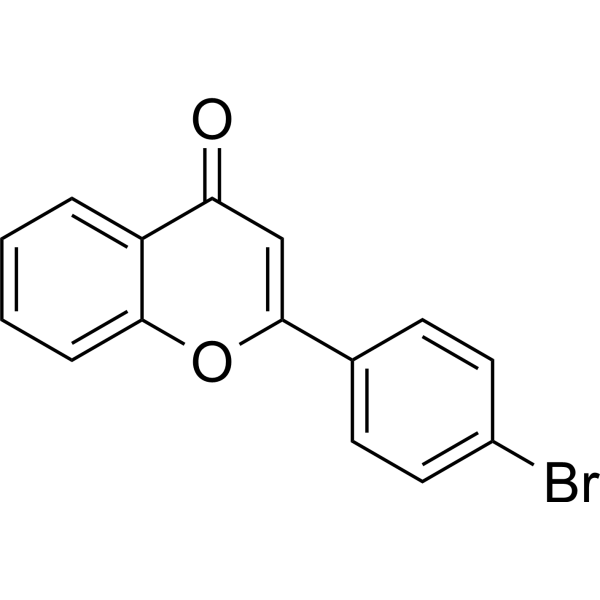
Physicochemical Properties
| Molecular Formula | C15H9BRO2 |
| Molecular Weight | 301.13500 |
| Exact Mass | 299.979 |
| CAS # | 20525-20-6 |
| PubChem CID | 1686 |
| Appearance | Typically exists as solid at room temperature |
| Density | 1.54g/cm3 |
| Boiling Point | 406.6ºC at 760 mmHg |
| Melting Point | 174-176ºC |
| Flash Point | 199.7ºC |
| Vapour Pressure | 8.07E-07mmHg at 25°C |
| Index of Refraction | 1.656 |
| LogP | 4.222 |
| Hydrogen Bond Donor Count | 0 |
| Hydrogen Bond Acceptor Count | 2 |
| Rotatable Bond Count | 1 |
| Heavy Atom Count | 18 |
| Complexity | 356 |
| Defined Atom Stereocenter Count | 0 |
| SMILES | BrC1=CC=C(C2=CC(=O)C3=CC=CC=C3O2)C=C1 |
| InChi Key | URZUAHXELZUWFE-UHFFFAOYSA-N |
| InChi Code | InChI=1S/C15H9BrO2/c16-11-7-5-10(6-8-11)15-9-13(17)12-3-1-2-4-14(12)18-15/h1-9H |
| Chemical Name | 2-(4-bromophenyl)chromen-4-one |
| HS Tariff Code | 2934.99.9001 |
| Storage |
Powder-20°C 3 years 4°C 2 years In solvent -80°C 6 months -20°C 1 month |
| Shipping Condition | Room temperature (This product is stable at ambient temperature for a few days during ordinary shipping and time spent in Customs) |
Biological Activity
| ln Vitro | 4′-Bromoflavone robustly promotes the α- and mu-isoforms of glutathione S-transferase in cultured H4IIE rat hepatoma cells with no reported toxicity[1]. It also considerably increases quinone reductase (QR) activity in cultured murine hepatoma 1c1c7 cells (concentration to double activity: 10 nM). With an IC50 of 0.86 μM, 4′-bromoflavone is a strong inhibitor of cytochrome P4501A1-mediated ethoxyresorufin-O-deethylase activity. 4′-Bromoflavone dramatically decreases the covalent binding of metabolically activated benzo[a]pyrene to cellular DNA in HepG2 or MCF-7 cells[1]. |
| ln Vivo | In rat liver, mammary gland, colon, stomach, and lung, 4′-bromoflavone is also demonstrated to raise glutathione levels and QR activity in a dose-dependent way in short-term feeding trials. Studies using female Sprague Dawley rats have shown that 4′-Bromoflavone greatly raises the phase II enzyme QR activity[1]. |
| References | [1]. L L Song, et al. Cancer chemopreventive activity mediated by 4'-bromoflavone, a potent inducer of phase II detoxification enzymes. Cancer Res. 1999 Feb 1;59(3):578-85. |
| Additional Infomation | 4'-Bromoflavone has been reported in Bruguiera gymnorhiza and Nocardiopsis with data available. |
Solubility Data
| Solubility (In Vitro) | May dissolve in DMSO (in most cases), if not, try other solvents such as H2O, Ethanol, or DMF with a minute amount of products to avoid loss of samples |
| Solubility (In Vivo) |
Note: Listed below are some common formulations that may be used to formulate products with low water solubility (e.g. < 1 mg/mL), you may test these formulations using a minute amount of products to avoid loss of samples. Injection Formulations (e.g. IP/IV/IM/SC) Injection Formulation 1: DMSO : Tween 80: Saline = 10 : 5 : 85 (i.e. 100 μL DMSO stock solution → 50 μL Tween 80 → 850 μL Saline) *Preparation of saline: Dissolve 0.9 g of sodium chloride in 100 mL ddH ₂ O to obtain a clear solution. Injection Formulation 2: DMSO : PEG300 :Tween 80 : Saline = 10 : 40 : 5 : 45 (i.e. 100 μL DMSO → 400 μLPEG300 → 50 μL Tween 80 → 450 μL Saline) Injection Formulation 3: DMSO : Corn oil = 10 : 90 (i.e. 100 μL DMSO → 900 μL Corn oil) Example: Take the Injection Formulation 3 (DMSO : Corn oil = 10 : 90) as an example, if 1 mL of 2.5 mg/mL working solution is to be prepared, you can take 100 μL 25 mg/mL DMSO stock solution and add to 900 μL corn oil, mix well to obtain a clear or suspension solution (2.5 mg/mL, ready for use in animals). Injection Formulation 4: DMSO : 20% SBE-β-CD in saline = 10 : 90 [i.e. 100 μL DMSO → 900 μL (20% SBE-β-CD in saline)] *Preparation of 20% SBE-β-CD in Saline (4°C,1 week): Dissolve 2 g SBE-β-CD in 10 mL saline to obtain a clear solution. Injection Formulation 5: 2-Hydroxypropyl-β-cyclodextrin : Saline = 50 : 50 (i.e. 500 μL 2-Hydroxypropyl-β-cyclodextrin → 500 μL Saline) Injection Formulation 6: DMSO : PEG300 : castor oil : Saline = 5 : 10 : 20 : 65 (i.e. 50 μL DMSO → 100 μLPEG300 → 200 μL castor oil → 650 μL Saline) Injection Formulation 7: Ethanol : Cremophor : Saline = 10: 10 : 80 (i.e. 100 μL Ethanol → 100 μL Cremophor → 800 μL Saline) Injection Formulation 8: Dissolve in Cremophor/Ethanol (50 : 50), then diluted by Saline Injection Formulation 9: EtOH : Corn oil = 10 : 90 (i.e. 100 μL EtOH → 900 μL Corn oil) Injection Formulation 10: EtOH : PEG300:Tween 80 : Saline = 10 : 40 : 5 : 45 (i.e. 100 μL EtOH → 400 μLPEG300 → 50 μL Tween 80 → 450 μL Saline) Oral Formulations Oral Formulation 1: Suspend in 0.5% CMC Na (carboxymethylcellulose sodium) Oral Formulation 2: Suspend in 0.5% Carboxymethyl cellulose Example: Take the Oral Formulation 1 (Suspend in 0.5% CMC Na) as an example, if 100 mL of 2.5 mg/mL working solution is to be prepared, you can first prepare 0.5% CMC Na solution by measuring 0.5 g CMC Na and dissolve it in 100 mL ddH2O to obtain a clear solution; then add 250 mg of the product to 100 mL 0.5% CMC Na solution, to make the suspension solution (2.5 mg/mL, ready for use in animals). Oral Formulation 3: Dissolved in PEG400 Oral Formulation 4: Suspend in 0.2% Carboxymethyl cellulose Oral Formulation 5: Dissolve in 0.25% Tween 80 and 0.5% Carboxymethyl cellulose Oral Formulation 6: Mixing with food powders Note: Please be aware that the above formulations are for reference only. InvivoChem strongly recommends customers to read literature methods/protocols carefully before determining which formulation you should use for in vivo studies, as different compounds have different solubility properties and have to be formulated differently. (Please use freshly prepared in vivo formulations for optimal results.) |
| Preparing Stock Solutions | 1 mg | 5 mg | 10 mg | |
| 1 mM | 3.3207 mL | 16.6036 mL | 33.2071 mL | |
| 5 mM | 0.6641 mL | 3.3207 mL | 6.6414 mL | |
| 10 mM | 0.3321 mL | 1.6604 mL | 3.3207 mL |