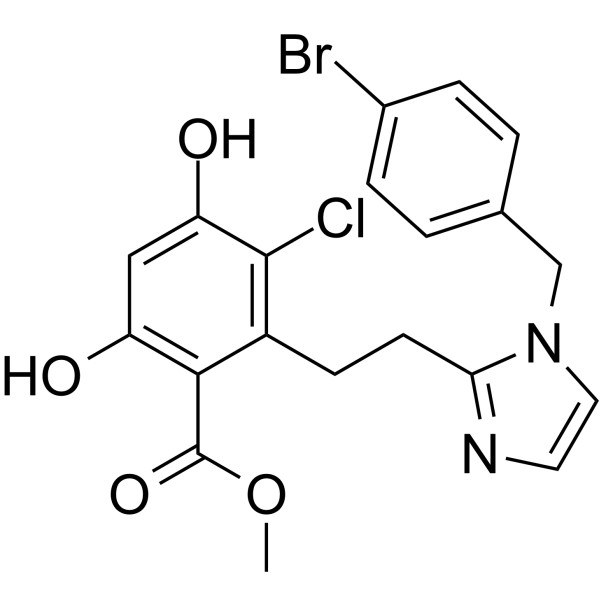
Physicochemical Properties
| Molecular Formula | C20H18BRCLN2O4 |
| Molecular Weight | 465.72 |
| Exact Mass | 464.013 |
| CAS # | 1654775-71-9 |
| PubChem CID | 127049159 |
| Appearance | Typically exists as solid at room temperature |
| LogP | 4.9 |
| Hydrogen Bond Donor Count | 2 |
| Hydrogen Bond Acceptor Count | 5 |
| Rotatable Bond Count | 7 |
| Heavy Atom Count | 28 |
| Complexity | 520 |
| Defined Atom Stereocenter Count | 0 |
| InChi Key | FHDUIAYTJZAXNW-UHFFFAOYSA-N |
| InChi Code | InChI=1S/C20H18BrClN2O4/c1-28-20(27)18-14(19(22)16(26)10-15(18)25)6-7-17-23-8-9-24(17)11-12-2-4-13(21)5-3-12/h2-5,8-10,25-26H,6-7,11H2,1H3 |
| Chemical Name | methyl 2-[2-[1-[(4-bromophenyl)methyl]imidazol-2-yl]ethyl]-3-chloro-4,6-dihydroxybenzoate |
| HS Tariff Code | 2934.99.9001 |
| Storage |
Powder-20°C 3 years 4°C 2 years In solvent -80°C 6 months -20°C 1 month Note: Please store this product in a sealed and protected environment (e.g. under nitrogen), avoid exposure to moisture and light. |
| Shipping Condition | Room temperature (This product is stable at ambient temperature for a few days during ordinary shipping and time spent in Customs) |
Biological Activity
| Targets | EC50: 0.96 µM (glucose-regulated protein 94, Grp94)[1][2] |
| ln Vitro | In human embryonic kidney (HEK) cells, 4-Br-Bnlm (0-100 µM; 24 h) suppresses the production of the 1477N mutant cardiac protein [1]. The toxicity and levels of mutant myocardin in primary human trabecular meshwork (HTM) cells are reduced by 4-Br-Bnlm (30 µM; 24 h) [1]. In a dose-dependent manner, 4-Br-Bnlm (3, 10 and 30 µM; 24 h) suppresses myocardin production in myosin cells [1]. In HTM cells, 4-Br-Bnlm (30 µM and 100 µM; 24 h) does not cause a heat shock response [2]. |
| ln Vivo | In the Tg-MYOCY437H mouse model, 4-Br-Bnlm (300 µM; eye drops; once daily for 12 weeks) decreased intraocular pressure and removed mutant cardiomyopathy within trabecular meshwork (TM) cells. The photonegative reaction (PhNR) defect is improved by 4-Br-Bnlm[2]. |
| Cell Assay |
Cell Viability Assay[1] Cell Types: Primary human HTM cells. Tested Concentrations: 30 µM. Incubation Duration: 24 h. Experimental Results: Dramatically diminished the level of Y437H mutant myocilin without affecting WT myocilin and the RFP vector in HEK cells. Western Blot Analysis [1] Cell Types: HEK cells. Tested Concentrations: 0, 1, 3, 10, 30 and 100 µM. Incubation Duration: 24 h. Experimental Results: Dramatically diminished 1477N mutant myocilin in HEK cells expression without causing the degradation of other Hsp90-dependent clients Akt and Ras. |
| Animal Protocol |
Animal/Disease Models: Tg-MYOCY437H mice[2]. Doses: 300 µM. Route of Administration: Eye drops; one time/day for 12 weeks. Experimental Results: Inhibited mutant myocilin expression and restored the PhNR deficits. |
| References |
[1]. Stothert AR, et al, Fontaine SN, Crowley VM, Mishra S, Blagg BS, Lieberman RL, Dickey CA. Exploiting the interaction between Grp94 and aggregated myocilin to treat glaucoma. Hum Mol Genet. 2014 Dec 15;23(24):6470-80. [2]. Stothert AR, et al. Isoform-selective Hsp90 inhibition rescues model of hereditary open-angle glaucoma. Sci Rep. 2017 Dec 20;7(1):17951. |
Solubility Data
| Solubility (In Vitro) | DMSO: 33.33 mg/mL (71.57 mM) |
| Solubility (In Vivo) |
Solubility in Formulation 1: ≥ 2.5 mg/mL (5.37 mM) (saturation unknown) in 10% DMSO + 40% PEG300 + 5% Tween80 + 45% Saline (add these co-solvents sequentially from left to right, and one by one), clear solution. For example, if 1 mL of working solution is to be prepared, you can add 100 μL of 25.0 mg/mL clear DMSO stock solution to 400 μL PEG300 and mix evenly; then add 50 μL Tween-80 to the above solution and mix evenly; then add 450 μL normal saline to adjust the volume to 1 mL. Preparation of saline: Dissolve 0.9 g of sodium chloride in 100 mL ddH₂ O to obtain a clear solution. Solubility in Formulation 2: ≥ 2.5 mg/mL (5.37 mM) (saturation unknown) in 10% DMSO + 90% Corn Oil (add these co-solvents sequentially from left to right, and one by one), clear solution. For example, if 1 mL of working solution is to be prepared, you can add 100 μL of 25.0 mg/mL clear DMSO stock solution to 900 μL of corn oil and mix evenly. (Please use freshly prepared in vivo formulations for optimal results.) |
| Preparing Stock Solutions | 1 mg | 5 mg | 10 mg | |
| 1 mM | 2.1472 mL | 10.7361 mL | 21.4721 mL | |
| 5 mM | 0.4294 mL | 2.1472 mL | 4.2944 mL | |
| 10 mM | 0.2147 mL | 1.0736 mL | 2.1472 mL |