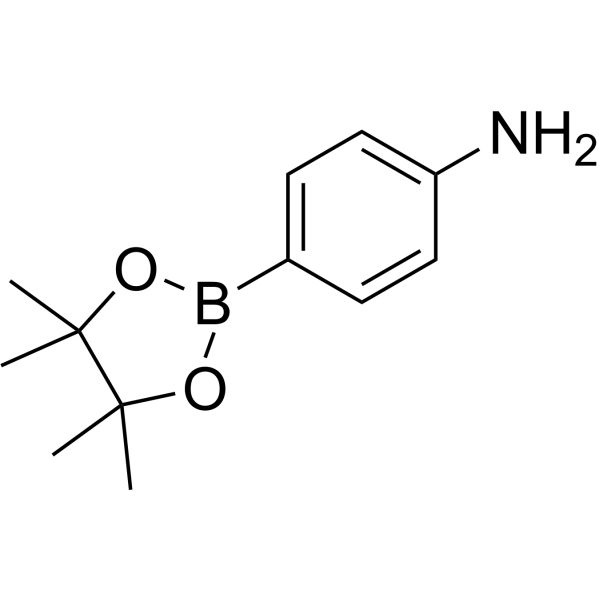
Physicochemical Properties
| Molecular Formula | C12H18BNO2 |
| Molecular Weight | 219.09 |
| Exact Mass | 219.143 |
| CAS # | 214360-73-3 |
| PubChem CID | 2734620 |
| Appearance | Brown to gray solid powder |
| Density | 1.1±0.1 g/cm3 |
| Boiling Point | 340.0±25.0 °C at 760 mmHg |
| Melting Point | 165-169 °C(lit.) |
| Flash Point | 159.4±23.2 °C |
| Vapour Pressure | 0.0±0.7 mmHg at 25°C |
| Index of Refraction | 1.517 |
| LogP | 2.149 |
| Hydrogen Bond Donor Count | 1 |
| Hydrogen Bond Acceptor Count | 3 |
| Rotatable Bond Count | 1 |
| Heavy Atom Count | 16 |
| Complexity | 244 |
| Defined Atom Stereocenter Count | 0 |
| SMILES | O1B(C2C([H])=C([H])C(=C([H])C=2[H])N([H])[H])OC(C([H])([H])[H])(C([H])([H])[H])C1(C([H])([H])[H])C([H])([H])[H] |
| InChi Key | ZANPJXNYBVVNSD-UHFFFAOYSA-N |
| InChi Code | InChI=1S/C12H18BNO2/c1-11(2)12(3,4)16-13(15-11)9-5-7-10(14)8-6-9/h5-8H,14H2,1-4H3 |
| Chemical Name | 4-(4,4,5,5-tetramethyl-1,3,2-dioxaborolan-2-yl)aniline |
| HS Tariff Code | 2934.99.9001 |
| Storage |
Powder-20°C 3 years 4°C 2 years In solvent -80°C 6 months -20°C 1 month Note: This product requires protection from light (avoid light exposure) during transportation and storage. |
| Shipping Condition | Room temperature (This product is stable at ambient temperature for a few days during ordinary shipping and time spent in Customs) |
Biological Activity
| ln Vitro | 4-(4,4,5,5-Tetramethyl-1,3,2-dioxaboran-2yl)aniline is a structural unit that is heterocyclic. It has been utilized to create roscovitine derivatives, which are CDKs (cyclin-dependent kinases) and casein Dual inhibitor of kinase 1 (CK1), as well as 3-aminoindazole-based multi-target receptor tyrosine kinase (RTK) inhibitors with anticancer action. |
| References |
[1]. Dai, Y., Hartandi, K., Ji, Z., et al al. Discovery of N-(4-(3-amino-1H-indazol-4-yl)phenyl)-N'-(2-fluoro-5-methylphenyl)urea (ABT-869), a 3-aminoindazole-based ORALLY ACTIVE MULTITARGED Receptor Tyrosine Kinase Inchibitorj. Chem.50 (7) 1584-1597 (2007). [2]. Paraiso, KHT, HAARBERG, He, Wood, E., ET Al.The HSP9 0 Inhibitor XL888 Overcomes Braf Inchibitor Resistance Mediated Through diverse mechanisms Clin. Cancer Res. 18(9) 2502-2514(2012). |
Solubility Data
| Solubility (In Vitro) | DMSO: 100 mg/mL (456.43 mM) |
| Solubility (In Vivo) |
Solubility in Formulation 1: ≥ 2.5 mg/mL (11.41 mM) (saturation unknown) in 10% DMSO + 40% PEG300 + 5% Tween80 + 45% Saline (add these co-solvents sequentially from left to right, and one by one), clear solution. For example, if 1 mL of working solution is to be prepared, you can add 100 μL of 25.0 mg/mL clear DMSO stock solution to 400 μL PEG300 and mix evenly; then add 50 μL Tween-80 to the above solution and mix evenly; then add 450 μL normal saline to adjust the volume to 1 mL. Preparation of saline: Dissolve 0.9 g of sodium chloride in 100 mL ddH₂ O to obtain a clear solution. Solubility in Formulation 2: ≥ 2.5 mg/mL (11.41 mM) (saturation unknown) in 10% DMSO + 90% (20% SBE-β-CD in Saline) (add these co-solvents sequentially from left to right, and one by one), clear solution. For example, if 1 mL of working solution is to be prepared, you can add 100 μL of 25.0 mg/mL clear DMSO stock solution to 900 μL of 20% SBE-β-CD physiological saline solution and mix evenly. Preparation of 20% SBE-β-CD in Saline (4°C,1 week): Dissolve 2 g SBE-β-CD in 10 mL saline to obtain a clear solution. Solubility in Formulation 3: ≥ 2.5 mg/mL (11.41 mM) (saturation unknown) in 10% DMSO + 90% Corn Oil (add these co-solvents sequentially from left to right, and one by one), clear solution. For example, if 1 mL of working solution is to be prepared, you can add 100 μL of 25.0 mg/mL clear DMSO stock solution to 900 μL of corn oil and mix evenly. (Please use freshly prepared in vivo formulations for optimal results.) |
| Preparing Stock Solutions | 1 mg | 5 mg | 10 mg | |
| 1 mM | 4.5643 mL | 22.8217 mL | 45.6433 mL | |
| 5 mM | 0.9129 mL | 4.5643 mL | 9.1287 mL | |
| 10 mM | 0.4564 mL | 2.2822 mL | 4.5643 mL |