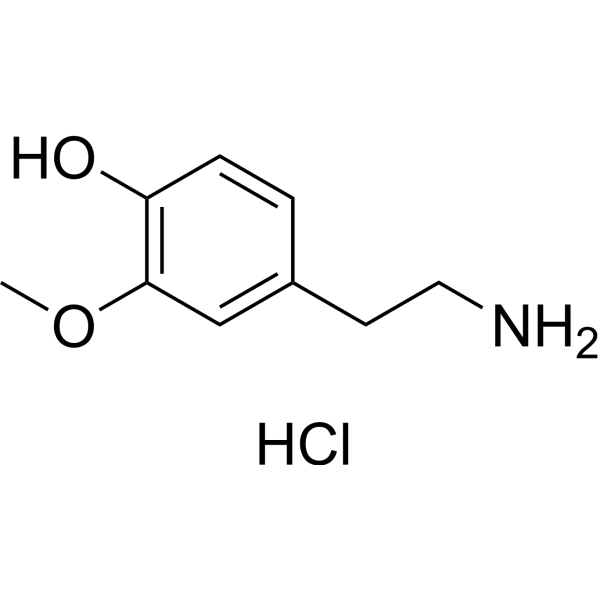
Physicochemical Properties
| Molecular Formula | C9H14CLNO2 |
| Molecular Weight | 203.6660 |
| Exact Mass | 203.071 |
| CAS # | 1477-68-5 |
| Related CAS # | 3-Methoxytyramine;554-52-9;3-Methoxytyramine-d4 hydrochloride;1216788-76-9 |
| PubChem CID | 11957621 |
| Appearance | Off-white to light brown solid powder |
| Boiling Point | 306.8ºC at 760 mmHg |
| Melting Point | 213 - 215ºC |
| Flash Point | 139.3ºC |
| Vapour Pressure | 0.000418mmHg at 25°C |
| LogP | 2.404 |
| Hydrogen Bond Donor Count | 3 |
| Hydrogen Bond Acceptor Count | 3 |
| Rotatable Bond Count | 3 |
| Heavy Atom Count | 13 |
| Complexity | 130 |
| Defined Atom Stereocenter Count | 0 |
| InChi Key | AWRIOTVUTPLWLF-UHFFFAOYSA-N |
| InChi Code | InChI=1S/C9H13NO2.ClH/c1-12-9-6-7(4-5-10)2-3-8(9)11;/h2-3,6,11H,4-5,10H2,1H3;1H |
| Chemical Name | 4-(2-aminoethyl)-2-methoxyphenol;hydrochloride |
| HS Tariff Code | 2934.99.9001 |
| Storage |
Powder-20°C 3 years 4°C 2 years In solvent -80°C 6 months -20°C 1 month Note: Please store this product in a sealed and protected environment (e.g. under nitrogen), avoid exposure to moisture and light. |
| Shipping Condition | Room temperature (This product is stable at ambient temperature for a few days during ordinary shipping and time spent in Customs) |
Biological Activity
| Targets | The obtained fluorescence intensity is linearly linked to the amount of at least 1 μg of 3-methoxytyramine hydrochloride in the sample. The fluorescence from 3-methoxytyramine hydrochloride is diminished when significant amounts of dopamine are present in the reaction mixture [1]. |
| ln Vitro |
The obtained fluorescence intensity is linearly linked to the amount of at least 1 μg of 3-methoxytyramine hydrochloride in the sample. The fluorescence from 3-methoxytyramine hydrochloride is diminished when significant amounts of dopamine are present in the reaction mixture [1]. 3-MT activates human TAAR1 expressed in HEK-293 cells, leading to cAMP accumulation with an EC₅₀ of 700 ± 180 nM, comparable to tyramine (EC₅₀ = 320 ± 100 nM). In HEK-293 cells expressing hTAAR1, treatment with 3-MT (10 µM) induced time-dependent phosphorylation of ERK2 (significant at 2, 5, 10, and 20 minutes) and CREB (significant at 10 and 20 minutes), indicating activation of Gs-mediated signaling cascades.[1] |
| ln Vivo |
In DDD mice, the extracellular DA metabolite 3-methoxytyramine hydrochloride (3-MT) significantly activates behavior. Instead of typical forward motions, this activity primarily takes the form of a succession of disordered abnormal movements, such as tremors, head shaking, tail wagging, grooming, and abnormal oral and facial movements. When 3-methoxytyramine hydrochloride was administered at levels less than 9 µg and greater than 9 µg, no impact was seen. 3. A complex cascade of behaviors is accompanied by a temporary behavioral activation that is dose-dependently induced by methyloxytyramine hydrochloride. Specifically, following infusion of 9 µg of 3-methoxytyramine hydrochloride, brief hyperactivity and stereotyped, sniffing, grooming, standing erect, and moderately aberrant involuntary movements of the limbs (AIM) were noted. After receiving 18 µg of 3-methoxytyramine hydrochloride, a similar behavior was seen, along with the development of tremor and oral and systemic AIM [1]. Intracerebroventricular (i.c.v.) infusion of 3-MT (36 µg and 180 µg) induced a complex set of abnormal involuntary movements (AIMs) in dopamine-deficient DAT-KO mice, significantly increasing horizontal activity counts compared to vehicle controls. In normal C57BL/6 mice, i.c.v. 3-MT (9–36 µg) caused dose-dependent behavioral activation, including transient hyperactivity, stereotypy, grooming, tremor, head bobbing, and orofacial AIMs. At 36 µg, it also induced minor seizure-like activity. These behavioral effects were partially attenuated in TAAR1 knockout (TAAR1-KO) mice, with the lowest dose (9 µg) being completely inactive in mutants. 3-MT (18 µg, i.c.v.) induced significant phosphorylation of ERK2 and CREB in the striatum of wild-type mice, an effect significantly reduced in TAAR1-KO mice.[1] |
| Enzyme Assay |
A standard cAMP column assay was used to measure TAAR1 activation. HEK-293 cells were transiently transfected with human TAAR1 (hTAAR1). After 24 hours, cells were treated with various concentrations of 3-MT or tyramine for 15 minutes at room temperature. Intracellular [³H]-cAMP accumulation was measured using Dowex and Alumina column chromatography to determine agonist potency (EC₅₀).[1] |
| Cell Assay |
HEK-293 cells were transfected with hTAAR1. After 24 hours, cells were treated with 3-MT (10 µM) for different time points (0, 2, 5, 10, 20 min). Cells were lysed, and proteins were extracted. Western blot analysis was performed using specific antibodies against phospho-ERK1/2 (Thr-202/Tyr-204), total ERK, phospho-CREB (Ser-133), and total CREB. Chemiluminescence detection was used for quantification, with total protein levels serving as loading controls.[1] |
| Animal Protocol |
Dopamine-deficient (DDD) mice were generated by treating DAT-KO mice with α-methyl-p-tyrosine (αMT, 250 mg/kg, i.p.) to inhibit dopamine synthesis. One hour after αMT, 3-MT (dissolved in artificial cerebrospinal fluid) was administered i.c.v. (4 µL volume, 1 µL/min infusion rate) at doses of 36 µg or 180 µg. Locomotor activity was monitored for up to 3 hours. For studies in normal and TAAR1-KO mice, animals were placed in locomotor chambers, habituated for 30 minutes, then briefly removed for i.c.v. infusion of 3-MT (9, 18, or 36 µg in 4 µL artificial CSF) or vehicle. After infusion, mice were returned to the chamber, and behavior was recorded for 90 minutes. For signaling studies, mice were euthanized 30 minutes after i.c.v. 3-MT (18 µg) administration, and striatal tissue was rapidly dissected and processed for Western blot analysis of ERK and CREB phosphorylation.[1] |
| ADME/Pharmacokinetics |
Microdialysis measurements in freely moving mice showed that i.c.v. infusion of 3-MT (9 µg) elevated extracellular 3-MT concentrations in the striatum, with maximal dialysate levels approaching 100 nM. Considering an estimated in vivo recovery of ~20%, the estimated behaviorally active extracellular concentration was above 500 nM.[1] |
| References |
[1]. The dopamine metabolite 3-methoxytyramine is a neuromodulator. PLoS One. 2010 Oct 18;5(10):e13452. [2]. Some observations on the estimation of 3-methoxytyramine in brain tissue. Br J Pharmacol. 1971 Aug;42(4):505-11. |
| Additional Infomation |
3-Methoxytyramine (3-MT) is the major extracellular metabolite of dopamine, formed via catechol-O-methyltransferase (COMT). Previously considered inactive, this study identifies it as a novel neuromodulator that can activate TAAR1 and induce dopamine-independent behavioral and signaling effects. Its effects are only partially mediated by TAAR1, suggesting involvement of additional unknown receptors. Alterations in 3-MT levels due to COMT or MAO inhibition may have implications for neurological disorders such as Parkinson's disease and schizophrenia.[1] |
Solubility Data
| Solubility (In Vitro) | DMSO : ≥ 100 mg/mL (~490.99 mM) |
| Solubility (In Vivo) |
Solubility in Formulation 1: ≥ 2.5 mg/mL (12.27 mM) (saturation unknown) in 10% DMSO + 40% PEG300 + 5% Tween80 + 45% Saline (add these co-solvents sequentially from left to right, and one by one), clear solution. For example, if 1 mL of working solution is to be prepared, you can add 100 μL of 25.0 mg/mL clear DMSO stock solution to 400 μL PEG300 and mix evenly; then add 50 μL Tween-80 to the above solution and mix evenly; then add 450 μL normal saline to adjust the volume to 1 mL. Preparation of saline: Dissolve 0.9 g of sodium chloride in 100 mL ddH₂ O to obtain a clear solution. Solubility in Formulation 2: ≥ 2.5 mg/mL (12.27 mM) (saturation unknown) in 10% DMSO + 90% (20% SBE-β-CD in Saline) (add these co-solvents sequentially from left to right, and one by one), clear solution. For example, if 1 mL of working solution is to be prepared, you can add 100 μL of 25.0 mg/mL clear DMSO stock solution to 900 μL of 20% SBE-β-CD physiological saline solution and mix evenly. Preparation of 20% SBE-β-CD in Saline (4°C,1 week): Dissolve 2 g SBE-β-CD in 10 mL saline to obtain a clear solution. Solubility in Formulation 3: ≥ 2.5 mg/mL (12.27 mM) (saturation unknown) in 10% DMSO + 90% Corn Oil (add these co-solvents sequentially from left to right, and one by one), clear solution. For example, if 1 mL of working solution is to be prepared, you can add 100 μL of 25.0 mg/mL clear DMSO stock solution to 900 μL of corn oil and mix evenly. (Please use freshly prepared in vivo formulations for optimal results.) |
| Preparing Stock Solutions | 1 mg | 5 mg | 10 mg | |
| 1 mM | 4.9099 mL | 24.5495 mL | 49.0990 mL | |
| 5 mM | 0.9820 mL | 4.9099 mL | 9.8198 mL | |
| 10 mM | 0.4910 mL | 2.4550 mL | 4.9099 mL |