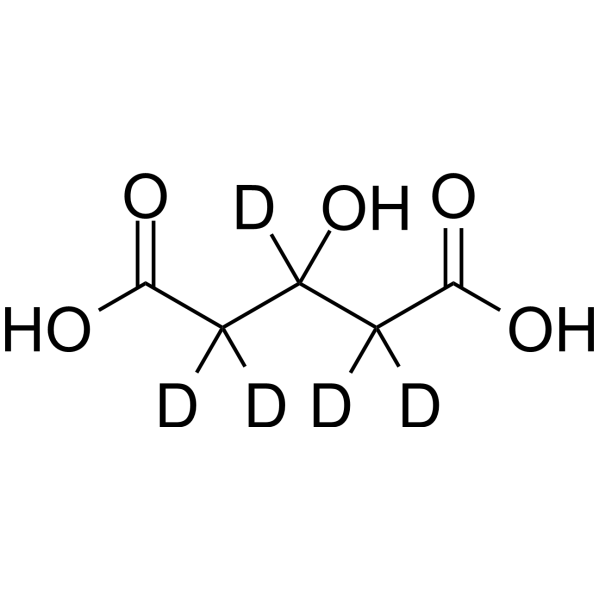
Physicochemical Properties
| Molecular Formula | C5H3D5O5 |
| Molecular Weight | 153.14 |
| Exact Mass | 148.037 |
| CAS # | 1219805-72-7 |
| Related CAS # | 3-Hydroxyglutaric acid;638-18-6 |
| PubChem CID | 118387770 |
| Appearance | White to off-white solid powder |
| Density | 1.5±0.1 g/cm3 |
| Boiling Point | 365.0±32.0 °C at 760 mmHg |
| Flash Point | 188.7±21.6 °C |
| Vapour Pressure | 0.0±1.8 mmHg at 25°C |
| Index of Refraction | 1.520 |
| LogP | -2.68 |
| Hydrogen Bond Donor Count | 3 |
| Hydrogen Bond Acceptor Count | 5 |
| Rotatable Bond Count | 4 |
| Heavy Atom Count | 10 |
| Complexity | 125 |
| Defined Atom Stereocenter Count | 0 |
| SMILES | [2H]C([2H])(C(=O)O)C([2H])(C([2H])([2H])C(=O)O)O |
| InChi Key | ZQHYXNSQOIDNTL-UXXIZXEISA-N |
| InChi Code | InChI=1S/C5H8O5/c6-3(1-4(7)8)2-5(9)10/h3,6H,1-2H2,(H,7,8)(H,9,10)/i1D2,2D2,3D |
| Chemical Name | 2,2,3,4,4-pentadeuterio-3-hydroxypentanedioic acid |
| Synonyms | 3-Hydroxyglutaric acid-d5; 1219805-72-7; 3-Hydroxy-1,5-pentanedioic--d5 Acid; 3-hydroxy-1,5-pentanedioic-2,2,3,4,4-d5 acid; 3-Hydroxy-pentanedioic Acid-d5; 2,4-Dideoxypentaric Acid-d5; ss-Hydroxyglutaric Acid-d5;; 2,2,3,4,4-Pentadeuterio-3-hydroxypentanedioic acid; SCHEMBL17104443; |
| HS Tariff Code | 2934.99.9001 |
| Storage |
Powder-20°C 3 years 4°C 2 years In solvent -80°C 6 months -20°C 1 month |
| Shipping Condition | Room temperature (This product is stable at ambient temperature for a few days during ordinary shipping and time spent in Customs) |
Biological Activity
| Targets | Deuterate form of 3-Hydroxyglutaric acid; NMDA receptors |
| ln Vitro | Drug compounds have included stable heavy isotopes of carbon, hydrogen, and other elements, mostly as quantitative tracers while the drugs were being developed. Because deuteration may have an effect on a drug's pharmacokinetics and metabolic properties, it is a cause for concern [1]. |
| ln Vivo | Neurological symptoms are common in patients with glutaric acidemia type I (GA-I). Although the pathophysiology of this disorder is not yet fully established, 3-hydroxyglutaric acid (3-HGA), which accumulates in affected patients, has recently been demonstrated to be excitotoxic to embryonic chick and neonatal rat neurons probably via NMDA glutamate receptors. In the present study, we investigated the in vitro effects of 3-HGA on the [(3)H]glutamate and [(3)H]MK-801 (dizocilpine) binding to rat synaptic plasma membranes from cerebral cortex of young rats in order to elucidate the interactions of 3-HGA with glutamate receptors and its possible contribution to the in vitro excitotoxic properties of 3-HGA. 3-HGA (10-100 microM) significantly decreased Na(+)-dependent (up to 62%) and Na(+)-independent (up to 30%) [(3)H]glutamate binding to synaptic membranes, reflecting a possible competition between glutamate and 3-HGA for the glutamate transporter and receptor sites, respectively. Since a decrease in Na(+)-independent glutamate binding might represent an interaction of 3-HGA with glutamate receptors, we next investigated whether 3-HGA interacts with NMDA receptors by adding NMDA alone or combined with 3-HGA and measuring Na(+)-independent [(3)H]glutamate binding to synaptic membranes (binding to receptors). We verified that 3-HGA and NMDA, at 10 and 100 microM concentrations, decreased glutamate binding by up to 20 and 45%, respectively, and that the simultaneous addition of both substances did not provoke an additive effect, implying that they bind to NMDA receptors at the same site. Furthermore, the binding of the NMDA-channel blocker [(3)H ]MK-801 was significantly increased (approximately 32-40%) by 10 and 100 microM 3-HGA, implying that 3-HGA was able to open the NMDA channel allowing MK-801 binding, which is a characteristic of NMDA agonists. On the other hand, glutamate had a much higher stimulatory effect on this binding (180% increase), reflecting its strong NMDA agonist property. Furthermore, the simultaneous addition of 3-HGA and glutamate provoked an additive stimulatory effect on [(3)H]MK-801 binding to the NMDA receptor. These data indicate that, relatively to glutamate, 3-HGA is a weak agonist of NMDA receptors. Finally, we demonstrated that 3-HGA provoked a significant increase of extracellular calcium uptake by cerebral cortex slices, strengthening therefore, the view that 3-HGA activates NMDA receptors. The present study therefore, demonstrates at the molecular level that 3-HGA modulates glutamatergic neurotransmission and may explain previous findings relating the neurotoxic actions of this organic acid with excitotoxicity [2]. |
| References |
[1]. Impact of Deuterium Substitution on the Pharmacokinetics of Pharmaceuticals. Ann Pharmacother. 2019;53(2):211-216. [2]. Evidence that 3-hydroxyglutaric acid interacts with NMDA receptors in synaptic plasma membranes from cerebral cortex of young rats. Neurochem Int. 2004 Dec;45(7):1087-94. |
| Additional Infomation | Objective: Stable heavy isotopes of hydrogen, carbon, and other elements have been incorporated into drug molecules, largely as tracers for quantitation during the drug development process. Studies involving the human use of drugs labeled with deuterium suggest that these compounds may offer some advantages when compared with their nondeuterated counterparts. Deuteration has gained attention because of its potential to affect the pharmacokinetic and metabolic profiles of drugs. Deutetrabenazine (Austedo, Teva Pharmaceutical Industries, Ltd) is the first deuterated drug to receive Food and Drug Administration approval. This deuterated form of the drug tetrabenazine is indicated for the treatment of chorea associated with Huntington's disease as well as tardive dyskinesia. Ongoing clinical trials suggest that a number of other deuterated compounds are being evaluated for the treatment of human diseases and not merely as research tools. Data sources: A search of the MEDLINE (1946 to present) database was undertaken using the Ovid interface. The search was conducted using the heading deuterium and then limited to Administration & Dosage, Adverse Effects, Pharmacokinetics, Pharmacology, Poisoning, Therapeutic Use, and Toxicity. Study selection and data extraction: All articles were reviewed and those with human information were included. Review articles were likewise interrogated for additional published human data. Conclusions: Deuterated compounds may, in some cases, offer advantages over nondeuterated forms, often through alterations in clearance. Deuteration may also redirect metabolic pathways in directions that reduce toxicities. The approval of additional deuterated compounds may soon follow. Clinicians will need to be familiar with the dosing, efficacy, potential side effects, and unique metabolic profiles of these new entities. [1] |
Solubility Data
| Solubility (In Vitro) | H2O: 250 mg/mL (1632.49 mM) |
| Solubility (In Vivo) |
Note: Listed below are some common formulations that may be used to formulate products with low water solubility (e.g. < 1 mg/mL), you may test these formulations using a minute amount of products to avoid loss of samples. Injection Formulations (e.g. IP/IV/IM/SC) Injection Formulation 1: DMSO : Tween 80: Saline = 10 : 5 : 85 (i.e. 100 μL DMSO stock solution → 50 μL Tween 80 → 850 μL Saline) *Preparation of saline: Dissolve 0.9 g of sodium chloride in 100 mL ddH ₂ O to obtain a clear solution. Injection Formulation 2: DMSO : PEG300 :Tween 80 : Saline = 10 : 40 : 5 : 45 (i.e. 100 μL DMSO → 400 μLPEG300 → 50 μL Tween 80 → 450 μL Saline) Injection Formulation 3: DMSO : Corn oil = 10 : 90 (i.e. 100 μL DMSO → 900 μL Corn oil) Example: Take the Injection Formulation 3 (DMSO : Corn oil = 10 : 90) as an example, if 1 mL of 2.5 mg/mL working solution is to be prepared, you can take 100 μL 25 mg/mL DMSO stock solution and add to 900 μL corn oil, mix well to obtain a clear or suspension solution (2.5 mg/mL, ready for use in animals). Injection Formulation 4: DMSO : 20% SBE-β-CD in saline = 10 : 90 [i.e. 100 μL DMSO → 900 μL (20% SBE-β-CD in saline)] *Preparation of 20% SBE-β-CD in Saline (4°C,1 week): Dissolve 2 g SBE-β-CD in 10 mL saline to obtain a clear solution. Injection Formulation 5: 2-Hydroxypropyl-β-cyclodextrin : Saline = 50 : 50 (i.e. 500 μL 2-Hydroxypropyl-β-cyclodextrin → 500 μL Saline) Injection Formulation 6: DMSO : PEG300 : castor oil : Saline = 5 : 10 : 20 : 65 (i.e. 50 μL DMSO → 100 μLPEG300 → 200 μL castor oil → 650 μL Saline) Injection Formulation 7: Ethanol : Cremophor : Saline = 10: 10 : 80 (i.e. 100 μL Ethanol → 100 μL Cremophor → 800 μL Saline) Injection Formulation 8: Dissolve in Cremophor/Ethanol (50 : 50), then diluted by Saline Injection Formulation 9: EtOH : Corn oil = 10 : 90 (i.e. 100 μL EtOH → 900 μL Corn oil) Injection Formulation 10: EtOH : PEG300:Tween 80 : Saline = 10 : 40 : 5 : 45 (i.e. 100 μL EtOH → 400 μLPEG300 → 50 μL Tween 80 → 450 μL Saline) Oral Formulations Oral Formulation 1: Suspend in 0.5% CMC Na (carboxymethylcellulose sodium) Oral Formulation 2: Suspend in 0.5% Carboxymethyl cellulose Example: Take the Oral Formulation 1 (Suspend in 0.5% CMC Na) as an example, if 100 mL of 2.5 mg/mL working solution is to be prepared, you can first prepare 0.5% CMC Na solution by measuring 0.5 g CMC Na and dissolve it in 100 mL ddH2O to obtain a clear solution; then add 250 mg of the product to 100 mL 0.5% CMC Na solution, to make the suspension solution (2.5 mg/mL, ready for use in animals). Oral Formulation 3: Dissolved in PEG400 Oral Formulation 4: Suspend in 0.2% Carboxymethyl cellulose Oral Formulation 5: Dissolve in 0.25% Tween 80 and 0.5% Carboxymethyl cellulose Oral Formulation 6: Mixing with food powders Note: Please be aware that the above formulations are for reference only. InvivoChem strongly recommends customers to read literature methods/protocols carefully before determining which formulation you should use for in vivo studies, as different compounds have different solubility properties and have to be formulated differently. (Please use freshly prepared in vivo formulations for optimal results.) |
| Preparing Stock Solutions | 1 mg | 5 mg | 10 mg | |
| 1 mM | 6.5300 mL | 32.6499 mL | 65.2997 mL | |
| 5 mM | 1.3060 mL | 6.5300 mL | 13.0599 mL | |
| 10 mM | 0.6530 mL | 3.2650 mL | 6.5300 mL |