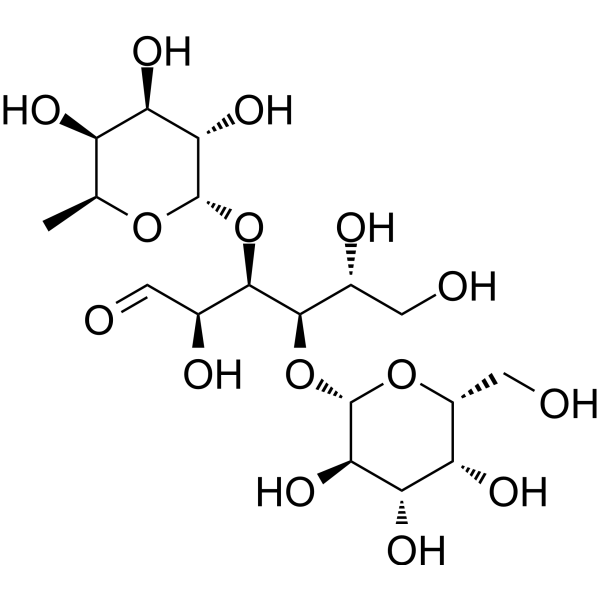
Physicochemical Properties
| Molecular Formula | C18H32O15 |
| Molecular Weight | 488.43800 |
| Exact Mass | 488.174 |
| Elemental Analysis | C, 44.26; H, 6.60; O, 49.13 |
| CAS # | 41312-47-4 |
| PubChem CID | 16216990 |
| Appearance | Light yellow to yellow solid powder |
| Density | 1.73g/cm3 |
| Boiling Point | 803.2ºC at 760 mmHg |
| Melting Point | >165°C (dec.) (lit.) |
| Flash Point | 439.6ºC |
| Vapour Pressure | 7.55E-30mmHg at 25°C |
| Index of Refraction | 1.652 |
| LogP | -5.8 |
| Hydrogen Bond Donor Count | 10 |
| Hydrogen Bond Acceptor Count | 15 |
| Rotatable Bond Count | 6 |
| Heavy Atom Count | 33 |
| Complexity | 626 |
| Defined Atom Stereocenter Count | 14 |
| SMILES | C[C@H]1[C@H]([C@H]([C@@H]([C@@H](O1)O[C@H]2[C@@H]([C@H](OC([C@@H]2O)O)CO)O[C@H]3[C@@H]([C@H]([C@H]([C@H](O3)CO)O)O)O)O)O)O |
| InChi Key | WJPIUUDKRHCAEL-YVEAQFMBSA-N |
| InChi Code | InChI=1S/C18H32O15/c1-4-7(21)9(23)11(25)17(29-4)33-15-13(27)16(28)30-6(3-20)14(15)32-18-12(26)10(24)8(22)5(2-19)31-18/h4-28H,2-3H2,1H3/t4-,5+,6+,7+,8-,9+,10-,11-,12+,13+,14+,15+,16?,17-,18-/m0/s1 |
| Chemical Name | (2S,3S,4R,5S,6S)-2-[(3R,4R,5R,6R)-2,3-dihydroxy-6-(hydroxymethyl)-5-[(2S,3R,4S,5R,6R)-3,4,5-trihydroxy-6-(hydroxymethyl)oxan-2-yl]oxyoxan-4-yl]oxy-6-methyloxane-3,4,5-triol |
| Synonyms | Fuc(a1-3)[Gal(b1-4)]Glc; Gal(beta-4)[Fuc(alpha-3)]Glc; 3-fucosyllactose; 3-O-Fucosyllactose; 41312-47-4; D-Glucopyranose, O-6-deoxy-alpha-L-galactopyranosyl-(1-3)-O-beta-D-galactopyranosyl-(1-4)-; O-6-deoxy-a-L-galactopyranosyl-(1->3)-O-[b-D-galactopyranosyl-(1->4)]- D-Glucose; O-6-deoxy-alpha-L-galactopyranosyl-(1->3)-O-[b-D-galactopyranosyl-(1->4)]- D-Glucose; |
| HS Tariff Code | 2934.99.9001 |
| Storage |
Powder-20°C 3 years 4°C 2 years In solvent -80°C 6 months -20°C 1 month Note: This product requires protection from light (avoid light exposure) during transportation and storage. |
| Shipping Condition | Room temperature (This product is stable at ambient temperature for a few days during ordinary shipping and time spent in Customs) |
Biological Activity
| Targets | Oligosaccharide |
| ln Vitro |
3-Fucosyl-D-lactose (10 mg/mL) prevents intestinal and respiratory infections from adhering to the human epithelial cell lines Caco-2 and A549 [2].
3-Fucosyllactose (3-FL) is one of the major fucosylated oligosaccharides in human milk. Along with 2'-fucosyllactose (2'-FL), it is known for its prebiotic, immunomodulator, neonatal brain development, and antimicrobial function. Whereas the biological production of 2'-FL has been widely studied and made significant progress over the years, the biological production of 3-FL has been hampered by the low activity and insoluble expression of α-1,3-fucosyltransferase (FutA), relatively low abundance in human milk oligosaccharides compared with 2'-FL, and lower digestibility of 3-FL than 2'-FL by bifidobacteria. In this study, we report the gram-scale production of 3-FL using E. coli BL21(DE3). We previously generated the FutA quadruple mutant (mFutA) with four site mutations at S46F, A128N, H129E, Y132I, and its specific activity was increased by nearly 15 times compared with that of wild-type FutA owing to the increase in kcat and the decrease in Km . We overexpressed mFutA in its maximum expression level, which was achieved by the optimization of yeast extract concentration in culture media. We also overexpressed L-fucokinase/GDP- L-fucose pyrophosphorylase to increase the supply of GDP-fucose in the cytoplasm. To increase the mass of recombinant whole-cell catalysts, the host E. coli BW25113 was switched to E. coli BL21(DE3) because of the lower acetate accumulation of E. coli BL21(DE3) than that of E. coli BW25113. Finally, the lactose operon was modified by partially deleting the sequence of LacZ (lacZΔm15) for better utilization of D-lactose. Production using the lacZΔm15 mutant yielded 3-FL concentration of 4.6 g/L with the productivity of 0.076 g·L-1 ·hr-1 and the specific 3-FL yield of 0.5 g/g dry cell weight.[1] Human milk oligosaccharides help to prevent infectious diseases in breastfed infants. Larger scale testing, particularly in animal models and human clinical studies, is still limited due to shortened availability of more complex oligosaccharides. The purpose of this study was to evaluate 2'-fucosyllactose (2'-FL) and 3-Fucosyllactose (3-FL) synthesized by whole-cell biocatalysis for their biological activity in vitro. Therefore, we have tested these oligosaccharides for their inhibitory potential of pathogen adhesion in two different human epithelial cell lines. 2'-FL could inhibit adhesion of Campylobacter jejuni, enteropathogenic Escherichia coli, Salmonella enterica serovar fyris, and Pseudomonas aeruginosa to the intestinal human cell line Caco-2 (reduction of 26%, 18%, 12%, and 17%, respectively), as could be shown for 3-FL (enteropathogenic E coli 29%, P aeruginosa 26%). Furthermore, adherence of P aeruginosa to the human respiratory epithelial cell line A549 was significantly inhibited by 2'-FL and 3-FL (reduction of 24% and 23%, respectively). These results confirm the biological and functional activity of biotechnologically synthesized human milk oligosaccharides. Mass-tailored human milk oligosaccharides could be used in the future to supplement infant formula ingredients or as preventatives to reduce the impact of infectious diseases [2]. |
| Cell Assay |
Media optimization [1] Minimal media was used for biotransformation from glycerol, L-fucose, and lactose to 3-Fucosyllactose/3-FL production. The media was prepared with 3 g/L KH2PO4, 12 g/L K2HPO4, 5 g/L (NH4)2SO4, 0.1 g/L NaCl, 0.3 g/L MgSO4·7H2O, 0.015 g/L CaCl2·2H2O, 0.11 g/L FeSO4·7H2O in 1.5 g/L sodium citrate, 7.5 μg/L thiamine, and trace element (×100 trace element consisted of 5 g/L ethylenediaminetetraacetic acid, 0.83 g/L FeCl3·6H2O, 84 mg/L ZnCl2, 13 mg/L CuCl2·2H2O, 10 mg/L CoCl2·2H2O, 10 mg/L H3BO3, 1.6 mg/L MnCl2·4H2O, pH 7.5). To increase the solubility of mFutA, yeast extract was added in minimal media according to the composition of yeast extract in TB broth. Then, the concentration of yeast extract in minimal media was optimized for the solubility of mFutA and 3-FL production. Batch and Fed-batch culture condition in the flask [1] For the production of 3-Fucosyllactose/3-FL using the co-expression system of two plasmids, pCDFm and pJExpress401, the vectors harboring the corresponding genes were transformed into engineered E. coli cells by the heat-shock method developed. The transformant, which was selected on Kan and Sm antibiotics, was cultured in a selective LB medium. Seed culture grown in LB medium overnight was transferred to a 250 ml baffled flask to make a 1% inoculation volume (vol/vol) for the main culture. The 250 ml flask contained 50 ml of minimal or optimized media supplemented with 50 μg/mL of Kan/Sm and 5 g/L glycerol as a carbon source. Cells were cultured at 37°C with 200 rpm until the cells reached OD600 at 0.9–1.0, and then 0.1 mM of isopropyl β-d-1-thiogalactopyranoside (IPTG) was added to the media. At the time of induction, 10 mM L-fucose and 20 or 40 mM D-lactose were added, and cells were further cultured at 30°C for protein expression and 3-FL production. Fed-batch cultivation was performed using a 250 ml baffled flask with 50 ml of the working volume of minimal or optimized media with the same method mentioned above. In the case of optimized media, 1% yeast extract was added to minimal media along with 5 g/L of glycerol. Cells were cultured at 37°C with 200 rpm until the cells reached OD600 at 0.9–1.0, and then 0.1 mM of IPTG was added to the media. After the addition of substrates with induction, cultivation was proceeded at 30°C with 200 rpm at a pH controlled to 7.0 using 25% (vol/vol) ammonium hydroxide solution. After the initially added glycerol was completely consumed, 50% (vol/vol) glycerol solution dissolved in minimal media with antibiotics was added to the culture media for making 1.5 g/L of glycerol concentration. During the cultivation, glycerol was fed when the glycerol concentration remained below 1 g/L. Glycerol concentration was determined by a chemical assay using chromotropic acid. Quantification of intracellular and extracellular 3-Fucosyllactose/3-FL [1] During the cultivation, 1 ml of culture was sampled and centrifuged (22,250g, 3 min) to separate the media and cells. Media was heated at 95°C for 40 s and centrifuged at 22,250g for 20 min to get a clear supernatant for the detection of 3-FL secreted into the media from the cytoplasm of E. coli. Cell pellets were washed with 1 ml of deionized water and resuspended in 400 μl 10 mM sodium phosphate buffer (pH 7.6). Cells were disrupted by sonication, heated at 95°C for 40 s, centrifuged at 22,250g for 20 min to get the supernatant for the detection of 3-FL in the cytosol. Produced 3-FL was quantified by Bio-LC. |
| References |
[1]. Biosynthesis of the human milk oligosaccharide 3-fucosyllactose in metabolically engineered Escherichia coli via the salvage pathway through increasing GTP synthesis and β-galactosidase modification. Biotechnol Bioeng. 2019 Dec;116(12):3324-3332. [2]. Bioengineered 2'-fucosyllactose and 3-fucosyllactose inhibit the adhesion of Pseudomonas aeruginosa and enteric pathogens to human intestinal and respiratory cell lines. Nutr Res. 2013 Oct;33(10):831-8. |
| Additional Infomation |
3-fucosyllactose is a trisaccharide that is lactose in which the hydroxy group at position 3 of the glucosyl moiety has undergone formal condensation with the anomeric hydroxy group of fucose (6-deoxy-L-galactose) to give the corresponding glycoside. Found in human milk. It has a role as a human metabolite. It is functionally related to a lactose. 3-FL is an important molecule for its potential applicability to prebiotics, functional foods, and pharmaceuticals. Thus, it is important to develop a stable biological production method due to complications or limitations of other methods such as chemical synthesis or direct purification from human milk. Several previous studies have shown that E. coli can be a suitable production host for oligosaccharides, and we have also constructed a 3-FL production pathway by heterologously overexpressing the GDP-fucose synthesis gene from B. fragilis, Fkp, and the FutA mutant, mFutA, which we previously constructed, in E. coli. To increase the 3-FL production from E. coli, we first optimized the concentration of yeast extract in culture media. The optimization of yeast extract improved the expressivity of mFutA, resulting in a 2.6-fold increase in 3-FL production. Then, we identified that intracellular GTP synthesis was a rate-determining step, which hindered the synthesis of GDP-fucose. Additional overexpression of Gsk not only resulted in increasing the concentration of GMP but also of GTP, GDP-fucose, and 3-FL. We changed the production host to E. coli BL21 because E. coli BW25113, which was initially used as a production host, was a derivative of E. coli K12 and was known to accumulate a substantial amount of acetate. E. coli BL21 showed a faster cell growth rate and higher 3-FL production than E. coli BW25113 probably because E. coli BL21 is more tolerant to acetate accumulation than E. coli BW25113. Finally, lactose operon on the chromosome was modified by the deletion of 31 amino acids (from residue 11–41) from the LacZ coding sequence to generate lacZΔm15. The utilization of D-lactose was elevated in the lacZΔm15 strain, along with the increase of 3-FL titer by 2.3-fold compared with the lacZ-deleted strain. It is our understanding that this was the first attempt to produce 3-FL via the salvage pathway in any organism.[1] |
Solubility Data
| Solubility (In Vitro) | May dissolve in DMSO (in most cases), if not, try other solvents such as H2O, Ethanol, or DMF with a minute amount of products to avoid loss of samples |
| Solubility (In Vivo) |
Note: Listed below are some common formulations that may be used to formulate products with low water solubility (e.g. < 1 mg/mL), you may test these formulations using a minute amount of products to avoid loss of samples. Injection Formulations (e.g. IP/IV/IM/SC) Injection Formulation 1: DMSO : Tween 80: Saline = 10 : 5 : 85 (i.e. 100 μL DMSO stock solution → 50 μL Tween 80 → 850 μL Saline) *Preparation of saline: Dissolve 0.9 g of sodium chloride in 100 mL ddH ₂ O to obtain a clear solution. Injection Formulation 2: DMSO : PEG300 :Tween 80 : Saline = 10 : 40 : 5 : 45 (i.e. 100 μL DMSO → 400 μLPEG300 → 50 μL Tween 80 → 450 μL Saline) Injection Formulation 3: DMSO : Corn oil = 10 : 90 (i.e. 100 μL DMSO → 900 μL Corn oil) Example: Take the Injection Formulation 3 (DMSO : Corn oil = 10 : 90) as an example, if 1 mL of 2.5 mg/mL working solution is to be prepared, you can take 100 μL 25 mg/mL DMSO stock solution and add to 900 μL corn oil, mix well to obtain a clear or suspension solution (2.5 mg/mL, ready for use in animals). Injection Formulation 4: DMSO : 20% SBE-β-CD in saline = 10 : 90 [i.e. 100 μL DMSO → 900 μL (20% SBE-β-CD in saline)] *Preparation of 20% SBE-β-CD in Saline (4°C,1 week): Dissolve 2 g SBE-β-CD in 10 mL saline to obtain a clear solution. Injection Formulation 5: 2-Hydroxypropyl-β-cyclodextrin : Saline = 50 : 50 (i.e. 500 μL 2-Hydroxypropyl-β-cyclodextrin → 500 μL Saline) Injection Formulation 6: DMSO : PEG300 : castor oil : Saline = 5 : 10 : 20 : 65 (i.e. 50 μL DMSO → 100 μLPEG300 → 200 μL castor oil → 650 μL Saline) Injection Formulation 7: Ethanol : Cremophor : Saline = 10: 10 : 80 (i.e. 100 μL Ethanol → 100 μL Cremophor → 800 μL Saline) Injection Formulation 8: Dissolve in Cremophor/Ethanol (50 : 50), then diluted by Saline Injection Formulation 9: EtOH : Corn oil = 10 : 90 (i.e. 100 μL EtOH → 900 μL Corn oil) Injection Formulation 10: EtOH : PEG300:Tween 80 : Saline = 10 : 40 : 5 : 45 (i.e. 100 μL EtOH → 400 μLPEG300 → 50 μL Tween 80 → 450 μL Saline) Oral Formulations Oral Formulation 1: Suspend in 0.5% CMC Na (carboxymethylcellulose sodium) Oral Formulation 2: Suspend in 0.5% Carboxymethyl cellulose Example: Take the Oral Formulation 1 (Suspend in 0.5% CMC Na) as an example, if 100 mL of 2.5 mg/mL working solution is to be prepared, you can first prepare 0.5% CMC Na solution by measuring 0.5 g CMC Na and dissolve it in 100 mL ddH2O to obtain a clear solution; then add 250 mg of the product to 100 mL 0.5% CMC Na solution, to make the suspension solution (2.5 mg/mL, ready for use in animals). Oral Formulation 3: Dissolved in PEG400 Oral Formulation 4: Suspend in 0.2% Carboxymethyl cellulose Oral Formulation 5: Dissolve in 0.25% Tween 80 and 0.5% Carboxymethyl cellulose Oral Formulation 6: Mixing with food powders Note: Please be aware that the above formulations are for reference only. InvivoChem strongly recommends customers to read literature methods/protocols carefully before determining which formulation you should use for in vivo studies, as different compounds have different solubility properties and have to be formulated differently. (Please use freshly prepared in vivo formulations for optimal results.) |
| Preparing Stock Solutions | 1 mg | 5 mg | 10 mg | |
| 1 mM | 2.0473 mL | 10.2367 mL | 20.4733 mL | |
| 5 mM | 0.4095 mL | 2.0473 mL | 4.0947 mL | |
| 10 mM | 0.2047 mL | 1.0237 mL | 2.0473 mL |