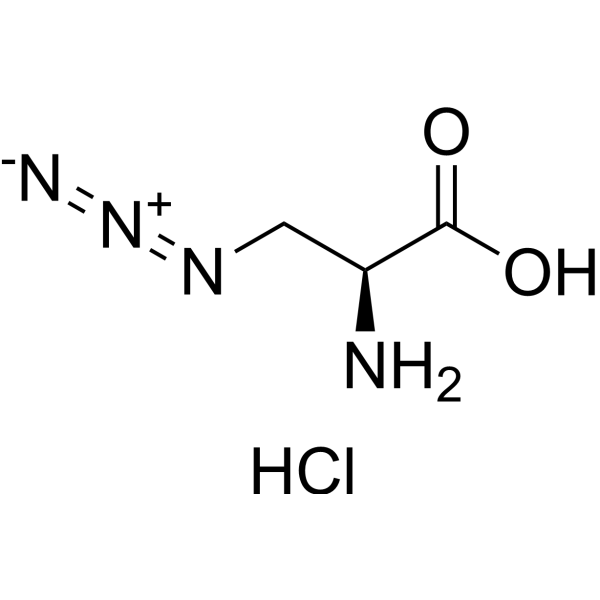
Physicochemical Properties
| Molecular Formula | C3H7CLN4O2 |
| Molecular Weight | 166.56627869606 |
| Exact Mass | 166.025 |
| CAS # | 1620171-64-3 |
| Related CAS # | 3-Azido-L-alanine;105661-40-3 |
| PubChem CID | 121235330 |
| Appearance | Off-white to pink solid powder |
| Hydrogen Bond Donor Count | 3 |
| Hydrogen Bond Acceptor Count | 5 |
| Rotatable Bond Count | 3 |
| Heavy Atom Count | 10 |
| Complexity | 150 |
| Defined Atom Stereocenter Count | 1 |
| SMILES | C([C@@H](C(=O)O)N)N=[N+]=[N-].Cl |
| InChi Key | MQDWRZHPCDDSJZ-DKWTVANSSA-N |
| InChi Code | InChI=1S/C3H6N4O2.ClH/c4-2(3(8)9)1-6-7-5;/h2H,1,4H2,(H,8,9);1H/t2-;/m0./s1 |
| Chemical Name | (2S)-2-amino-3-azidopropanoic acid;hydrochloride |
| Synonyms | 3-Azido-L-Alanine HCl; MFCD18382048; 1620171-64-3; 3-Azido-L-alanine (hydrochloride); C3H7ClN4O2; 3-Azido-L-alanine hydrochloride; (S)-2-Amino-3-azidopropanoic acid hydrochloride; Nbeta-Azido-L-2,3-diaminopropionic acid hydrochloride; |
| HS Tariff Code | 2934.99.9001 |
| Storage |
Powder-20°C 3 years 4°C 2 years In solvent -80°C 6 months -20°C 1 month Note: Please store this product in a sealed and protected environment, avoid exposure to moisture. |
| Shipping Condition | Room temperature (This product is stable at ambient temperature for a few days during ordinary shipping and time spent in Customs) |
Biological Activity
| Targets |
3-Azido-L-alanine functions as a chemical reporter incorporated into microcystins via precursor-directed biosynthesis for bioorthogonal labeling, without direct interaction with biological receptors or enzymes [1] |
| ln Vitro |
- Biosynthetic Incorporation into Microcystins: 1. Cyanobacterial Cultivation: 3-Azido-L-alanine (0.1–1 mM) was supplemented into BG-11 medium for Microcystis aeruginosa cultures. Incorporation efficiency was assessed via LC-MS, showing 3-azidoalanine substitution at the Adda moiety position (mass shift +28 Da) in 20–40% of total microcystins after 7 days [1] 2. Click Chemistry Labeling: Azido-functionalized microcystins were reacted with DBCO-fluorophores (10 μM, 37°C, 1 h) in PBS buffer, achieving >90% labeling efficiency as confirmed by fluorescence spectroscopy (λex 488 nm, λem 520 nm) [1] - Cytotoxicity Retention: 1. HepG2 Cell Viability: Click-labeled microcystin derivatives (10 nM) showed comparable cytotoxicity (IC₅₀ = 12 ± 2 nM) to native microcystin-LR, as measured by MTT assay. Labeling did not alter protein phosphatase 1/2A inhibition (IC₅₀ = 8 ± 1 nM, in vitro enzyme assay) [1] |
| ln Vivo |
- Cellular Uptake Dynamics: 1. Time-Lapse Microscopy: Fluorescent microcystins (10 nM) were internalized by HepG2 cells expressing OATP1B1/1B3 transporters within 5 minutes, accumulating in perinuclear vesicles. Uptake was blocked by 10 μM rifampicin (OATP inhibitor) [1] |
| Enzyme Assay |
- Protein Phosphatase Inhibition Assay [1]: 1. Reaction Setup: Recombinant PP1 catalytic subunit (20 nM) was incubated with 32P-labeled phosphorylase a (1 μM) in assay buffer (50 mM Tris-HCl pH 7.5, 10 mM MgCl₂). 3-Azido-L-alanine-labeled microcystin (0.1–100 nM) was added, and dephosphorylation was stopped with SDS-PAGE loading buffer after 30 minutes at 37°C. 2. Quantification: Phosphorylase a activity was measured by autoradiography, showing IC₅₀ values identical to native microcystin-LR (8 ± 1 nM), confirming azido substitution did not impair enzyme binding [1] |
| Cell Assay |
- Microcystin Incorporation and Labeling Protocol [1]: 1. Cyanobacterial Culture: Microcystis aeruginosa cells were grown in BG-11 medium supplemented with 3-Azido-L-alanine (0.5 mM) for 7 days. Cells were harvested by centrifugation (5,000g, 10 min), and microcystins were extracted with 80% methanol. 2. Click Reaction: Extracts were reacted with DBCO-PEG4-TAMRA (10 μM) in PBS (pH 7.4) for 1 h at room temperature. Labeled microcystins were purified by C18 SPE cartridges and analyzed by LC-MS/MS - Confocal Microscopy: 1. HepG2 Cell Staining: Cells treated with labeled microcystins (10 nM) were fixed with 4% PFA, permeabilized with 0.1% Triton X-100, and counterstained with DAPI. Fluorescence colocalization with LysoTracker Red (lysosomal marker) confirmed vesicular trafficking [1] |
| References |
[1]. Precursor-Directed Biosynthesis and Fluorescence Labeling of Clickable Microcystins. J Nat Prod. 2020 Jun 26;83(6):1960-1970. |
| Additional Infomation |
- Biosynthetic Engineering: 1. Precursor Specificity: Microcystis strains varied in their ability to incorporate 3-Azido-L-alanine, with M. aeruginosa PCC 7806 showing higher tolerance (up to 1 mM) compared to M. flos-aquae (max 0.2 mM) [1] 2. Metabolic Competition: Incorporation efficiency was enhanced by co-supplementing L-alanine (0.5 mM) to reduce competition with native amino acid pools [1] - Application Scope: 1. Imaging Probe Development: Clickable microcystins enabled live-cell tracking of toxin trafficking, revealing OATP-dependent uptake pathways [1] 2. Structure-Activity Studies: Azido substitution allowed site-specific conjugation of affinity tags for pull-down assays, identifying novel protein interactors [1] - Limitations: 1. Low Natural Abundance: Endogenous microcystin production in Microcystis decreased by 30–50% upon azidoalanine supplementation, likely due to metabolic stress [1] |
Solubility Data
| Solubility (In Vitro) | DMSO: 125 mg/mL (750.44 mM) |
| Solubility (In Vivo) |
Note: Listed below are some common formulations that may be used to formulate products with low water solubility (e.g. < 1 mg/mL), you may test these formulations using a minute amount of products to avoid loss of samples. Injection Formulations (e.g. IP/IV/IM/SC) Injection Formulation 1: DMSO : Tween 80: Saline = 10 : 5 : 85 (i.e. 100 μL DMSO stock solution → 50 μL Tween 80 → 850 μL Saline) *Preparation of saline: Dissolve 0.9 g of sodium chloride in 100 mL ddH ₂ O to obtain a clear solution. Injection Formulation 2: DMSO : PEG300 :Tween 80 : Saline = 10 : 40 : 5 : 45 (i.e. 100 μL DMSO → 400 μLPEG300 → 50 μL Tween 80 → 450 μL Saline) Injection Formulation 3: DMSO : Corn oil = 10 : 90 (i.e. 100 μL DMSO → 900 μL Corn oil) Example: Take the Injection Formulation 3 (DMSO : Corn oil = 10 : 90) as an example, if 1 mL of 2.5 mg/mL working solution is to be prepared, you can take 100 μL 25 mg/mL DMSO stock solution and add to 900 μL corn oil, mix well to obtain a clear or suspension solution (2.5 mg/mL, ready for use in animals). Injection Formulation 4: DMSO : 20% SBE-β-CD in saline = 10 : 90 [i.e. 100 μL DMSO → 900 μL (20% SBE-β-CD in saline)] *Preparation of 20% SBE-β-CD in Saline (4°C,1 week): Dissolve 2 g SBE-β-CD in 10 mL saline to obtain a clear solution. Injection Formulation 5: 2-Hydroxypropyl-β-cyclodextrin : Saline = 50 : 50 (i.e. 500 μL 2-Hydroxypropyl-β-cyclodextrin → 500 μL Saline) Injection Formulation 6: DMSO : PEG300 : castor oil : Saline = 5 : 10 : 20 : 65 (i.e. 50 μL DMSO → 100 μLPEG300 → 200 μL castor oil → 650 μL Saline) Injection Formulation 7: Ethanol : Cremophor : Saline = 10: 10 : 80 (i.e. 100 μL Ethanol → 100 μL Cremophor → 800 μL Saline) Injection Formulation 8: Dissolve in Cremophor/Ethanol (50 : 50), then diluted by Saline Injection Formulation 9: EtOH : Corn oil = 10 : 90 (i.e. 100 μL EtOH → 900 μL Corn oil) Injection Formulation 10: EtOH : PEG300:Tween 80 : Saline = 10 : 40 : 5 : 45 (i.e. 100 μL EtOH → 400 μLPEG300 → 50 μL Tween 80 → 450 μL Saline) Oral Formulations Oral Formulation 1: Suspend in 0.5% CMC Na (carboxymethylcellulose sodium) Oral Formulation 2: Suspend in 0.5% Carboxymethyl cellulose Example: Take the Oral Formulation 1 (Suspend in 0.5% CMC Na) as an example, if 100 mL of 2.5 mg/mL working solution is to be prepared, you can first prepare 0.5% CMC Na solution by measuring 0.5 g CMC Na and dissolve it in 100 mL ddH2O to obtain a clear solution; then add 250 mg of the product to 100 mL 0.5% CMC Na solution, to make the suspension solution (2.5 mg/mL, ready for use in animals). Oral Formulation 3: Dissolved in PEG400 Oral Formulation 4: Suspend in 0.2% Carboxymethyl cellulose Oral Formulation 5: Dissolve in 0.25% Tween 80 and 0.5% Carboxymethyl cellulose Oral Formulation 6: Mixing with food powders Note: Please be aware that the above formulations are for reference only. InvivoChem strongly recommends customers to read literature methods/protocols carefully before determining which formulation you should use for in vivo studies, as different compounds have different solubility properties and have to be formulated differently. (Please use freshly prepared in vivo formulations for optimal results.) |
| Preparing Stock Solutions | 1 mg | 5 mg | 10 mg | |
| 1 mM | 6.0035 mL | 30.0174 mL | 60.0348 mL | |
| 5 mM | 1.2007 mL | 6.0035 mL | 12.0070 mL | |
| 10 mM | 0.6003 mL | 3.0017 mL | 6.0035 mL |