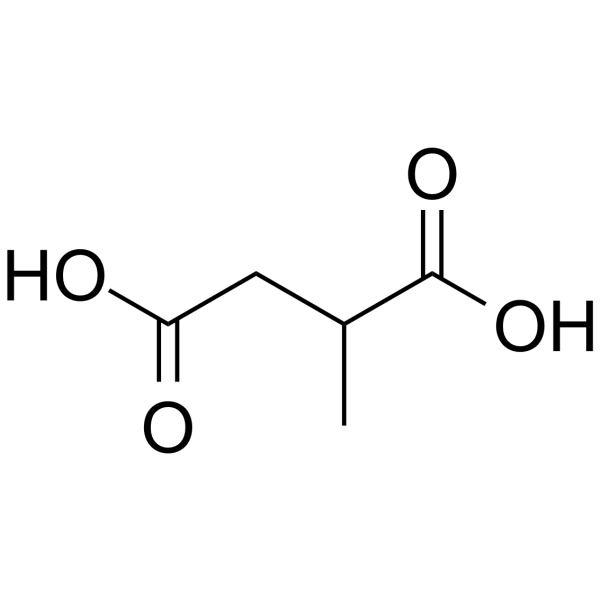
Physicochemical Properties
| Molecular Formula | C5H8O4 |
| Molecular Weight | 132.1146 |
| Exact Mass | 132.042 |
| CAS # | 498-21-5 |
| Related CAS # | 2-Methylsuccinic acid-d6;347840-08-8 |
| PubChem CID | 10349 |
| Appearance | White to off-white solid powder |
| Density | 1.3±0.1 g/cm3 |
| Boiling Point | 236.5±13.0 °C at 760 mmHg |
| Melting Point | 110-115 °C(lit.) |
| Flash Point | 111.1±16.3 °C |
| Vapour Pressure | 0.0±1.0 mmHg at 25°C |
| Index of Refraction | 1.474 |
| LogP | -0.24 |
| Hydrogen Bond Donor Count | 2 |
| Hydrogen Bond Acceptor Count | 4 |
| Rotatable Bond Count | 3 |
| Heavy Atom Count | 9 |
| Complexity | 129 |
| Defined Atom Stereocenter Count | 0 |
| InChi Key | WXUAQHNMJWJLTG-UHFFFAOYSA-N |
| InChi Code | InChI=1S/C5H8O4/c1-3(5(8)9)2-4(6)7/h3H,2H2,1H3,(H,6,7)(H,8,9) |
| Chemical Name | 2-methylbutanedioic acid |
| HS Tariff Code | 2934.99.9001 |
| Storage |
Powder-20°C 3 years 4°C 2 years In solvent -80°C 6 months -20°C 1 month |
| Shipping Condition | Room temperature (This product is stable at ambient temperature for a few days during ordinary shipping and time spent in Customs) |
Biological Activity
| ln Vitro | 2-Methylsuccinate is a typical metabolite found in human bodily fluids and the main biochemically detectable feature of encephalopathy caused by ethylmalonic acid [1]. The catabolism of isoleucine is the fundamental biochemical problem [2]. |
| ln Vivo |
- In patients with ethylmalonic encephalopathy (EE), 2-Methylsuccinic acid was detected at elevated levels in urine and cerebrospinal fluid (CSF). Urinary 2-Methylsuccinic acid concentrations ranged from 80 to 250 μmol/mmol creatinine (normal range: <10 μmol/mmol creatinine), and CSF concentrations ranged from 5 to 18 μmol/L (normal range: undetectable) [1] - In EE patients, 2-Methylsuccinic acid accumulation was associated with abnormal isoleucine metabolism. After oral administration of [1-¹⁴C]-isoleucine to EE patients, radioactive labeling was detected in urinary 2-Methylsuccinic acid, confirming that it is a metabolic byproduct of isoleucine catabolism [2] |
| Enzyme Assay |
- For urinary organic acid analysis (to detect 2-Methylsuccinic acid): Urine samples from EE patients and healthy controls were collected and deproteinized by centrifugation after adding sulfosalicylic acid. The supernatant was filtered through a 0.22 μm membrane and analyzed by gas chromatography-mass spectrometry (GC-MS). The column was programmed to升温 from 80°C to 280°C at a rate of 10°C/min, and the mass spectrometer was operated in electron ionization mode. 2-Methylsuccinic acid was identified by comparing its retention time and mass spectrum with a standard reference, and its concentration was quantified using an internal standard (heptadecanoic acid) [1, 2] - For isotope tracing experiment (to confirm 2-Methylsuccinic acid origin): EE patients were given a single oral dose of [1-¹⁴C]-isoleucine (1 μCi/kg body weight). Urine was collected at 2-hour intervals for 24 hours, and urinary 2-Methylsuccinic acid was isolated by preparative HPLC. The radioactivity of the isolated 2-Methylsuccinic acid was measured using a liquid scintillation counter, and the percentage of radioactive labeling was calculated to confirm its derivation from isoleucine [2] |
| References |
[1]. Ethylmalonic encephalopathy: further clinical and neuroradiological characterization. J Neurol. 2002 Oct;249(10):1446-50. [2]. Ethylmalonic and methylsuccinic aciduria in ethylmalonic encephalopathy arise from abnormal isoleucine metabolism. Metabolism. 1998 Jul;47(7):836-9. |
| Additional Infomation |
Methyl succinic acid appears as white or yellowish crystals or beige powder. (NTP, 1992) 2-methylbutanedioic acid is a dicarboxylic acid that is butanedioic acid substituted at position 2 by a methyl group. It is a conjugate acid of a methylsuccinate. Methylsuccinic acid has been reported in Aloe africana with data available. - 2-Methylsuccinic acid is a dicarboxylic acid that accumulates abnormally in ethylmalonic encephalopathy (EE), a rare autosomal recessive metabolic disorder [1, 2] - The accumulation of 2-Methylsuccinic acid in EE arises from a block in the isoleucine degradation pathway, specifically at the step of 2-methylacetoacetyl-CoA thiolase. This block causes shunting of isoleucine metabolites toward 2-Methylsuccinic acid formation [2] - 2-Methylsuccinic acid is a key diagnostic marker for EE: its elevated levels in urine and CSF, combined with clinical features (e.g., developmental delay, seizures, acrocyanosis), help distinguish EE from other metabolic encephalopathies [1] |
Solubility Data
| Solubility (In Vitro) | DMSO : ≥ 100 mg/mL (~756.89 mM) |
| Solubility (In Vivo) |
Solubility in Formulation 1: ≥ 2.5 mg/mL (18.92 mM) (saturation unknown) in 10% DMSO + 40% PEG300 + 5% Tween80 + 45% Saline (add these co-solvents sequentially from left to right, and one by one), clear solution. For example, if 1 mL of working solution is to be prepared, you can add 100 μL of 25.0 mg/mL clear DMSO stock solution to 400 μL PEG300 and mix evenly; then add 50 μL Tween-80 to the above solution and mix evenly; then add 450 μL normal saline to adjust the volume to 1 mL. Preparation of saline: Dissolve 0.9 g of sodium chloride in 100 mL ddH₂ O to obtain a clear solution. Solubility in Formulation 2: ≥ 2.5 mg/mL (18.92 mM) (saturation unknown) in 10% DMSO + 90% (20% SBE-β-CD in Saline) (add these co-solvents sequentially from left to right, and one by one), clear solution. For example, if 1 mL of working solution is to be prepared, you can add 100 μL of 25.0 mg/mL clear DMSO stock solution to 900 μL of 20% SBE-β-CD physiological saline solution and mix evenly. Preparation of 20% SBE-β-CD in Saline (4°C,1 week): Dissolve 2 g SBE-β-CD in 10 mL saline to obtain a clear solution. Solubility in Formulation 3: ≥ 2.5 mg/mL (18.92 mM) (saturation unknown) in 10% DMSO + 90% Corn Oil (add these co-solvents sequentially from left to right, and one by one), clear solution. For example, if 1 mL of working solution is to be prepared, you can add 100 μL of 25.0 mg/mL clear DMSO stock solution to 900 μL of corn oil and mix evenly. (Please use freshly prepared in vivo formulations for optimal results.) |
| Preparing Stock Solutions | 1 mg | 5 mg | 10 mg | |
| 1 mM | 7.5694 mL | 37.8472 mL | 75.6945 mL | |
| 5 mM | 1.5139 mL | 7.5694 mL | 15.1389 mL | |
| 10 mM | 0.7569 mL | 3.7847 mL | 7.5694 mL |