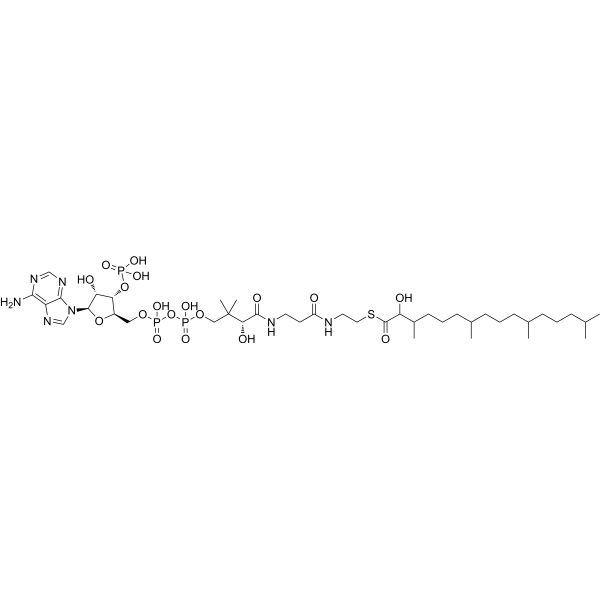
Physicochemical Properties
| Molecular Formula | C41H74N7O18P3S |
| Molecular Weight | 1078.04876 |
| Exact Mass | 1077.402 |
| CAS # | 172787-73-4 |
| PubChem CID | 441263 |
| Appearance | Typically exists as solid at room temperature |
| LogP | 2.1 |
| Hydrogen Bond Donor Count | 10 |
| Hydrogen Bond Acceptor Count | 23 |
| Rotatable Bond Count | 34 |
| Heavy Atom Count | 70 |
| Complexity | 1790 |
| Defined Atom Stereocenter Count | 7 |
| SMILES | CC(C)CCCC(C)CCCC(C)CCCC(C)C(C(=O)SCCNC(=O)CCNC(=O)C(C(C)(C)COP(=O)(O)OP(=O)(O)OCC1C(C(C(O1)N2C=NC3=C(N=CN=C32)N)O)OP(=O)(O)O)O)O |
| InChi Key | WNVFJMYPVBOLKV-PJDIVXIPSA-N |
| InChi Code | InChI=1S/C41H74N7O18P3S/c1-25(2)11-8-12-26(3)13-9-14-27(4)15-10-16-28(5)32(50)40(54)70-20-19-43-30(49)17-18-44-38(53)35(52)41(6,7)22-63-69(60,61)66-68(58,59)62-21-29-34(65-67(55,56)57)33(51)39(64-29)48-24-47-31-36(42)45-23-46-37(31)48/h23-29,32-35,39,50-52H,8-22H2,1-7H3,(H,43,49)(H,44,53)(H,58,59)(H,60,61)(H2,42,45,46)(H2,55,56,57)/t26-,27-,28+,29-,32?,33-,34-,35?,39-/m1/s1 |
| Chemical Name | S-[2-[3-[[4-[[[(2R,3S,4R,5R)-5-(6-aminopurin-9-yl)-4-hydroxy-3-phosphonooxyoxolan-2-yl]methoxy-hydroxyphosphoryl]oxy-hydroxyphosphoryl]oxy-2-hydroxy-3,3-dimethylbutanoyl]amino]propanoylamino]ethyl] (3S,7R,11R)-2-hydroxy-3,7,11,15-tetramethylhexadecanethioate |
| Synonyms | 2-Hydroxyphytanoyl-CoA; 172787-73-4; S-[2-[3-[[4-[[[(2R,3S,4R,5R)-5-(6-aminopurin-9-yl)-4-hydroxy-3-phosphonooxyoxolan-2-yl]methoxy-hydroxyphosphoryl]oxy-hydroxyphosphoryl]oxy-2-hydroxy-3,3-dimethylbutanoyl]amino]propanoylamino]ethyl] (3S,7R,11R)-2-hydroxy-3,7,11,15-tetramethylhexadecanethioate; {[(2R,3S,4R,5R)-5-(6-amino-9H-purin-9-yl)-4-hydroxy-2-({[hydroxy({hydroxy[3-hydroxy-3-({2-[(2-{[(3S,7R,11R)-2-hydroxy-3,7,11,15-tetramethylhexadecanoyl]sulfanyl}ethyl)carbamoyl]ethyl}carbamoyl)-2,2-dimethylpropoxy]phosphoryl}oxy)phosphoryl]oxy}methyl)oxolan-3-yl]oxy}phosphonic acid; [5-(6-aminopurin-9-yl)-4-hydroxy-2-[[hydroxy-[hydroxy-[3-hydroxy-3-[2-[2-(2-hydroxy-3,7,11,15-tetram; 3S2HPhy-CoA; 3S2HPhy-Coenzyme A; (3S)-2-hydroxyphytanoyl-CoA; |
| HS Tariff Code | 2934.99.9001 |
| Storage |
Powder-20°C 3 years 4°C 2 years In solvent -80°C 6 months -20°C 1 month |
| Shipping Condition | Room temperature (This product is stable at ambient temperature for a few days during ordinary shipping and time spent in Customs) |
Biological Activity
| Targets | Biochemical |
| ln Vitro | 2-Hydroxyfatty acids, constituents of brain cerebrosides and sulfatides, were previously reported to be degraded by an alpha-oxidation system, generating fatty acids shortened by one carbon atom. In the current study we used labeled and unlabeled 2-hydroxyoctadecanoic acid to reinvestigate the degradation of this class of lipids. Both in intact and broken cell systems formate was identified as a main reaction product. Furthermore, the generation of an n-1 aldehyde was demonstrated. In permeabilized rat hepatocytes and liver homogenates, studies on cofactor requirements revealed a dependence on ATP, CoA, Mg(2+), thiamine pyrophosphate, and NAD(+). Together with subcellular fractionation data and studies on recombinant enzymes, this led to the following picture. In a first step, the 2-hydroxyfatty acid is activated to an acyl-CoA; subsequently, the 2-hydroxy fatty acyl-CoA is cleaved by 2-hydroxyphytanoyl-CoA lyase, to formyl-CoA and an n-1 aldehyde. The severe inhibition of formate generation by oxythiamin treatment of intact fibroblasts indicates that cleavage through the thiamine pyrophosphate-dependent 2-hydroxyphytanoyl-CoA lyase is the main pathway for the degradation of 2-hydroxyfatty acids. The latter protein was initially characterized as an essential enzyme in the peroxisomal alpha-oxidation of 3-methyl-branched fatty acids such as phytanic acid. Our findings point to a new role for peroxisomes in mammals, i.e. the breakdown of 2-hydroxyfatty acids, at least the long chain 2-hydroxyfatty acids. Most likely, the more abundant very long chain 2-hydroxyfatty acids are degraded in a similar manner [2]. |
| ln Vivo | The structure and enzymology of the phytanic acid alpha-oxidation pathway have long remained an enigma. Recent studies have shown that phytanic acid first undergoes activation to its coenzyme A ester, followed by hydroxylation to 2-hydroxyphytanoyl-CoA. In this paper we have studied the mechanism of decarboxylation of 2-hydroxyphytanoyl-CoA in human liver. To this end, human liver homogenates were incubated with 2-hydroxyphytanoyl-CoA in the presence or absence of NAD+. Hereafter, the medium was analyzed for the presence of pristanal and pristanic acid by gas chromatography mass spectrometry. Our results show that pristanal is formed from 2-hydroxyphytanoyl-CoA. Pristanal is subsequently oxidized to pristanic acid in a NAD+ dependent reaction. These results finally resolve the mechanism of the phytanic acid alpha-oxidation process in human liver. [1] |
| References |
[1].Resolution of the Phytanic Acid a-Oxidation Pathway: Identification of Pristanal as Product of the Decarboxylation of 2-Hydroxyphytanoyl-CoA. Biochem Biophys Res Commun. 1997 Aug 8;237(1):33-6. [2].Breakdown of 2-hydroxylated straight chain fatty acids via peroxisomal 2-hydroxyphytanoyl-CoA lyase: a revised pathway for the alpha-oxidation of straight chain fatty acids. J Biol Chem. 2005 Mar 18;280(11):9802-12. |
| Additional Infomation | To control the levels of 2-hydroxyfatty acids in brain cerebrosides and sulfatides, supposed to play a role in myelinization, a strategy relying on different sets of enzymes for their synthesis and degradation, located at different subcellular sites, might be more beneficial. Moreover, as was reported in older literature and recently discussed by Alderson et al., hydroxylation of straight chain fatty acids might occur only after incorporation in sphingolipids, which would further rule out peroxisomes as a key player in this hydroxylation process. In this context it is of interest to note that 2-hydroxyoctadecanoic acid was hardly incorporated into complex lipids when given to intact cells.3 Overall, the α-oxidation of straight chain fatty acids, as has been described especially for brain, appears to proceed as follows; 1) hydroxylation of the fatty acid by a fatty acid 2-hydroxylase (see the Introduction), 2) activation of the 2-hydroxyfatty acid to a 2-hydroxyacyl-CoA, 3) cleavage of the CoA ester into formyl-CoA and an n – 1 fatty aldehyde, and 4) dehydrogenation of the aldehyde to the corresponding n – 1 odd-numbered fatty acid. [2] |
Solubility Data
| Solubility (In Vitro) | Typically soluble in DMSO (e.g. 10 mM) |
| Solubility (In Vivo) |
Note: Listed below are some common formulations that may be used to formulate products with low water solubility (e.g. < 1 mg/mL), you may test these formulations using a minute amount of products to avoid loss of samples. Injection Formulations (e.g. IP/IV/IM/SC) Injection Formulation 1: DMSO : Tween 80: Saline = 10 : 5 : 85 (i.e. 100 μL DMSO stock solution → 50 μL Tween 80 → 850 μL Saline) *Preparation of saline: Dissolve 0.9 g of sodium chloride in 100 mL ddH ₂ O to obtain a clear solution. Injection Formulation 2: DMSO : PEG300 :Tween 80 : Saline = 10 : 40 : 5 : 45 (i.e. 100 μL DMSO → 400 μLPEG300 → 50 μL Tween 80 → 450 μL Saline) Injection Formulation 3: DMSO : Corn oil = 10 : 90 (i.e. 100 μL DMSO → 900 μL Corn oil) Example: Take the Injection Formulation 3 (DMSO : Corn oil = 10 : 90) as an example, if 1 mL of 2.5 mg/mL working solution is to be prepared, you can take 100 μL 25 mg/mL DMSO stock solution and add to 900 μL corn oil, mix well to obtain a clear or suspension solution (2.5 mg/mL, ready for use in animals). Injection Formulation 4: DMSO : 20% SBE-β-CD in saline = 10 : 90 [i.e. 100 μL DMSO → 900 μL (20% SBE-β-CD in saline)] *Preparation of 20% SBE-β-CD in Saline (4°C,1 week): Dissolve 2 g SBE-β-CD in 10 mL saline to obtain a clear solution. Injection Formulation 5: 2-Hydroxypropyl-β-cyclodextrin : Saline = 50 : 50 (i.e. 500 μL 2-Hydroxypropyl-β-cyclodextrin → 500 μL Saline) Injection Formulation 6: DMSO : PEG300 : castor oil : Saline = 5 : 10 : 20 : 65 (i.e. 50 μL DMSO → 100 μLPEG300 → 200 μL castor oil → 650 μL Saline) Injection Formulation 7: Ethanol : Cremophor : Saline = 10: 10 : 80 (i.e. 100 μL Ethanol → 100 μL Cremophor → 800 μL Saline) Injection Formulation 8: Dissolve in Cremophor/Ethanol (50 : 50), then diluted by Saline Injection Formulation 9: EtOH : Corn oil = 10 : 90 (i.e. 100 μL EtOH → 900 μL Corn oil) Injection Formulation 10: EtOH : PEG300:Tween 80 : Saline = 10 : 40 : 5 : 45 (i.e. 100 μL EtOH → 400 μLPEG300 → 50 μL Tween 80 → 450 μL Saline) Oral Formulations Oral Formulation 1: Suspend in 0.5% CMC Na (carboxymethylcellulose sodium) Oral Formulation 2: Suspend in 0.5% Carboxymethyl cellulose Example: Take the Oral Formulation 1 (Suspend in 0.5% CMC Na) as an example, if 100 mL of 2.5 mg/mL working solution is to be prepared, you can first prepare 0.5% CMC Na solution by measuring 0.5 g CMC Na and dissolve it in 100 mL ddH2O to obtain a clear solution; then add 250 mg of the product to 100 mL 0.5% CMC Na solution, to make the suspension solution (2.5 mg/mL, ready for use in animals). Oral Formulation 3: Dissolved in PEG400 Oral Formulation 4: Suspend in 0.2% Carboxymethyl cellulose Oral Formulation 5: Dissolve in 0.25% Tween 80 and 0.5% Carboxymethyl cellulose Oral Formulation 6: Mixing with food powders Note: Please be aware that the above formulations are for reference only. InvivoChem strongly recommends customers to read literature methods/protocols carefully before determining which formulation you should use for in vivo studies, as different compounds have different solubility properties and have to be formulated differently. (Please use freshly prepared in vivo formulations for optimal results.) |
| Preparing Stock Solutions | 1 mg | 5 mg | 10 mg | |
| 1 mM | 0.9276 mL | 4.6380 mL | 9.2760 mL | |
| 5 mM | 0.1855 mL | 0.9276 mL | 1.8552 mL | |
| 10 mM | 0.0928 mL | 0.4638 mL | 0.9276 mL |