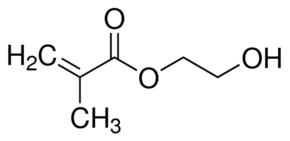
2-Hydroxyethyl methacrylate (HEMA) was the first monomer to be used in the synthesis of hydrogels for biomedical applications.The water swelling properties of HEMA are enhanced by copolymerization with more hydrophilic monomers. HEMA has wide applications in drug delivery.
Physicochemical Properties
| Molecular Formula | C6H10O3 |
| Molecular Weight | 130.1418 |
| Exact Mass | 130.062 |
| CAS # | 868-77-9 |
| Related CAS # | 25249-16-5;9016-69-7;25736-86-1 |
| PubChem CID | 13360 |
| Appearance | Clear mobile liquid |
| Density | 1.1±0.1 g/cm3 |
| Boiling Point | 189.0±0.0 °C at 760 mmHg |
| Melting Point | -12 °C |
| Flash Point | 97.2±0.0 °C |
| Vapour Pressure | 0.2±0.7 mmHg at 25°C |
| Index of Refraction | 1.443 |
| LogP | 0.5 |
| Hydrogen Bond Donor Count | 1 |
| Hydrogen Bond Acceptor Count | 3 |
| Rotatable Bond Count | 4 |
| Heavy Atom Count | 9 |
| Complexity | 118 |
| Defined Atom Stereocenter Count | 0 |
| SMILES | O=C(C(C)=C)OCCO |
| InChi Key | WOBHKFSMXKNTIM-UHFFFAOYSA-N |
| InChi Code | InChI=1S/C6H10O3/c1-5(2)6(8)9-4-3-7/h7H,1,3-4H2,2H3 |
| Chemical Name | 2-hydroxyethyl 2-methylprop-2-enoate |
| HS Tariff Code | 2934.99.9001 |
| Storage |
Powder-20°C 3 years 4°C 2 years In solvent -80°C 6 months -20°C 1 month Note: This product requires protection from light (avoid light exposure) during transportation and storage. |
| Shipping Condition | Room temperature (This product is stable at ambient temperature for a few days during ordinary shipping and time spent in Customs) |
Biological Activity
| ADME/Pharmacokinetics |
Metabolism / Metabolites SMALL QUANTITIES OF METHACRYLATES MAY READILY BE METABOLIZED BY SAPONIFICATION INTO THE ALCOHOL AND METHACRYLIC ACID. THE LATTER MAY FORM AN ACETYL-COENZYME DERIVATIVE, WHICH THEN ENTERS THE NORMAL LIPID METABOLISM. /METHACRYLATES/ |
| Toxicity/Toxicokinetics |
Non-Human Toxicity Values LD50 MICE INTRAPERITONEAL 0.497 ML/KG LD50 MICE ORAL 5.1 ML/KG LD50 Rat oral 11.2 g/kg LD50 Rabbit percutaneous > 3.0 g/kg For more Non-Human Toxicity Values (Complete) data for 2-HYDROXYETHYL METHACRYLATE (7 total), please visit the HSDB record page. |
| Additional Infomation |
2-hydroxyethyl methacrylate is an enoate ester that is the monomethacryloyl derivative of ethylene glycol. It has a role as a polymerisation monomer and an allergen. It is functionally related to an ethylene glycol and a methacrylic acid. 2-Hydroxyethyl Methacrylate is a hydroxyester compound and a resin monomer used in desensitizing dentin. By applying 2-hydroxyethyl methacrylate locally to sensitive teeth, sensitive areas in the teeth get sealed and block the dentinal tubules at the dentin surface from stimuli that cause pain. This prevents excitation of the tooth nerve and relieves pain caused by tooth hypersensitivity. See also: Phemfilcon A (monomer of); Senofilcon A (monomer of); Hioxifilcon A (monomer of) ... View More ... |
Solubility Data
| Solubility (In Vitro) | DMSO : ≥ 100 mg/mL (~768.40 mM) |
| Solubility (In Vivo) |
Solubility in Formulation 1: ≥ 2.5 mg/mL (19.21 mM) (saturation unknown) in 10% DMSO + 40% PEG300 + 5% Tween80 + 45% Saline (add these co-solvents sequentially from left to right, and one by one), clear solution. For example, if 1 mL of working solution is to be prepared, you can add 100 μL of 25.0 mg/mL clear DMSO stock solution to 400 μL PEG300 and mix evenly; then add 50 μL Tween-80 to the above solution and mix evenly; then add 450 μL normal saline to adjust the volume to 1 mL. Preparation of saline: Dissolve 0.9 g of sodium chloride in 100 mL ddH₂ O to obtain a clear solution. Solubility in Formulation 2: ≥ 2.5 mg/mL (19.21 mM) (saturation unknown) in 10% DMSO + 90% (20% SBE-β-CD in Saline) (add these co-solvents sequentially from left to right, and one by one), clear solution. For example, if 1 mL of working solution is to be prepared, you can add 100 μL of 25.0 mg/mL clear DMSO stock solution to 900 μL of 20% SBE-β-CD physiological saline solution and mix evenly. Preparation of 20% SBE-β-CD in Saline (4°C,1 week): Dissolve 2 g SBE-β-CD in 10 mL saline to obtain a clear solution. Solubility in Formulation 3: ≥ 2.5 mg/mL (19.21 mM) (saturation unknown) in 10% DMSO + 90% Corn Oil (add these co-solvents sequentially from left to right, and one by one), clear solution. For example, if 1 mL of working solution is to be prepared, you can add 100 μL of 25.0 mg/mL clear DMSO stock solution to 900 μL of corn oil and mix evenly. (Please use freshly prepared in vivo formulations for optimal results.) |
| Preparing Stock Solutions | 1 mg | 5 mg | 10 mg | |
| 1 mM | 7.6840 mL | 38.4202 mL | 76.8403 mL | |
| 5 mM | 1.5368 mL | 7.6840 mL | 15.3681 mL | |
| 10 mM | 0.7684 mL | 3.8420 mL | 7.6840 mL |