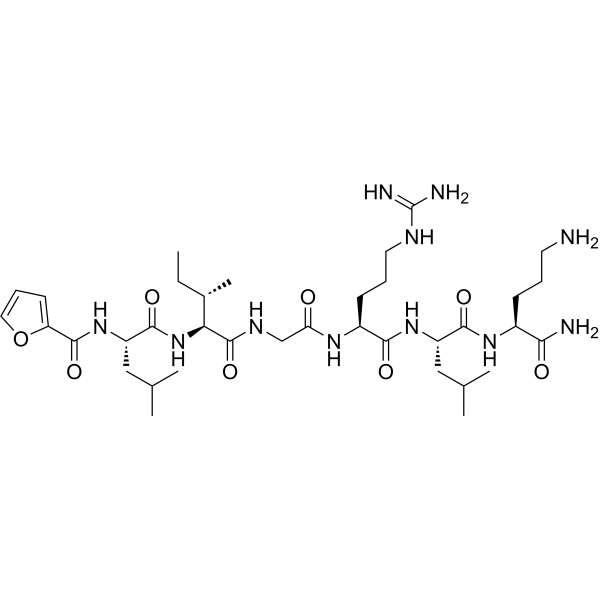
Physicochemical Properties
| Molecular Formula | C36H63N11O8 |
| Molecular Weight | 777.95 |
| Exact Mass | 777.486 |
| CAS # | 729589-58-6 |
| Related CAS # | 2-Furoyl-LIGRLO-amide TFA;2468029-34-5 |
| PubChem CID | 10395438 |
| Appearance | White to off-white solid powder |
| Density | 1.3±0.1 g/cm3 |
| Index of Refraction | 1.605 |
| LogP | 1.17 |
| Hydrogen Bond Donor Count | 10 |
| Hydrogen Bond Acceptor Count | 10 |
| Rotatable Bond Count | 26 |
| Heavy Atom Count | 55 |
| Complexity | 1310 |
| Defined Atom Stereocenter Count | 6 |
| SMILES | CC[C@H](C)[C@@H](C(=O)NCC(=O)N[C@@H](CCCN=C(N)N)C(=O)N[C@@H](CC(C)C)C(=O)N[C@@H](CCCN)C(=O)N)NC(=O)[C@H](CC(C)C)NC(=O)C1=CC=CO1 |
| InChi Key | OSKIRYSKGDEIOG-WTWMNNMUSA-N |
| InChi Code | InChI=1S/C36H63N11O8/c1-7-22(6)29(47-33(52)26(18-21(4)5)46-34(53)27-13-10-16-55-27)35(54)42-19-28(48)43-24(12-9-15-41-36(39)40)31(50)45-25(17-20(2)3)32(51)44-23(30(38)49)11-8-14-37/h10,13,16,20-26,29H,7-9,11-12,14-15,17-19,37H2,1-6H3,(H2,38,49)(H,42,54)(H,43,48)(H,44,51)(H,45,50)(H,46,53)(H,47,52)(H4,39,40,41)/t22-,23-,24-,25-,26-,29-/m0/s1 |
| Chemical Name | N-[(2S)-1-[[(2S,3S)-1-[[2-[[(2S)-5-(diaminomethylideneamino)-1-[[(2S)-1-[[(2S)-1,5-diamino-1-oxopentan-2-yl]amino]-4-methyl-1-oxopentan-2-yl]amino]-1-oxopentan-2-yl]amino]-2-oxoethyl]amino]-3-methyl-1-oxopentan-2-yl]amino]-4-methyl-1-oxopentan-2-yl]furan-2-carboxamide |
| HS Tariff Code | 2934.99.9001 |
| Storage |
Powder-20°C 3 years 4°C 2 years In solvent -80°C 6 months -20°C 1 month Note: Please store this product in a sealed and protected environment, avoid exposure to moisture. |
| Shipping Condition | Room temperature (This product is stable at ambient temperature for a few days during ordinary shipping and time spent in Customs) |
Biological Activity
| Targets | PAR2 |
| ln Vitro | In cultured human and rat cells, 2-Furoyl-LIGRLO-amide (2-Furoyl-LIGRLO-NH2) enhances PAR2-expressing cells [1]. Two to three hundred times more potent than SLIGRL-NH2 is 2-Furoyl-LIGRLO-amide (2-Furoyl-LIGRLO-NH2) in bioassays of tissue PAR2 activity, as determined by arterial vasodilation and hyperpolarization. 2-Furoyl-LIGRLO-amide does not significantly cause non-PAR2-mediated contraction of mouse femoral arteries, in contrast to trans-cinnamoyl-LIGRLO-NH2 [1]. |
| ln Vivo | When given intradermally in the nape of the neck at a dose of 10 μg prior to the reaction, Furoyl-LIGRLO-amide (but not histamine) causes less scratches in Trpv3-/-mice. However, it dramatically decreased the quantity of scratches in WT mice[1]. |
| Animal Protocol |
Animal/Disease Models: Adult male (2/3-month-old) Trpv3-/- and WT mice[3] Doses: 10 μg Route of Administration: Injected intradermally at the nape of the neck Experimental Results: Was involved in PAR2- induced acute itch. |
| References |
[1]. 2-furoyl-LIGRLO-amide: a potent and selective proteinase-activated receptor 2 agonist. J Pharmacol Exp Ther. 2004 Jun;309(3):1124-31. [2]. An antagonist of human protease activated receptor-2 attenuates PAR2 signaling, macrophage activation, mast cell degranulation, and collagen-induced arthritis in rats. FASEB J. 2012 Jul;26(7):2877-87. [3]. PAR2 Mediates Itch via TRPV3 Signaling in Keratinocytes. J Invest Dermatol. |
Solubility Data
| Solubility (In Vitro) | H2O: 50 mg/mL (64.27 mM) |
| Solubility (In Vivo) |
Solubility in Formulation 1: 50 mg/mL (64.27 mM) in PBS (add these co-solvents sequentially from left to right, and one by one), clear solution; with sonication. (Please use freshly prepared in vivo formulations for optimal results.) |
| Preparing Stock Solutions | 1 mg | 5 mg | 10 mg | |
| 1 mM | 1.2854 mL | 6.4271 mL | 12.8543 mL | |
| 5 mM | 0.2571 mL | 1.2854 mL | 2.5709 mL | |
| 10 mM | 0.1285 mL | 0.6427 mL | 1.2854 mL |