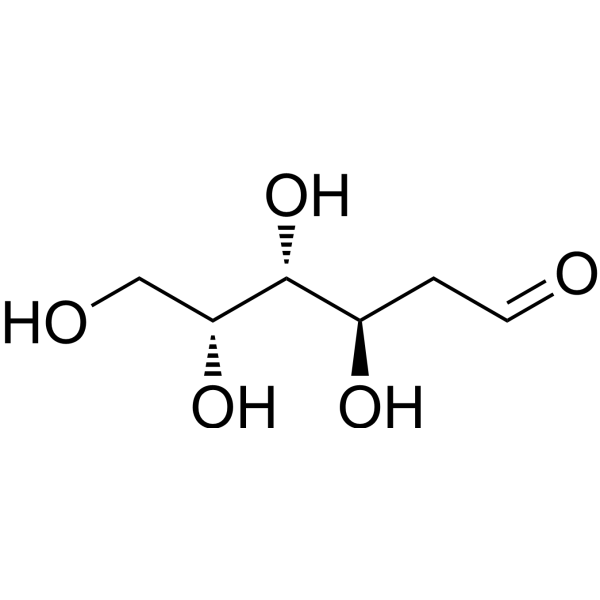
Physicochemical Properties
| Molecular Formula | C6H12O5 |
| Molecular Weight | 164.16 |
| Exact Mass | 164.068 |
| CAS # | 1949-89-9 |
| PubChem CID | 102191 |
| Appearance | Off-white to light yellow solid powder |
| Density | 1.4±0.1 g/cm3 |
| Boiling Point | 456.7±45.0 °C at 760 mmHg |
| Melting Point | 107-110 °C(lit.) |
| Flash Point | 244.1±25.2 °C |
| Vapour Pressure | 0.0±2.5 mmHg at 25°C |
| Index of Refraction | 1.534 |
| LogP | -3.07 |
| Hydrogen Bond Donor Count | 4 |
| Hydrogen Bond Acceptor Count | 5 |
| Rotatable Bond Count | 5 |
| Heavy Atom Count | 11 |
| Complexity | 116 |
| Defined Atom Stereocenter Count | 3 |
| SMILES | O([H])[C@@]([H])([C@@]([H])(C([H])([H])O[H])O[H])[C@@]([H])(C([H])([H])C([H])=O)O[H] |
| InChi Key | VRYALKFFQXWPIH-UHFFFAOYSA-N |
| InChi Code | InChI=1S/C6H12O5/c7-2-1-4(9)6(11)5(10)3-8/h2,4-6,8-11H,1,3H2 |
| Chemical Name | 3,4,5,6-tetrahydroxyhexanal |
| HS Tariff Code | 2934.99.9001 |
| Storage |
Powder-20°C 3 years 4°C 2 years In solvent -80°C 6 months -20°C 1 month Note: This product requires protection from light (avoid light exposure) during transportation and storage. |
| Shipping Condition | Room temperature (This product is stable at ambient temperature for a few days during ordinary shipping and time spent in Customs) |
Biological Activity
| ln Vitro | In ascites hepatoma cells, 2-Deoxy-D-galactose (1 mM/L; 5 h) is phosphorylated rapidly during the first 30 min and then drops to around 20% of this rate throughout the following hours[4]. |
| ln Vivo | 2-Deoxy-D-galactose (380 mg/kg; intraperitoneally; six times) significantly reduces the amounts of UDP galactose, UMP, and UDPG in rat livers[1]. 2-Deoxy-D-galactose (2–8 μM; intracerebroventricular injection; once) exhibits PAR impairment 15 minutes after do-gal administration and 30 minutes before to the acquisition trial at a dose of 4 μM[3]. |
| Animal Protocol |
Animal/Disease Models: Male adult Wistar rats with passive avoidance response (PAR) acquisition trial[3] ] Doses: 2, 4 and 8 μM Route of Administration: Intracerebroventricular injection; 2-8 μM; once Experimental Results: demonstrated PAR disruption at a dose of 4 μM. |
| ADME/Pharmacokinetics |
Absorption, Distribution and Excretion WHEN THE RENAL EXCRETION OF 2-DEOXYGLUCOSE WAS STUDIED IN DOGS AND RATS BY CONVENTIONAL CLEARANCE AND STOP-FLOW TECHNIQUES, IT WAS REABSORBED BY THE RENAL TUBULES AT AN AVG OF 68-89% OF THE FILTERED LOADS AND THE REABSORPTION SITE WAS IN THE PROXIMAL TUBULES. Metabolism / Metabolites 2-DEOXY-D-GLUCOSE WAS CONVERTED TO THE 6-PHOSPHATE IN MOUSE TESTIS AND LIVER AFTER IP INJECTION OF 50 MG/KG BODY WT DAILY FOR 7 DAYS. |
| Toxicity/Toxicokinetics |
Interactions 2-DEOXYGLUCOSE INJECTED INTRAPERITONEALLY IN RATS IN LARGE DOSES CAUSED CHANGES IN THE ELECTRORETINOGRAM CONSISTING OF A DECR IN BOTH ALPHA- AND BETA-WAVES. THE EFFECT WAS ANTAGONIZED BY D-GLUCOSE. SIMULTANEOUS ADMIN OF GLUCOSE @ DOSE EXCEEDING ITS MAX TUBULAR TRANSPORT CAPACITY INHIBITED TUBULAR REABSORPTION OF 2-DEOXYGLUCOSE. THUS, THE PROCESS OF TUBULAR REABSORPTION IS PROBABLY THE SAME AS THAT FOR GLUCOSE. IN ANESTROUS SHEEP, 2-DEOXYGLUCOSE INFUSION INHIBITED LH RELEASE INDUCED BY ESTRADIOL BUT NOT BY LH-RH. 2-DEOXY-D-GLUCOSE INHIBITED REPAIR OF POTENTIALLY LETHAL DAMAGE INDUCED BY X-RAYS IN MOUSE EHRLICH ASCITES TUMOR CELLS. For more Interactions (Complete) data for 2-DEOXY-D-GLUCOSE (6 total), please visit the HSDB record page. |
| References |
[1]. Keppler DO, et al. The trapping of uridine phosphates by D-galactosamine. D-glucosamine, and 2-deoxy-D-galactose. A study on the mechanism of galactosamine hepatitis. Eur J Biochem. 1970 Dec;17(2):246-53. [2]. Krug M, et al. The amnesic substance 2-deoxy-D-galactose suppresses the maintenance of hippocampal LTP. Brain Res. 1991 Feb 1;540(1-2):237-42. [3]. Lorenzini CG, et al. 2-Deoxy-D-galactose effects on passive avoidance memorization in the rat. Neurobiol Learn Mem. 1997 Nov;68(3):317-24. [4]. Smith DF, Keppler DO. 2-Deoxy-D-galactose metabolism in ascites hepatoma cells results in phosphate trapping and glycolysis inhibition. Eur J Biochem. 1977 Feb 15;73(1):83-92. |
| Additional Infomation |
2-deoxy-D-galactose is a deoxygalactose. It is functionally related to an aldehydo-D-galactose and a D-galactose. 2-Deoxy-D-glucose is a non-metabolizable glucose analog in which the hydroxyl group at position 2 of glucose is replaced by hydrogen, with potential glycolysis inhibiting and antineoplastic activities. Although the exact mechanism of action has yet to be fully elucidated, upon administration of 2-deoxy-D-glucose (2-DG), this agent competes with glucose for uptake by proliferating cells, such as tumor cells. 2-DG inhibits the first step of glycolysis and therefore prevents cellular energy production, which may result in decreased tumor cell proliferation. See also: 2-Deoxy-lyxo-hexose (annotation moved to). Therapeutic Uses Antimetabolites; Antiviral Agents MEDICATION (VET): TOPICAL TREATMENT OF HERPES GENITALIS IN FEMALE GUINEA PIGS WITH 2-DEOXY-D-GLUCOSE IN EITHER AGAROSE GELS OR MICONAZOLE NITRATE OINTMENT FAILED TO PREVENT DEVELOPMENT OF GENITAL LESIONS OR TO REDUCE THE MEAN TITERS OF RECOVERABLE VIRUS IN VAGINAL SWABS FROM INFECTED ANIMALS. |
Solubility Data
| Solubility (In Vitro) |
H2O: 250 mg/mL (1522.90 mM) Methanol: 125 mg/mL (761.45 mM) |
| Solubility (In Vivo) |
Note: Listed below are some common formulations that may be used to formulate products with low water solubility (e.g. < 1 mg/mL), you may test these formulations using a minute amount of products to avoid loss of samples. Injection Formulations (e.g. IP/IV/IM/SC) Injection Formulation 1: DMSO : Tween 80: Saline = 10 : 5 : 85 (i.e. 100 μL DMSO stock solution → 50 μL Tween 80 → 850 μL Saline) *Preparation of saline: Dissolve 0.9 g of sodium chloride in 100 mL ddH ₂ O to obtain a clear solution. Injection Formulation 2: DMSO : PEG300 :Tween 80 : Saline = 10 : 40 : 5 : 45 (i.e. 100 μL DMSO → 400 μLPEG300 → 50 μL Tween 80 → 450 μL Saline) Injection Formulation 3: DMSO : Corn oil = 10 : 90 (i.e. 100 μL DMSO → 900 μL Corn oil) Example: Take the Injection Formulation 3 (DMSO : Corn oil = 10 : 90) as an example, if 1 mL of 2.5 mg/mL working solution is to be prepared, you can take 100 μL 25 mg/mL DMSO stock solution and add to 900 μL corn oil, mix well to obtain a clear or suspension solution (2.5 mg/mL, ready for use in animals). Injection Formulation 4: DMSO : 20% SBE-β-CD in saline = 10 : 90 [i.e. 100 μL DMSO → 900 μL (20% SBE-β-CD in saline)] *Preparation of 20% SBE-β-CD in Saline (4°C,1 week): Dissolve 2 g SBE-β-CD in 10 mL saline to obtain a clear solution. Injection Formulation 5: 2-Hydroxypropyl-β-cyclodextrin : Saline = 50 : 50 (i.e. 500 μL 2-Hydroxypropyl-β-cyclodextrin → 500 μL Saline) Injection Formulation 6: DMSO : PEG300 : castor oil : Saline = 5 : 10 : 20 : 65 (i.e. 50 μL DMSO → 100 μLPEG300 → 200 μL castor oil → 650 μL Saline) Injection Formulation 7: Ethanol : Cremophor : Saline = 10: 10 : 80 (i.e. 100 μL Ethanol → 100 μL Cremophor → 800 μL Saline) Injection Formulation 8: Dissolve in Cremophor/Ethanol (50 : 50), then diluted by Saline Injection Formulation 9: EtOH : Corn oil = 10 : 90 (i.e. 100 μL EtOH → 900 μL Corn oil) Injection Formulation 10: EtOH : PEG300:Tween 80 : Saline = 10 : 40 : 5 : 45 (i.e. 100 μL EtOH → 400 μLPEG300 → 50 μL Tween 80 → 450 μL Saline) Oral Formulations Oral Formulation 1: Suspend in 0.5% CMC Na (carboxymethylcellulose sodium) Oral Formulation 2: Suspend in 0.5% Carboxymethyl cellulose Example: Take the Oral Formulation 1 (Suspend in 0.5% CMC Na) as an example, if 100 mL of 2.5 mg/mL working solution is to be prepared, you can first prepare 0.5% CMC Na solution by measuring 0.5 g CMC Na and dissolve it in 100 mL ddH2O to obtain a clear solution; then add 250 mg of the product to 100 mL 0.5% CMC Na solution, to make the suspension solution (2.5 mg/mL, ready for use in animals). Oral Formulation 3: Dissolved in PEG400 Oral Formulation 4: Suspend in 0.2% Carboxymethyl cellulose Oral Formulation 5: Dissolve in 0.25% Tween 80 and 0.5% Carboxymethyl cellulose Oral Formulation 6: Mixing with food powders Note: Please be aware that the above formulations are for reference only. InvivoChem strongly recommends customers to read literature methods/protocols carefully before determining which formulation you should use for in vivo studies, as different compounds have different solubility properties and have to be formulated differently. (Please use freshly prepared in vivo formulations for optimal results.) |
| Preparing Stock Solutions | 1 mg | 5 mg | 10 mg | |
| 1 mM | 6.0916 mL | 30.4581 mL | 60.9162 mL | |
| 5 mM | 1.2183 mL | 6.0916 mL | 12.1832 mL | |
| 10 mM | 0.6092 mL | 3.0458 mL | 6.0916 mL |