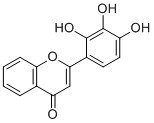
2-D08, a synthetic flavone, is a cell permeable inhibitor of protein sumoylation that has a unique mechanism of action. It is also inhibits Axl, IRAK4, ROS1, MLK4, GSK3β, RET, KDR and PI3Kα with IC50 values of 0.49, 3.9, 5.3, 9.8, 11, 11, 17 and 35 nM respectively in biochemical assays. Protein sumoylation is a dynamic posttranslational modification involved in diverse biological processes during cellular homeostasis and development. Sumoylation has been shown to play a critical role in cancer. 2-D08 showed anti-aggregatory and neuroprotective effect and may be used for the treatment of related diseases.
Physicochemical Properties
| Molecular Formula | C15H10O5 | |
| Molecular Weight | 270.24 | |
| Exact Mass | 270.052 | |
| Elemental Analysis | C, 66.67; H, 3.73; O, 29.60 | |
| CAS # | 144707-18-6 | |
| Related CAS # |
|
|
| PubChem CID | 22507438 | |
| Appearance | Light yellow to yellow solid powder | |
| Density | 1.5±0.1 g/cm3 | |
| Boiling Point | 517.9±50.0 °C at 760 mmHg | |
| Flash Point | 201.7±23.6 °C | |
| Vapour Pressure | 0.0±1.4 mmHg at 25°C | |
| Index of Refraction | 1.732 | |
| LogP | 2.77 | |
| Hydrogen Bond Donor Count | 3 | |
| Hydrogen Bond Acceptor Count | 5 | |
| Rotatable Bond Count | 1 | |
| Heavy Atom Count | 20 | |
| Complexity | 419 | |
| Defined Atom Stereocenter Count | 0 | |
| SMILES | C1=CC2C(C=C(C3=C(O)C(O)=C(O)C=C3)OC=2C=C1)=O |
|
| InChi Key | JJAXTFSPCLZPIW-UHFFFAOYSA-N | |
| InChi Code | InChI=1S/C15H10O5/c16-10-6-5-9(14(18)15(10)19)13-7-11(17)8-3-1-2-4-12(8)20-13/h1-7,16,18-19H | |
| Chemical Name | 2-(2,3,4-trihydroxyphenyl)-4H-1-benzopyran-4-one | |
| Synonyms | 2-D08; 2D08; 2 D08. | |
| HS Tariff Code | 2934.99.9001 | |
| Storage |
Powder-20°C 3 years 4°C 2 years In solvent -80°C 6 months -20°C 1 month Note: This product requires protection from light (avoid light exposure) during transportation and storage. |
|
| Shipping Condition | Room temperature (This product is stable at ambient temperature for a few days during ordinary shipping and time spent in Customs) |
Biological Activity
| Targets |
Axl(IC50= 0.49 nM)
Protein sumoylation [1] - Gephyrin SUMOylation [2] |
| ln Vitro |
2-D08, a synthetic flavone, is a cell permeable inhibitor of protein sumoylation that has a unique mechanism of action. It is also inhibits Axl, IRAK4, ROS1, MLK4, GSK3β, RET, KDR and PI3Kα with IC50 values of 0.49, 3.9, 5.3, 9.8, 11, 11, 17 and 35 nM respectively in biochemical assays. Protein sumoylation is a dynamic posttranslational modification involved in diverse biological processes during cellular homeostasis and development. Sumoylation has been shown to play a critical role in cancer. 2-D08 showed anti-aggregatory and neuroprotective effect and may be used for the treatment of related diseases. 2-D08 was identified as a cell-permeable and mechanistically unique inhibitor of protein sumoylation. In an endpoint biochemical assay, 2-D08 inhibited the sumoylation process when incubated with SUMO1, E1, E2 enzymes, a fluorescent substrate, and ATP in an appropriate buffer (reaction quenched with EDTA after 90 min), and the conversion was quantified by ratiometric peak height in a microfluidic electrophoretic mobility shift assay. In kinetic biochemical sumoylation assays, 2-D08 also showed inhibitory activity when incubated with the same components and monitored over 110 minutes, with conversion quantified using the same method [1] - In primary hippocampal neurons, treatment with 2-D08 affected the acetylation of gephyrin. A proximity ligation assay (PLA) showed that when SUMO conjugation on gephyrin was blocked by 2-D08, the acetylation of gephyrin (detected by PLA signal for Ac-Lys) was significantly reduced compared to the control group [2] |
| ln Vivo |
In vivo injection of SUMO inhibitor 2-D08 into α2−/− and morphology analysis for gephyrin cluster colocalization with γ2 GABAARs; (right panel) quantification shows significant increase in gephyrin clustering along with γ2 GABAAR on the ipsi- compared with the contra-lateral hemisphere. Injection of SUMO pathway inhibitor 2-D08 (30 μM) or saline into α2−/− mice (n=3) on one hemisphere near the hippocampal area. Twenty-four hours after injection, we analysed for gephyrin and γ2 GABAAR clusters in both ipsi- and contralateral hemispheres. One could see inflammation using antibody against CD68, a marker for microglia, near the lesion caused by the 2-D08 injection, but not saline. In Gabra2-null (α2⁻/⁻) mice, which lack gephyrin clusters in CA1 or neocortical neurons, in vivo injection of the SUMO inhibitor 2-D08 rescued gephyrin clustering. Morphological analysis showed a significant increase in gephyrin clustering colocalized with γ2 GABAₐ Rs on the ipsilateral hemisphere compared to the contralateral hemisphere [2] |
| Enzyme Assay |
2-D08 is a cell permeable, mechanistically unique inhibitor of protein sumoylation. It is also inhibits Axl, IRAK4, ROS1, MLK4, GSK3β, RET, KDR and PI3Kα with IC50 values of 0.49, 3.9, 5.3, 9.8, 11, 11, 17 and 35 nM respectively in biochemical assays. IC50 values of the Axl kinase inhibitor (2D08) are determined using kinase-mediated phosphorylation of poly-GAT by AlphaScreen luminescence detection technology. The inhibitor is tested at eight points of dilution in duplicate. Endpoint biochemical sumoylation assay: First, prepare a reaction mixture containing SUMO1, E1 enzyme, E2 enzyme, a fluorescent substrate, and ATP in an appropriate buffer. Add different concentrations of 2-D08 (or control compounds) to the reaction mixture and incubate the mixture for 90 minutes. After incubation, add EDTA to quench the reaction. Then, use a microfluidic electrophoretic mobility shift assay with a Perkin Elmer EZ Reader II to quantify the conversion of the fluorescent substrate by measuring the ratiometric peak height, so as to evaluate the inhibitory activity of 2-D08 on the sumoylation enzyme system [1] - Kinetic biochemical sumoylation assay: Prepare the same reaction mixture as in the endpoint assay (including SUMO1, E1, E2, fluorescent substrate, ATP, and 2-D08) in an appropriate buffer. Instead of quenching the reaction after a fixed time, monitor the reaction continuously over the course of 110 minutes. At different time points, use the microfluidic electrophoretic mobility shift assay (Perkin Elmer EZ Reader II) to measure the ratiometric peak height and quantify the substrate conversion dynamically, so as to analyze the time-dependent inhibitory effect of 2-D08 on sumoylation [1] |
| Cell Assay |
Human lung multi-potent cells at passage 5 are plated at a density of 250 000 cells per well in six-well plates with growth medium. After 24 h, multi-potent cells are incubated with DMEM+0.5% BSA+penicillin/streptomycin containing 0.1% DMSO (vehicle) or 2D08 (0.1, 1, 10 μM) for 3 h in a humidified 5% CO2 incubator at 37℃. These cells are trypsinized and seeded at 20 000 cells per well in three replicates on 12-well cell culture transwell inserts with 8 μm pore size with DMEM+0.5% BSA+penicillin/streptomycin. Lower transwell chambers contained DMEM+10% FBS+penicillin/streptomycin are used to allow cells to migrate. 0.1% DMSO or 2D08 is added to corresponding upper and lower transwell chambers. After 16 h, non-migrated cells are removed by cotton swabs. Migrated cells are fixed with 4% PFA, permeabilized with methanol and stained with crystal violet. The field-images per transwell are taken by an inverted light microscope. Proximity ligation assay (PLA) for gephyrin acetylation in neurons: Culture primary hippocampal neurons (at the appropriate developmental stage, e.g., DIV 8+7 as referenced in other experiments of the same study). Treat the neurons with 2-D08 (concentration not specified in the literature) to block SUMO conjugation on gephyrin. For control groups, use neurons without 2-D08 treatment or with other relevant treatments (e.g., ERK1/2 inhibitor PD98059). After treatment, fix the neurons and perform PLA using antibodies specific for gephyrin and Ac-Lys (acetyl-lysine). Observe and image the PLA signals using a fluorescence microscope. Quantify the PLA signals (e.g., number of signal spots per cell or per synaptic region) to compare the acetylation level of gephyrin between the 2-D08-treated group and control groups [2] |
| Animal Protocol |
Dissolved in 30 μM (10 μl); injected on one hemisphere near the hippocampal area α2 / mice (8 to 10 weeks old) In vivo rescue experiment of gephyrin clustering in α2⁻/⁻ mice: Use Gabra2-null (α2⁻/⁻) mice as the experimental model (number of mice: n=3 for mRNA and protein expression analysis, n=5 for in utero electroporation experiments; gender not specified). Prepare 2-D08 (formulation not specified in the literature) and inject it into one hemisphere (ipsilateral hemisphere) of the mice; the contralateral hemisphere serves as the internal control without 2-D08 injection (or with vehicle injection, not specified). After injection (time interval between injection and analysis not specified), sacrifice the mice and dissect the brain tissues. Prepare brain sections and perform immunofluorescence staining using antibodies against gephyrin and γ2 GABAₐ Rs. Use a fluorescence microscope to image the sections and analyze the colocalization of gephyrin clusters with γ2 GABAₐ Rs. Quantify the number or size of gephyrin clusters in the ipsilateral and contralateral hemispheres to evaluate the rescue effect of 2-D08 [2] |
| References |
[1]. Bioorg Med Chem Lett.2014 Feb 15;24(4):1094-7 [2]. Nat Commun.2016 Nov 7;7:13365 [3]. Lab Invest.2017 Sep;97(9):1047-1062. |
| Additional Infomation |
2-D08 (chemical name: 2',3',4'-trihydroxyflavone) was initially found as a contaminant in a screening well from a commercial supplier, which was likely generated by an unanticipated Wessely-Moser rearrangement during the deprotection step of methyl ether under vigorous conditions. An efficient synthesis method for 2-D08 and its structurally related but inactive isomer was developed in the study [1] - Protein sumoylation is a dynamic posttranslational modification involved in diverse biological processes during cellular homeostasis and development, and it plays a critical role in cancer. However, there were few small molecule probes available to inhibit enzymes involved in the SUMO conjugation process before the identification of 2-D08 [1] - The crosstalk between SUMOylation, acetylation, and phosphorylation pathways regulates gephyrin scaffolding at GABAergic synapses. 2-D08, as a SUMO inhibitor, blocks gephyrin SUMOylation, which further affects gephyrin acetylation and ultimately rescues gephyrin clustering in α2⁻/⁻ mice, indicating that 2-D08 acts as a tool compound to study the role of SUMOylation in gephyrin scaffolding and GABAergic transmission [2] |
Solubility Data
| Solubility (In Vitro) | DMSO : 54~150 mg/mL ( 199.82~555.06 mM ) |
| Solubility (In Vivo) |
Solubility in Formulation 1: ≥ 2.5 mg/mL (9.25 mM) (saturation unknown) in 10% DMSO + 40% PEG300 + 5% Tween80 + 45% Saline (add these co-solvents sequentially from left to right, and one by one), clear solution. For example, if 1 mL of working solution is to be prepared, you can add 100 μL of 25.0 mg/mL clear DMSO stock solution to 400 μL PEG300 and mix evenly; then add 50 μL Tween-80 to the above solution and mix evenly; then add 450 μL normal saline to adjust the volume to 1 mL. Preparation of saline: Dissolve 0.9 g of sodium chloride in 100 mL ddH₂ O to obtain a clear solution. Solubility in Formulation 2: ≥ 2.5 mg/mL (9.25 mM) (saturation unknown) in 10% DMSO + 90% (20% SBE-β-CD in Saline) (add these co-solvents sequentially from left to right, and one by one), clear solution. For example, if 1 mL of working solution is to be prepared, you can add 100 μL of 25.0 mg/mL clear DMSO stock solution to 900 μL of 20% SBE-β-CD physiological saline solution and mix evenly. Preparation of 20% SBE-β-CD in Saline (4°C,1 week): Dissolve 2 g SBE-β-CD in 10 mL saline to obtain a clear solution. Solubility in Formulation 3: ≥ 2.5 mg/mL (9.25 mM) (saturation unknown) in 10% DMSO + 90% Corn Oil (add these co-solvents sequentially from left to right, and one by one), clear solution. For example, if 1 mL of working solution is to be prepared, you can add 100 μL of 25.0 mg/mL clear DMSO stock solution to 900 μL of corn oil and mix evenly. (Please use freshly prepared in vivo formulations for optimal results.) |
| Preparing Stock Solutions | 1 mg | 5 mg | 10 mg | |
| 1 mM | 3.7004 mL | 18.5021 mL | 37.0041 mL | |
| 5 mM | 0.7401 mL | 3.7004 mL | 7.4008 mL | |
| 10 mM | 0.3700 mL | 1.8502 mL | 3.7004 mL |