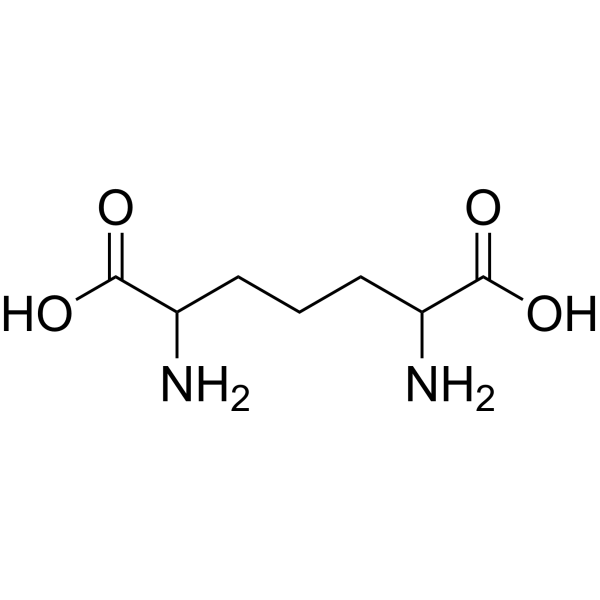
Physicochemical Properties
| Molecular Formula | C7H14N2O4 |
| Molecular Weight | 190.20 |
| Exact Mass | 190.095 |
| CAS # | 583-93-7 |
| PubChem CID | 865 |
| Appearance | White to off-white solid powder |
| Density | 1.3±0.1 g/cm3 |
| Boiling Point | 426.7±45.0 °C at 760 mmHg |
| Melting Point | ~295 °C (dec.)(lit.) |
| Flash Point | 211.8±28.7 °C |
| Vapour Pressure | 0.0±2.2 mmHg at 25°C |
| Index of Refraction | 1.543 |
| LogP | -1.58 |
| Hydrogen Bond Donor Count | 4 |
| Hydrogen Bond Acceptor Count | 6 |
| Rotatable Bond Count | 6 |
| Heavy Atom Count | 13 |
| Complexity | 175 |
| Defined Atom Stereocenter Count | 0 |
| InChi Key | GMKMEZVLHJARHF-UHFFFAOYSA-N |
| InChi Code | InChI=1S/C7H14N2O4/c8-4(6(10)11)2-1-3-5(9)7(12)13/h4-5H,1-3,8-9H2,(H,10,11)(H,12,13) |
| Chemical Name | 2,6-diaminoheptanedioic acid |
| HS Tariff Code | 2934.99.9001 |
| Storage |
Powder-20°C 3 years 4°C 2 years In solvent -80°C 6 months -20°C 1 month |
| Shipping Condition | Room temperature (This product is stable at ambient temperature for a few days during ordinary shipping and time spent in Customs) |
Biological Activity
| Targets | Human Endogenous Metabolite |
| Additional Infomation |
2,6-diaminopimelic acid is the amino dicarboxylic acid that is heptanedioic acid with amino substituents at C-2 and C-6. It has a role as an Escherichia coli metabolite. It is an amino dicarboxylic acid and a dicarboxylic fatty acid. It is functionally related to a pimelic acid. It is a conjugate acid of a 2,6-diaminopimelate(2-). Diaminopimelic acid is a metabolite found in or produced by Escherichia coli (strain K12, MG1655). Diaminopimelate has been reported in Glycine max, Salmonella enterica, and Phaseolus vulgaris with data available. A diamino derivative of heptanedioic acid with amino groups at C-2 and C-6 and the general formula (COOH)CH(NH2)CH2CH2CH2CH(NH2)(COOH). |
Solubility Data
| Solubility (In Vitro) | H2O: 10.42 mg/mL (54.78 mM) |
| Solubility (In Vivo) |
Solubility in Formulation 1: 6.67 mg/mL (35.07 mM) in PBS (add these co-solvents sequentially from left to right, and one by one), clear solution; with sonication (<60°C). (Please use freshly prepared in vivo formulations for optimal results.) |
| Preparing Stock Solutions | 1 mg | 5 mg | 10 mg | |
| 1 mM | 5.2576 mL | 26.2881 mL | 52.5762 mL | |
| 5 mM | 1.0515 mL | 5.2576 mL | 10.5152 mL | |
| 10 mM | 0.5258 mL | 2.6288 mL | 5.2576 mL |