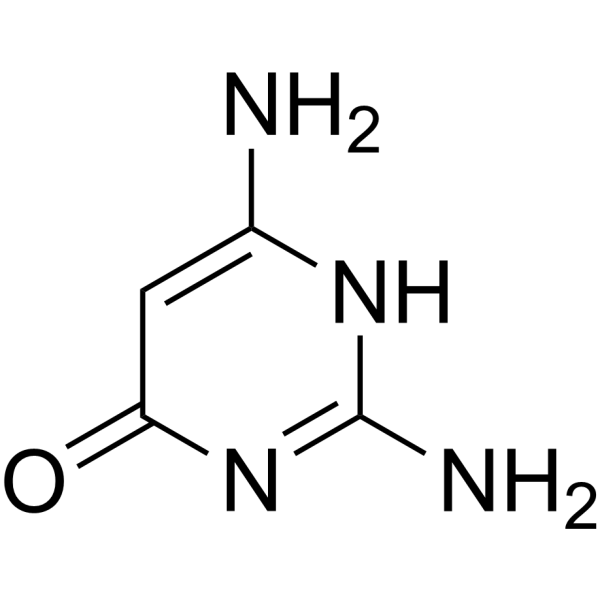
Physicochemical Properties
| Molecular Formula | C4H6N4O |
| Molecular Weight | 126.1166 |
| Exact Mass | 126.054 |
| CAS # | 56-06-4 |
| Related CAS # | 58470-85-2 (sulfate) |
| PubChem CID | 135408763 |
| Appearance | Off-white to light yellow solid powder |
| Density | 1.6±0.1 g/cm3 |
| Boiling Point | 524.0±53.0 °C at 760 mmHg |
| Melting Point | 285-286 °C (dec.)(lit.) |
| Flash Point | 270.7±30.9 °C |
| Vapour Pressure | 0.0±1.4 mmHg at 25°C |
| Index of Refraction | 1.770 |
| LogP | -1.29 |
| Hydrogen Bond Donor Count | 3 |
| Hydrogen Bond Acceptor Count | 3 |
| Rotatable Bond Count | 0 |
| Heavy Atom Count | 9 |
| Complexity | 205 |
| Defined Atom Stereocenter Count | 0 |
| InChi Key | SWELIMKTDYHAOY-UHFFFAOYSA-N |
| InChi Code | InChI=1S/C4H6N4O/c5-2-1-3(9)8-4(6)7-2/h1H,(H5,5,6,7,8,9) |
| Chemical Name | 2,4-diamino-1H-pyrimidin-6-one |
| HS Tariff Code | 2934.99.9001 |
| Storage |
Powder-20°C 3 years 4°C 2 years In solvent -80°C 6 months -20°C 1 month Note: This product requires protection from light (avoid light exposure) during transportation and storage. |
| Shipping Condition | Room temperature (This product is stable at ambient temperature for a few days during ordinary shipping and time spent in Customs) |
Biological Activity
| Targets |
- 2,4-Diamino-6-hydroxypyrimidine acts as an inhibitor of GTP cyclohydrolase I [1] |
| ln Vitro |
In response to food consumption, 2,4-Diamino-6-hydroxypyrimidine (DAHP) shows decreased generation of NO in chicken peritoneal macrophages (PEC) and the avian MC29 virus-transformed macrophage cell line HD11 [1]. In HUVEC cells, treatment with 2,4-Diamino-6-hydroxypyrimidine (DAHP; 5 mM; 24 h) dramatically lowered the amounts of BH4 and VCAM-1. 2,4-Diamino-6-hydroxypyrimidine (DAHP) was initially discovered as a biopterin framework for collagenous animal Crithidia fascicuLate growth stent[2]. It did this, at least in part, by suppressing NF-κB levels in HUVEC nuclei. - Treatment with 2,4-Diamino-6-hydroxypyrimidine suppressed nitric oxide production by chicken macrophages [1] - 2,4-Diamino-6-hydroxypyrimidine (DAHP) inhibited cytokine-induced VCAM-1 expression on the cell surface of human umbilical vein endothelial cells, and this effect was independent of BH(4) [2] |
| ln Vivo |
Serotonin levels in the duodenum and blood vessels of mice treated with 2,4-diamino-6-hydroxypyrimidine (DAHP) at a dose of 3 g/kg/day for 4 days were roughly 46% and 40% of control levels, respectively. All organs tested, with the exception of the brain, showed a sharp decline in BH4 levels (T1/2 less than 12 hours) in response to 2,4-Diamino-6-hydroxypyrimidine. The levels of BH4 restored to normal less than 24 hours after the injection of 2,4-diamino-6-hydroxypyrimidine was stopped [3]. - Administration of 2,4-Diamino-6-hydroxypyrimidine caused depletion of gastrointestinal serotonin in animals, which was associated with tetrahydrobiopterin deficiency [3] |
| References |
[1]. 2,4-Diamino-6-hydroxypyrimidine, an inhibitor of GTP cyclohydrolase I, suppresses nitric oxide production by chicken macrophages. Int J Immunopharmacol. 1994 Feb;16(2):101-8. [2]. 2,4-Diamino-6-hydroxypyrimidine (DAHP) suppresses cytokine-induced VCAM-1 expression on the cell surface of human umbilical vein endothelial cells in a BH(4)-independent manner. Biochim Biophys Acta. Jul-Aug 2008;1780(7-8):960-5. [3]. Gastrointestinal serotonin: depletion due to tetrahydrobiopterin deficiency induced by 2,4-diamino-6-hydroxypyrimidine administration. J Pharmacol Exp Ther. 1991 Feb;256(2):773-9. |
| Additional Infomation |
2,4-Diamino-6-hydroxypyrimidine is a hydroxypyrimidine. - 2,4-Diamino-6-hydroxypyrimidine-induced tetrahydrobiopterin deficiency is the mechanism underlying the depletion of gastrointestinal serotonin [3] |
Solubility Data
| Solubility (In Vitro) |
DMSO : ~16.67 mg/mL (~132.18 mM) H2O : ~10 mg/mL (~79.29 mM) |
| Solubility (In Vivo) |
Solubility in Formulation 1: ≥ 1.67 mg/mL (13.24 mM) (saturation unknown) in 10% DMSO + 40% PEG300 + 5% Tween80 + 45% Saline (add these co-solvents sequentially from left to right, and one by one), clear solution. For example, if 1 mL of working solution is to be prepared, you can add 100 μL of 16.7 mg/mL clear DMSO stock solution to 400 μL PEG300 and mix evenly; then add 50 μL Tween-80 to the above solution and mix evenly; then add 450 μL normal saline to adjust the volume to 1 mL. Preparation of saline: Dissolve 0.9 g of sodium chloride in 100 mL ddH₂ O to obtain a clear solution. Solubility in Formulation 2: ≥ 1.67 mg/mL (13.24 mM) (saturation unknown) in 10% DMSO + 90% (20% SBE-β-CD in Saline) (add these co-solvents sequentially from left to right, and one by one), clear solution. For example, if 1 mL of working solution is to be prepared, you can add 100 μL of 16.7 mg/mL clear DMSO stock solution to 900 μL of 20% SBE-β-CD physiological saline solution and mix evenly. Preparation of 20% SBE-β-CD in Saline (4°C,1 week): Dissolve 2 g SBE-β-CD in 10 mL saline to obtain a clear solution. Solubility in Formulation 3: ≥ 1.67 mg/mL (13.24 mM) (saturation unknown) in 10% DMSO + 90% Corn Oil (add these co-solvents sequentially from left to right, and one by one), clear solution. For example, if 1 mL of working solution is to be prepared, you can add 100 μL of 16.7 mg/mL clear DMSO stock solution to 900 μL of corn oil and mix evenly. Solubility in Formulation 4: 6.5 mg/mL (51.54 mM) in PBS (add these co-solvents sequentially from left to right, and one by one), clear solution; with ultrasonication. (Please use freshly prepared in vivo formulations for optimal results.) |
| Preparing Stock Solutions | 1 mg | 5 mg | 10 mg | |
| 1 mM | 7.9290 mL | 39.6448 mL | 79.2896 mL | |
| 5 mM | 1.5858 mL | 7.9290 mL | 15.8579 mL | |
| 10 mM | 0.7929 mL | 3.9645 mL | 7.9290 mL |