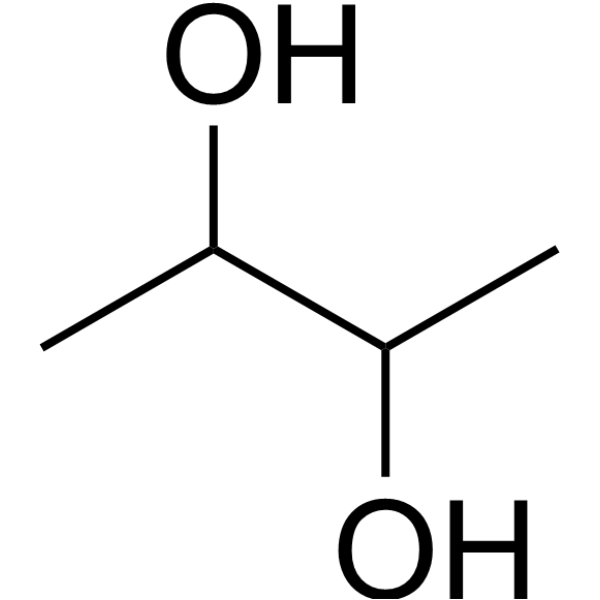
Physicochemical Properties
| Molecular Formula | C4H10O2 |
| Molecular Weight | 90.1210 |
| Exact Mass | 90.068 |
| CAS # | 513-85-9 |
| Related CAS # | 34439-75-3 |
| PubChem CID | 262 |
| Appearance | Colorless to light yellow liquid |
| Density | 1.0±0.1 g/cm3 |
| Boiling Point | 180.7±0.0 °C at 760 mmHg |
| Melting Point | 25 °C(lit.) |
| Flash Point | 85.0±0.0 °C |
| Vapour Pressure | 0.3±0.7 mmHg at 25°C |
| Index of Refraction | 1.435 |
| LogP | -0.99 |
| Hydrogen Bond Donor Count | 2 |
| Hydrogen Bond Acceptor Count | 2 |
| Rotatable Bond Count | 1 |
| Heavy Atom Count | 6 |
| Complexity | 30.5 |
| Defined Atom Stereocenter Count | 0 |
| SMILES | O([H])C([H])(C([H])([H])[H])C([H])(C([H])([H])[H])O[H] |
| InChi Key | OWBTYPJTUOEWEK-UHFFFAOYSA-N |
| InChi Code | InChI=1S/C4H10O2/c1-3(5)4(2)6/h3-6H,1-2H3 |
| Chemical Name | butane-2,3-diol |
| HS Tariff Code | 2934.99.9001 |
| Storage |
Powder-20°C 3 years 4°C 2 years In solvent -80°C 6 months -20°C 1 month |
| Shipping Condition | Room temperature (This product is stable at ambient temperature for a few days during ordinary shipping and time spent in Customs) |
Biological Activity
| ADME/Pharmacokinetics |
Absorption, Distribution and Excretion In a controlled experiment 15 (79%) of 19 severely alcoholic men but only 1 of 22 controls had a serum concentration of greater than or equal to 5 umol/l 2,3-butanediol after ingestion of distilled spirits. Metabolism / Metabolites 2-Butanol, 3-hydroxy-2-butanone, and 2,3-butanediol were identified as metabolies in the serum of guinea pigs injected ip with methyl ethyl ketone. ... Glucuronides of 2,3-butanediol /were found/ in the urine of rabbits equivalent to about 20% of the dose given. In a controlled experiment 15 (79%) of 19 severely alcoholic men but only 1 of 22 controls had a serum concentration of greater than or equal to 5 umol/L 2,3-butanediol after ingestion of distilled spirits. Another diol, 1,2-propanediol, was found in a concentration of greater than or equal to 5 umol/L in all patients' specimens after drinking; but it was also present in lower concentrations in the reference specimens of most of the patients. These data are consistent with the experimental evidence that ethanol can be metabolized in rats to produce 2,3-butanediol and with the epidemiological hypothesis that severely alcoholic men metabolize ethanol by a different pathway than do control subjects. Understanding the capacity of Paenibacillus polymyxa DSM 365 to tolerate increasing concentrations of 2,3-butanediol (2,3-BD) is critical to engineering a 2,3-BD-overproducing strain. Hence, we investigated the response of P. polymyxa to high 2,3-BD concentrations. In fed-batch cultures (6-L bioreactor) 2,3-BD was accumulated to a maximum concentration of 47 g/L despite the presence of residual 13 g/L glucose in the medium. Concomitantly, accumulation of acetoin, the precursor of 2,3-BD increased after maximum 2,3-BD concentration was reached, suggesting that 2,3-BD was reconverted to acetoin after the concentration tolerance threshold of 2,3-BD was exceeded. Cultures of P. polymyxa were then challenged with levo-2,3-BD (20, 40 and 60 g/L) at 0h in a glucose medium, and a concentration dependent growth inhibition response to levo-2,3-BD was observed. The growth of P. polymyxa was completely inhibited by 60 g/L levo-2,3-BD. Furthermore, P. polymyxa was challenged with incremental 2,3-BD concentrations (20, 40 and 60 g/L at 12, 24 and 36 hr, respectively) to mimic 2,3-BD accumulation during fermentation. Interestingly, 2,3-BD was reconverted to acetoin when its concentration reached 60 g/L, possibly to alleviate 2,3-BD toxicity. Collectively, our findings indicate that 2,3-BD-mediated toxicity is a major metabolic impediment to 2,3-BD overproduction, thus, making it an important metabolic engineering target towards rational design of a 2,3-BD-overproducing strain. The metabolism of diacetyl (2,3-butanedione), acetoin (3-hydroxy-2-butanone), and 2,3-butanediol, which are metabolites of acetaldehyde, was quantitatively investigated using rat liver homogenate, liver perfusion, and in vivo experiments. Diacetyl and acetoin were reduced to 2,3-butanediol in these experiments, but acetoin and 2,3-butanediol were scarcely oxidized to diacetyl, indicating that the reduction reaction to 2,3-butanediol from diacetyl occurs actively in rat liver. The formation of acetoin from diacetyl required either NADH or NADPH as a reductant, while the reduction of acetoin to 2,3-butanediol required NADH. Acetoin and 2,3-butanediol were more readily accumulated than diacetyl in brain tissue. Biological Half-Life ...The clearance rate for ... 2,3-butanediol was independent of dose for the two doses used (0.4 and 0.8 g/kg) and ... the half-life ... /was/ 3.45 hr ... . |
| Toxicity/Toxicokinetics |
Toxicity Summary IDENTIFICATION AND USE: 2,3-Butanediol is nearly colorless, crystalline solid or liquid. 2,3-Butanediol is used as a crosslinking agent for naphthalene-1,5-diisocyanate in the production of specific hard-rubber products. Derivatives of 2,3-butanediol are important as intermediates in the pharmaceutical industry. 2,3-Butanediols have some interest as humectants and in the synthesis of polymers and plasticizers. HUMAN STUDIES: For erythrocytes a solution of 30% 2,3-butanediol showed relatively low toxicity. Hemolysis was only 2% after 5 hr, but increased to 6% after 21 hr and reached 60% after 46 hr. ANIMAL STUDIES: Effects of 2,3-butanediol on the central nervous system (CNS) were investigated by using the analysis of EEG (electroencephalogram) spectral powers recorded at the frontal cortex in rats. It was found that 2,3-butanediol treatment led to increase in EEG spectral powers by oral and intravenous administrations at relatively low doses. From these findings it can be concluded that 2,3-butanediol has a potent CNS depressant effect. 2,3-Butanediol was not embryotoxic when examined in cultured 10-day rat embryo. 2,3-Butanediol has a negative regulatory effect on rats innate immunity response. Interactions Erythrocytes were stored at 4 degrees C in solutions of phosphate-buffered saline containing 2,3-butanediol and 4% (w/w) trehalose, sucrose, sorbitol, or mannitol. The 2,3-butanediol contained 96.7% (w/w) racemic mixture of the levo and dextro isomers and only 3.1% (w/w) of the meso isomer (2,3-butanediol 97% dl). The concentrations of 2,3-butanediol were 30 and 35% (w/w). A solution of 30% 2,3-butanediol showed relatively low toxicity. Hemolysis was only 2% after 5 hr, but increased to 6% after 21 hr and reached 60% after 46 hr. Adding 4% (w/w) of one of the above compounds drastically decreased the toxicity. The two most efficient were the sugars trehalose and sucrose. With 30% 2,3-butanediol and 4% of any of the four compounds, hemolysis was about 0.6% after 2 days of storage. Furthermore, with trehalose or sucrose, hemolysis remained below 3% for 1 month. With sorbitol or mannitol, hemolysis slowly increased to 2% after 7 days and then increased rapidly. Even with 35% 2,3-butanediol, solutions containing trehalose or sucrose showed low toxicity. Hemolysis was also measured after redilution to buffered solution without 2,3-butanediol and without the additive, to mimic perfusion of organs with cryoprotectants and washing. Minima of hemolysis were observed after a few days of storage. The present solutions also have high glass-forming tendencies. They could be of great interest for organ vitrification. ... A 16 hr pretreatment with either 2-butanone (2.1 mL/kg, orally) or 2,3-butanediol (2.12 mL/kg, orally) markedly enhanced the hepatotoxic response to CCl4 (0.1 mL/kg, ip), as measured by serum glutamic pyruvic transaminase activity and hepatic triglyceride content. In vivo, limited formation of 3-hydroxy-2-butanone occurred after this dose of 2,3-butanediol. Non-Human Toxicity Values LD50 Mouse oral 5462 mg/kg LD50 Mouse oral 9.0 mL/kg |
| References |
[1]. Mechanism of 2,3-butanediol stereoisomers formation in a newly isolated Serratia sp. T241. Sci Rep. 2016 Jan 12;6:19257. |
| Additional Infomation |
Butane-2,3-diol is a butanediol in which hydroxylation is at C-2 and C-3. It is a butanediol, a glycol and a secondary alcohol. 2,3-Butanediol has been reported in Bacillus subtilis, Arabidopsis thaliana, and other organisms with data available. 2,3-butanediol is a metabolite found in or produced by Saccharomyces cerevisiae. - 2,3-Butanediol is a chiral compound produced by Serratia sp. T241 via the acetoin pathway. The strain synthesizes both meso-2,3-butanediol and (R,R)-2,3-butanediol through sequential reduction of acetoin by two stereospecific 2,3-butanediol dehydrogenases (BDH1 and BDH2) [1] - The activity of BDH1 is NADH-dependent and preferentially produces meso-2,3-butanediol, while BDH2 uses NADPH and generates (R,R)-2,3-butanediol. This dual enzyme system enables the strain to adapt to different redox environments during fermentation [1] - The optimal conditions for 2,3-butanediol production by Serratia sp. T241 include glucose as the carbon source, pH 7.0, and incubation at 30°C. Under these conditions, the total 2,3-butanediol titer reaches 42.3 ± 1.8 g/L after 48 hours [1] |
Solubility Data
| Solubility (In Vitro) |
DMSO : ~100 mg/mL (~1109.63 mM) H2O : ~100 mg/mL (~1109.63 mM) |
| Solubility (In Vivo) |
Solubility in Formulation 1: ≥ 2.5 mg/mL (27.74 mM) (saturation unknown) in 10% DMSO + 40% PEG300 + 5% Tween80 + 45% Saline (add these co-solvents sequentially from left to right, and one by one), clear solution. For example, if 1 mL of working solution is to be prepared, you can add 100 μL of 25.0 mg/mL clear DMSO stock solution to 400 μL PEG300 and mix evenly; then add 50 μL Tween-80 to the above solution and mix evenly; then add 450 μL normal saline to adjust the volume to 1 mL. Preparation of saline: Dissolve 0.9 g of sodium chloride in 100 mL ddH₂ O to obtain a clear solution. Solubility in Formulation 2: 2.5 mg/mL (27.74 mM) in 10% DMSO + 90% (20% SBE-β-CD in Saline) (add these co-solvents sequentially from left to right, and one by one), suspension solution; with ultrasonication. For example, if 1 mL of working solution is to be prepared, you can add 100 μL of 25.0 mg/mL clear DMSO stock solution to 900 μL of 20% SBE-β-CD physiological saline solution and mix evenly. Preparation of 20% SBE-β-CD in Saline (4°C,1 week): Dissolve 2 g SBE-β-CD in 10 mL saline to obtain a clear solution. Solubility in Formulation 3: ≥ 2.5 mg/mL (27.74 mM) (saturation unknown) in 10% DMSO + 90% Corn Oil (add these co-solvents sequentially from left to right, and one by one), clear solution. For example, if 1 mL of working solution is to be prepared, you can add 100 μL of 25.0 mg/mL clear DMSO stock solution to 900 μL of corn oil and mix evenly. Solubility in Formulation 4: 140 mg/mL (1553.48 mM) in PBS (add these co-solvents sequentially from left to right, and one by one), clear solution; with ultrasonication. (Please use freshly prepared in vivo formulations for optimal results.) |
| Preparing Stock Solutions | 1 mg | 5 mg | 10 mg | |
| 1 mM | 11.0963 mL | 55.4816 mL | 110.9632 mL | |
| 5 mM | 2.2193 mL | 11.0963 mL | 22.1926 mL | |
| 10 mM | 1.1096 mL | 5.5482 mL | 11.0963 mL |