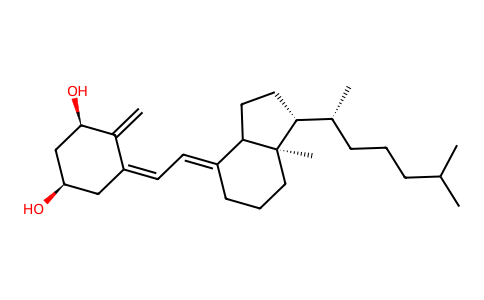
Physicochemical Properties
| Molecular Formula | C27H44O2 |
| Molecular Weight | 400.63706 |
| Exact Mass | 400.334 |
| CAS # | 63181-13-5 |
| PubChem CID | 2091 |
| Appearance | Typically exists as solid at room temperature |
| LogP | 6.589 |
| Hydrogen Bond Donor Count | 2 |
| Hydrogen Bond Acceptor Count | 2 |
| Rotatable Bond Count | 6 |
| Heavy Atom Count | 29 |
| Complexity | 643 |
| Defined Atom Stereocenter Count | 0 |
| SMILES | CC(C)CCC[C@@H](C)[C@H]1CCC2/C(=C/C=C\3/C[C@H](C[C@H](C3=C)O)O)/CCC[C@]12C |
| InChi Key | OFHCOWSQAMBJIW-UHFFFAOYSA-N |
| InChi Code | InChI=1S/C27H44O2/c1-18(2)8-6-9-19(3)24-13-14-25-21(10-7-15-27(24,25)5)11-12-22-16-23(28)17-26(29)20(22)4/h11-12,18-19,23-26,28-29H,4,6-10,13-17H2,1-3,5H3 |
| Chemical Name | 5-[2-[7a-methyl-1-(6-methylheptan-2-yl)-2,3,3a,5,6,7-hexahydro-1H-inden-4-ylidene]ethylidene]-4-methylidenecyclohexane-1,3-diol |
| HS Tariff Code | 2934.99.9001 |
| Storage |
Powder-20°C 3 years 4°C 2 years In solvent -80°C 6 months -20°C 1 month |
| Shipping Condition | Room temperature (This product is stable at ambient temperature for a few days during ordinary shipping and time spent in Customs) |
Biological Activity
| ADME/Pharmacokinetics |
Absorption, Distribution and Excretion Alfacalcidol is absorbed passively and almost completely in the small intestine. Metabolism / Metabolites Alfacalcidol is rapidly converted in the liver to 1,25-dihydroxyvitamin D, which is essentially the metabolite of vitamin D that regulates calcium and phosphate metabolism. Alfacalcidol is further metabolized to other polar inactive metabolites, excreted primarily through the bile. Biological Half-Life The half-life of alfacalcidol ranges from three to four hours. |
| Toxicity/Toxicokinetics |
Protein Binding The active metabolite of alfacalcidol, 1,25-dihydroxyvitamin D, is transported to tissues via globulin, a specific transport protein. |
| Additional Infomation |
Alfacalcidol, or 1-alpha-hydroxycholecalciferol or 1-alpha-hydroxyvitamin D3, is a non-endogenous analogue of [vitamin D]. It plays an essential function in calcium homeostasis and bone metabolism. Alfacaldisol is activated by the enzyme 25-hydroxylase in the liver to mediate its effects in the body, or most importantly, the kidneys and bones. The pharmacological actions of alfacalcidol are prolonged than vitamin D because a negative feedback mechanism regulates the final activation step of vitamin D in the kidneys. Alfacalcidol is available in oral and intravenous formulations. In Canada, it is marketed as ONE-ALPHA, which manages hypocalcemia, secondary hyperparathyroidism, and osteodystrophy in adults with chronic renal failure. In approving European countries, alfacalcidol is also indicated for managing nutritional and malabsorptive rickets and osteomalacia, vitamin D-dependent rickets and osteomalacia, and hypophosphataemic vitamin D resistant rickets and osteomalacia. Drug Indication Alfacalcidol is indicated in adult patients with chronic renal failure for the management of hypocalcemia, secondary hyperparathyroidism, or osteodystrophy. Alfacalcidol is indicated in the management of nutritional and malabsorptive rickets and osteomalacia, vitamin D-dependent rickets and osteomalacia, and hypophosphataemic vitamin D resistant rickets and osteomalacia. FDA Label Mechanism of Action In conditions like chronic renal failure, renal bone disease, hypoparathyroidism, and vitamin D dependent rickets, the kidneys' capacity for 1α-hydroxylation is impaired, leading to reduced production of endogenous 1,25-dihydroxyvitamin D and aberrated mineral metabolism. As an active and potent analog of vitamin D, alfacalcidol works to restore the functions and activities of endogenous 1,25-dihydroxyvitamin D. |
Solubility Data
| Solubility (In Vitro) | May dissolve in DMSO (in most cases), if not, try other solvents such as H2O, Ethanol, or DMF with a minute amount of products to avoid loss of samples |
| Solubility (In Vivo) |
Note: Listed below are some common formulations that may be used to formulate products with low water solubility (e.g. < 1 mg/mL), you may test these formulations using a minute amount of products to avoid loss of samples. Injection Formulations (e.g. IP/IV/IM/SC) Injection Formulation 1: DMSO : Tween 80: Saline = 10 : 5 : 85 (i.e. 100 μL DMSO stock solution → 50 μL Tween 80 → 850 μL Saline) *Preparation of saline: Dissolve 0.9 g of sodium chloride in 100 mL ddH ₂ O to obtain a clear solution. Injection Formulation 2: DMSO : PEG300 :Tween 80 : Saline = 10 : 40 : 5 : 45 (i.e. 100 μL DMSO → 400 μLPEG300 → 50 μL Tween 80 → 450 μL Saline) Injection Formulation 3: DMSO : Corn oil = 10 : 90 (i.e. 100 μL DMSO → 900 μL Corn oil) Example: Take the Injection Formulation 3 (DMSO : Corn oil = 10 : 90) as an example, if 1 mL of 2.5 mg/mL working solution is to be prepared, you can take 100 μL 25 mg/mL DMSO stock solution and add to 900 μL corn oil, mix well to obtain a clear or suspension solution (2.5 mg/mL, ready for use in animals). Injection Formulation 4: DMSO : 20% SBE-β-CD in saline = 10 : 90 [i.e. 100 μL DMSO → 900 μL (20% SBE-β-CD in saline)] *Preparation of 20% SBE-β-CD in Saline (4°C,1 week): Dissolve 2 g SBE-β-CD in 10 mL saline to obtain a clear solution. Injection Formulation 5: 2-Hydroxypropyl-β-cyclodextrin : Saline = 50 : 50 (i.e. 500 μL 2-Hydroxypropyl-β-cyclodextrin → 500 μL Saline) Injection Formulation 6: DMSO : PEG300 : castor oil : Saline = 5 : 10 : 20 : 65 (i.e. 50 μL DMSO → 100 μLPEG300 → 200 μL castor oil → 650 μL Saline) Injection Formulation 7: Ethanol : Cremophor : Saline = 10: 10 : 80 (i.e. 100 μL Ethanol → 100 μL Cremophor → 800 μL Saline) Injection Formulation 8: Dissolve in Cremophor/Ethanol (50 : 50), then diluted by Saline Injection Formulation 9: EtOH : Corn oil = 10 : 90 (i.e. 100 μL EtOH → 900 μL Corn oil) Injection Formulation 10: EtOH : PEG300:Tween 80 : Saline = 10 : 40 : 5 : 45 (i.e. 100 μL EtOH → 400 μLPEG300 → 50 μL Tween 80 → 450 μL Saline) Oral Formulations Oral Formulation 1: Suspend in 0.5% CMC Na (carboxymethylcellulose sodium) Oral Formulation 2: Suspend in 0.5% Carboxymethyl cellulose Example: Take the Oral Formulation 1 (Suspend in 0.5% CMC Na) as an example, if 100 mL of 2.5 mg/mL working solution is to be prepared, you can first prepare 0.5% CMC Na solution by measuring 0.5 g CMC Na and dissolve it in 100 mL ddH2O to obtain a clear solution; then add 250 mg of the product to 100 mL 0.5% CMC Na solution, to make the suspension solution (2.5 mg/mL, ready for use in animals). Oral Formulation 3: Dissolved in PEG400 Oral Formulation 4: Suspend in 0.2% Carboxymethyl cellulose Oral Formulation 5: Dissolve in 0.25% Tween 80 and 0.5% Carboxymethyl cellulose Oral Formulation 6: Mixing with food powders Note: Please be aware that the above formulations are for reference only. InvivoChem strongly recommends customers to read literature methods/protocols carefully before determining which formulation you should use for in vivo studies, as different compounds have different solubility properties and have to be formulated differently. (Please use freshly prepared in vivo formulations for optimal results.) |
| Preparing Stock Solutions | 1 mg | 5 mg | 10 mg | |
| 1 mM | 2.4960 mL | 12.4800 mL | 24.9601 mL | |
| 5 mM | 0.4992 mL | 2.4960 mL | 4.9920 mL | |
| 10 mM | 0.2496 mL | 1.2480 mL | 2.4960 mL |