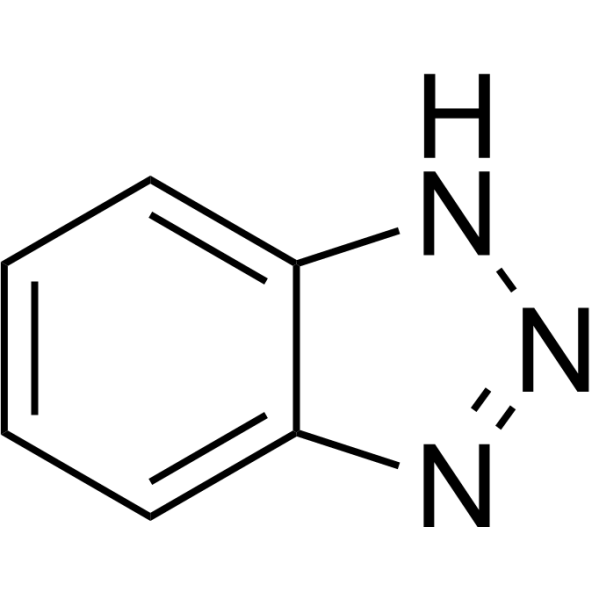
Physicochemical Properties
| Molecular Formula | C6H5N3 |
| Molecular Weight | 119.12 |
| Exact Mass | 119.048 |
| CAS # | 95-14-7 |
| Related CAS # | 1H-Benzotriazole-4,5,6,7-d4;1185072-03-0 |
| PubChem CID | 7220 |
| Appearance |
Needles from chloroform or benzene White to light tan, crystalline powder |
| Density | 1.3±0.1 g/cm3 |
| Boiling Point | 204 ºC (15 mmHg) |
| Melting Point | 97-99 °C(lit.) |
| Flash Point | 170 ºC |
| Vapour Pressure | 0.0±0.8 mmHg at 25°C |
| Index of Refraction | 1.715 |
| LogP | 1.34 |
| Hydrogen Bond Donor Count | 1 |
| Hydrogen Bond Acceptor Count | 2 |
| Rotatable Bond Count | 0 |
| Heavy Atom Count | 9 |
| Complexity | 92.5 |
| Defined Atom Stereocenter Count | 0 |
| SMILES | N1NC2C(=CC=CC=2)N=1 |
| InChi Key | QRUDEWIWKLJBPS-UHFFFAOYSA-N |
| InChi Code | InChI=1S/C6H5N3/c1-2-4-6-5(3-1)7-9-8-6/h1-4H,(H,7,8,9) |
| Chemical Name | 2H-benzotriazole |
| HS Tariff Code | 2934.99.9001 |
| Storage |
Powder-20°C 3 years 4°C 2 years In solvent -80°C 6 months -20°C 1 month |
| Shipping Condition | Room temperature (This product is stable at ambient temperature for a few days during ordinary shipping and time spent in Customs) |
Biological Activity
| ln Vitro | 1,2,3-benzotriazole, with the chemical formula C6H5N3, is a heterocyclic molecule with three nitrogen atoms. There are numerous applications for this polar, colorless aromatic molecule. |
| ADME/Pharmacokinetics |
Metabolism / Metabolites Benzotriazoles (BTs) are xenobiotic contaminants widely distributed in aquatic environments and of emerging concern due to their polarity, recalcitrance, and common use. During some water reclamation activities, such as stormwater bioretention or crop irrigation with recycled water, BTs come in contact with vegetation, presenting a potential exposure route to consumers. We discovered that BT in hydroponic systems was rapidly (approximately 1-log per day) assimilated by Arabidopsis plants and metabolized to novel BT metabolites structurally resembling tryptophan and auxin plant hormones; <1% remained as parent compound. Using LC-QTOF-MS untargeted metabolomics, we identified two major types of BT transformation products: glycosylation and incorporation into the tryptophan biosynthetic pathway. BT amino acid metabolites are structurally analogous to tryptophan and the storage forms of auxin plant hormones. Critical intermediates were synthesized (authenticated by (1)H/(13)C NMR) for product verification. In a multiple-exposure temporal mass balance, three major metabolites accounted for >60% of BT. Glycosylated BT was excreted by the plants into the hydroponic medium, a phenomenon not observed previously. The observed amino acid metabolites are likely formed when tryptophan biosynthetic enzymes substitute synthetic BT for native indolic molecules, generating potential phytohormone mimics. These results suggest that BT metabolism by plants could mask the presence of BT contamination in the environment. Furthermore, BT-derived metabolites are structurally related to plant auxin hormones and should be evaluated for undesirable biological effects. 1-H-Benzotriazole was metabolized by rat liver microsomes in vitro to 4-hydroxybenzotriazole and 5-hydroxybenzotriazole. |
| Toxicity/Toxicokinetics |
Toxicity Summary IDENTIFICATION AND USE: 1,2,3-Benzotriazole (BT) is a white to light tan, crystalline powder. It is used as photographic restrainer and a chemical intermediate. It is also a corrosion inhibitor in industrial water treatment, and in the treatment of bronze disease in metal fine art conservation. HUMAN STUDIES: A report showed that two metal workers developed contact dermatitis from exposure to lubricating oil that contained BT. ANIMAL STUDIES: In a test for primary skin irritation and sensitization on guinea pigs, BT was at most mildly irritating in concentrations up to 50% in ethanol and was not a sensitizer. The dry powder is severely irritating to rabbit eyes (0.1 mL unwashed) but prompt water washing reduces irritation considerably. BT was positive in the Salmonella typhimurium and Escherichia coli mutagenicity assays. ECOTOXICITY STUDIES: This chemical has been widely detected in aquatic environments and shows some degree of environmental persistence. BT exposure can negatively affect endocrine systems and can result in neurotoxicity in fish. BT demonstrated hepatotoxicity and neurotoxicity in Chinese rare minnow. In female marine medaka, exposure to 0.01 mg/L BT caused notable changes in expression levels of vitellogenin, CYP1A1 and CYP19a. In vitro assays conducted using a recombinant yeast (anti-) estrogen assay indicated that BT possessed clear antiestrogenic properties. BT metabolism by plants could mask the presence of BT contamination in the environment. Furthermore, BT-derived metabolites are structurally related to plant auxin hormones. Toxicity Data LC50 (rat) = 1,910 mg/m3/3H Interactions Benzotriazole (BTR), an emerging class of environmental pollutant, is widely used in industrial applications and household dishwashing agents. Despite the reported toxicity of BTR to aquatic organisms, little is known about its effects on terrestrial invertebrates. Copper (Cu) accumulates in agricultural soils receiving urban waste products, fertilizers, fungicides, and urban sewage. In this study, two different types of bioassays (acute toxicity test and behavioral toxicity test) were performed to evaluate the toxicity of Cu and BTR, both singly and together, on the earthworm (Eisenia fetida) in artificial soil. The results of avoidance behavior tests showed that the EC50 (48 hr) values for Cu and BTR were 1.47 and 0.46 mmol/kg, respectively. The results of the acute toxicity tests showed that the LC50 (7 d) and LC50 (14 d) of Cu in earthworms were 9.19 and 5.28 mmol/kg, respectively, and the LC50 (7 d) and LC50 (14 d) of BTR were 2.43 and 1.76 mmol/kg, respectively. Toxicity analysis demonstrated that the binary BTR and Cu mixture had predominantly antagonistic effects on the avoidance behavior and survival of earthworms. The Cu2+ activities and mortality of earthworms decreased significantly with increasing concentrations of BTR, while the solid-liquid distribution coefficient of Cu increased. These results indicated that the presence of BTR can reduce the toxicity as well as the bioavailability of Cu in soil with both BTR and Cu. As an emerging contaminant, 1-H-benzotriazole (1H-BTR) has been detected in the engineered and natural aquatic environments, which usually coexists with heavy metals and causes combined pollution. In the present study, wild-type and transgenic zebrafish Danio rerio were used to explore the acute toxicity as well as the single and joint hepatotoxicity of cadmium (Cd) and 1H-BTR. Although the acute toxicity of 1H-BTR to zebrafish was low, increased expression of liver-specific fatty acid binding protein was observed in transgenic zebrafish when the embryos were exposed to 5.0 uM of 1H-BTR for 30 days. Besides, co-exposure to 1H-BTR not only reduced the acute toxic effects induced by Cd, but also alleviated the Cd-induced liver atrophy in transgenic fish. Correspondingly, effects of combined exposure to 1H-BTR on the Cd-induced expressions of several signal pathway-related genes and superoxide dismutase and glutathione-s-transferase proteins were studied. Based on the determination of Cd bioaccumulation in fish and the complexing stability constant (beta) of Cd-BTR complex in solution, the detoxification mechanism of co-existing 1H-BTR on Cd to the zebrafish was discussed. Non-Human Toxicity Values LC50 Rat inhalation 1900 mg/cu m/3 hr LD50 Rat oral 600 mg/kg LD50 Mouse oral 615 mg/kg LD50 Mouse ip 400 mg/kg For more Non-Human Toxicity Values (Complete) data for 1,2,3-Benzotriazole (6 total), please visit the HSDB record page. |
| Additional Infomation |
1,2,3-benzotriazole appears as white to light tan crystals or white powder. No odor. (NTP, 1992) Benzotriazole is the simplest member of the class of benzotriazoles that consists of a benzene nucleus fused to a 1H-1,2,3-triazole ring. It has a role as an environmental contaminant and a xenobiotic. |
Solubility Data
| Solubility (In Vitro) | May dissolve in DMSO (in most cases), if not, try other solvents such as H2O, Ethanol, or DMF with a minute amount of products to avoid loss of samples |
| Solubility (In Vivo) |
Note: Listed below are some common formulations that may be used to formulate products with low water solubility (e.g. < 1 mg/mL), you may test these formulations using a minute amount of products to avoid loss of samples. Injection Formulations (e.g. IP/IV/IM/SC) Injection Formulation 1: DMSO : Tween 80: Saline = 10 : 5 : 85 (i.e. 100 μL DMSO stock solution → 50 μL Tween 80 → 850 μL Saline) *Preparation of saline: Dissolve 0.9 g of sodium chloride in 100 mL ddH ₂ O to obtain a clear solution. Injection Formulation 2: DMSO : PEG300 :Tween 80 : Saline = 10 : 40 : 5 : 45 (i.e. 100 μL DMSO → 400 μLPEG300 → 50 μL Tween 80 → 450 μL Saline) Injection Formulation 3: DMSO : Corn oil = 10 : 90 (i.e. 100 μL DMSO → 900 μL Corn oil) Example: Take the Injection Formulation 3 (DMSO : Corn oil = 10 : 90) as an example, if 1 mL of 2.5 mg/mL working solution is to be prepared, you can take 100 μL 25 mg/mL DMSO stock solution and add to 900 μL corn oil, mix well to obtain a clear or suspension solution (2.5 mg/mL, ready for use in animals). Injection Formulation 4: DMSO : 20% SBE-β-CD in saline = 10 : 90 [i.e. 100 μL DMSO → 900 μL (20% SBE-β-CD in saline)] *Preparation of 20% SBE-β-CD in Saline (4°C,1 week): Dissolve 2 g SBE-β-CD in 10 mL saline to obtain a clear solution. Injection Formulation 5: 2-Hydroxypropyl-β-cyclodextrin : Saline = 50 : 50 (i.e. 500 μL 2-Hydroxypropyl-β-cyclodextrin → 500 μL Saline) Injection Formulation 6: DMSO : PEG300 : castor oil : Saline = 5 : 10 : 20 : 65 (i.e. 50 μL DMSO → 100 μLPEG300 → 200 μL castor oil → 650 μL Saline) Injection Formulation 7: Ethanol : Cremophor : Saline = 10: 10 : 80 (i.e. 100 μL Ethanol → 100 μL Cremophor → 800 μL Saline) Injection Formulation 8: Dissolve in Cremophor/Ethanol (50 : 50), then diluted by Saline Injection Formulation 9: EtOH : Corn oil = 10 : 90 (i.e. 100 μL EtOH → 900 μL Corn oil) Injection Formulation 10: EtOH : PEG300:Tween 80 : Saline = 10 : 40 : 5 : 45 (i.e. 100 μL EtOH → 400 μLPEG300 → 50 μL Tween 80 → 450 μL Saline) Oral Formulations Oral Formulation 1: Suspend in 0.5% CMC Na (carboxymethylcellulose sodium) Oral Formulation 2: Suspend in 0.5% Carboxymethyl cellulose Example: Take the Oral Formulation 1 (Suspend in 0.5% CMC Na) as an example, if 100 mL of 2.5 mg/mL working solution is to be prepared, you can first prepare 0.5% CMC Na solution by measuring 0.5 g CMC Na and dissolve it in 100 mL ddH2O to obtain a clear solution; then add 250 mg of the product to 100 mL 0.5% CMC Na solution, to make the suspension solution (2.5 mg/mL, ready for use in animals). Oral Formulation 3: Dissolved in PEG400 Oral Formulation 4: Suspend in 0.2% Carboxymethyl cellulose Oral Formulation 5: Dissolve in 0.25% Tween 80 and 0.5% Carboxymethyl cellulose Oral Formulation 6: Mixing with food powders Note: Please be aware that the above formulations are for reference only. InvivoChem strongly recommends customers to read literature methods/protocols carefully before determining which formulation you should use for in vivo studies, as different compounds have different solubility properties and have to be formulated differently. (Please use freshly prepared in vivo formulations for optimal results.) |
| Preparing Stock Solutions | 1 mg | 5 mg | 10 mg | |
| 1 mM | 8.3949 mL | 41.9745 mL | 83.9490 mL | |
| 5 mM | 1.6790 mL | 8.3949 mL | 16.7898 mL | |
| 10 mM | 0.8395 mL | 4.1974 mL | 8.3949 mL |