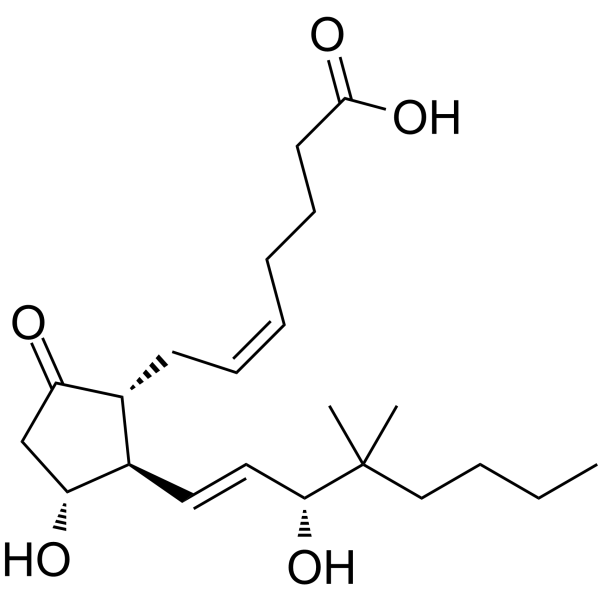
Physicochemical Properties
| Molecular Weight | 380.51824 |
| Exact Mass | 380.256 |
| CAS # | 39746-25-3 |
| PubChem CID | 5283066 |
| Appearance | Colorless to light yellow liquid |
| Density | 1.1±0.1 g/cm3 |
| Boiling Point | 541.3±50.0 °C at 760 mmHg |
| Melting Point | -85.6ºC |
| Flash Point | 295.2±26.6 °C |
| Vapour Pressure | 0.0±3.3 mmHg at 25°C |
| Index of Refraction | 1.551 |
| LogP | 2.57 |
| Hydrogen Bond Donor Count | 3 |
| Hydrogen Bond Acceptor Count | 5 |
| Rotatable Bond Count | 12 |
| Heavy Atom Count | 27 |
| Complexity | 535 |
| Defined Atom Stereocenter Count | 4 |
| SMILES | CCCCC(C)(C)[C@@H](/C=C/[C@@H]1[C@@H](C/C=C\CCCC(=O)O)C(=O)C[C@H]1O)O |
| InChi Key | QAOBBBBDJSWHMU-WMBBNPMCSA-N |
| InChi Code | InChI=1S/C22H36O5/c1-4-5-14-22(2,3)20(25)13-12-17-16(18(23)15-19(17)24)10-8-6-7-9-11-21(26)27/h6,8,12-13,16-17,19-20,24-25H,4-5,7,9-11,14-15H2,1-3H3,(H,26,27)/b8-6-,13-12+/t16-,17-,19-,20-/m1/s1 |
| Chemical Name | (Z)-7-[(1R,2R,3R)-3-hydroxy-2-[(E,3R)-3-hydroxy-4,4-dimethyloct-1-enyl]-5-oxocyclopentyl]hept-5-enoic acid |
| HS Tariff Code | 2934.99.9001 |
| Storage |
Powder-20°C 3 years 4°C 2 years In solvent -80°C 6 months -20°C 1 month |
| Shipping Condition | Room temperature (This product is stable at ambient temperature for a few days during ordinary shipping and time spent in Customs) |
Biological Activity
| ln Vivo | 16,16-Dimethyl prostaglandin E2 (16,16-dimethyl PGE2; 10 µg/kg; i.p.; every 12 hours; for 8 days) reverses Tpl2IMF-KO mice's worsened DSS colitis phenotype and regenerates epithelial function and proliferation[2]. |
| Animal Protocol |
Animal/Disease Models: Tpl2IMF-KO mice[2] Doses: 10 µg/kg Route of Administration: IP; Model and restore epithelial swelling and structure[2]. Every 12 hrs (hrs (hours)); for 8 days Experimental Results: Rescue of exacerbating DSS colitis phenotype and restoration of epithelial proliferation and architecture. |
| References |
[1]. Getting more for your marrow: boosting hematopoietic stem cell numbers with PGE2. xp Cell Res. 2014 Dec 10;329(2):220-6. [2]. Intestinal myofibroblast-specific Tpl2-Cox-2-PGE2 pathway links innate sensing to epithelial homeostasis. Proc Natl Acad Sci U S A. 2014 Oct 28;111(43):E4658-67. |
| Additional Infomation |
16,16-dimethylprostaglandin E2 is a prostanoid that is prostaglandin E2 in which both of the hydrogens at position 16 have been replaced by methyl groups. A synthetic analogue of prostaglandin E2, it is a potent inhibitor of pancreatic function and growth of experimental tumors. It also protects the gastric mucosa, prevents ulceration, and promotes the healing of peptic ulcers. It has a role as a radiation protective agent, an anti-ulcer drug and a gastrointestinal drug. It is a prostanoid, a monocarboxylic acid, a secondary allylic alcohol and a member of cyclopentanones. 16,16-Dimethyl Prostaglandin E2 is a stable derivative of prostaglandin E2 (PGE2) with potential hematopoietic activity. Administration of 16,16 dimethyl-prostaglandin E2 (dmPGE2) appears to lead to increased formation of hematopoietic stem and progenitor cells. Even though the exact mechanism of action has yet to be fully elucidated, this agent may stimulate hematopoiesis by activating the Wnt signaling pathway, which increases cellular levels of beta-catenin, a subunit of the cadherin protein complex. A synthetic prostaglandin E analog that protects the gastric mucosa, prevents ulceration, and promotes the healing of peptic ulcers. The protective effect is independent of acid inhibition. It is also a potent inhibitor of pancreatic function and growth of experimental tumors. |
Solubility Data
| Solubility (In Vitro) | DMSO : ~100 mg/mL (~262.80 mM) |
| Solubility (In Vivo) |
Solubility in Formulation 1: ≥ 2.5 mg/mL (6.57 mM) (saturation unknown) in 10% DMSO + 40% PEG300 + 5% Tween80 + 45% Saline (add these co-solvents sequentially from left to right, and one by one), clear solution. For example, if 1 mL of working solution is to be prepared, you can add 100 μL of 25.0 mg/mL clear DMSO stock solution to 400 μL PEG300 and mix evenly; then add 50 μL Tween-80 to the above solution and mix evenly; then add 450 μL normal saline to adjust the volume to 1 mL. Preparation of saline: Dissolve 0.9 g of sodium chloride in 100 mL ddH₂ O to obtain a clear solution. Solubility in Formulation 2: ≥ 2.5 mg/mL (6.57 mM) (saturation unknown) in 10% DMSO + 90% (20% SBE-β-CD in Saline) (add these co-solvents sequentially from left to right, and one by one), clear solution. For example, if 1 mL of working solution is to be prepared, you can add 100 μL of 25.0 mg/mL clear DMSO stock solution to 900 μL of 20% SBE-β-CD physiological saline solution and mix evenly. Preparation of 20% SBE-β-CD in Saline (4°C,1 week): Dissolve 2 g SBE-β-CD in 10 mL saline to obtain a clear solution. Solubility in Formulation 3: ≥ 2.5 mg/mL (6.57 mM) (saturation unknown) in 10% DMSO + 90% Corn Oil (add these co-solvents sequentially from left to right, and one by one), clear solution. For example, if 1 mL of working solution is to be prepared, you can add 100 μL of 25.0 mg/mL clear DMSO stock solution to 900 μL of corn oil and mix evenly. (Please use freshly prepared in vivo formulations for optimal results.) |
| Preparing Stock Solutions | 1 mg | 5 mg | 10 mg | |
| 1 mM | 2.6280 mL | 13.1399 mL | 26.2798 mL | |
| 5 mM | 0.5256 mL | 2.6280 mL | 5.2560 mL | |
| 10 mM | 0.2628 mL | 1.3140 mL | 2.6280 mL |