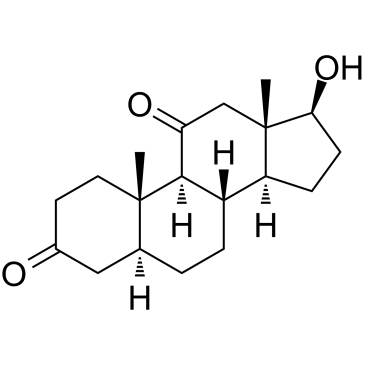
11-Ketodihydrotestosterone (also known as 11-KDHT; 5α-Dihydro-11-keto testosterone), an endogenous steroid, is a metabolite of 11β-Hydroxyandrostenedione. 11-Ketodihydrotestosterone is an active androgen and is also a highly potent androgen receptor (AR) agonist with a Ki of 20.4 nM and an EC50 of 1.35 nM for human AR. 11-Ketodihydrotestosterone drives gene regulation, protein expression and cell growth in androgen-dependent prostate cancer cells.
Physicochemical Properties
| Molecular Formula | C19H28O3 |
| Molecular Weight | 304.423826217651 |
| Exact Mass | 304.203 |
| CAS # | 32694-37-4 |
| Related CAS # | 11-Ketodihydrotestosterone-d3;2479914-02-6 |
| PubChem CID | 11197479 |
| Appearance | White to off-white solid powder |
| Density | 1.2±0.1 g/cm3 |
| Boiling Point | 453.4±45.0 °C at 760 mmHg |
| Flash Point | 242.1±25.2 °C |
| Vapour Pressure | 0.0±2.5 mmHg at 25°C |
| Index of Refraction | 1.546 |
| LogP | 1.84 |
| Hydrogen Bond Donor Count | 1 |
| Hydrogen Bond Acceptor Count | 3 |
| Rotatable Bond Count | 0 |
| Heavy Atom Count | 22 |
| Complexity | 527 |
| Defined Atom Stereocenter Count | 7 |
| SMILES | C[C@]12CCC(=O)C[C@@H]1CC[C@@H]3[C@@H]2C(=O)C[C@]4([C@H]3CC[C@@H]4O)C |
| InChi Key | RSQKILYTRHKUIJ-HZGXJFKTSA-N |
| InChi Code | InChI=1S/C19H28O3/c1-18-8-7-12(20)9-11(18)3-4-13-14-5-6-16(22)19(14,2)10-15(21)17(13)18/h11,13-14,16-17,22H,3-10H2,1-2H3/t11-,13-,14-,16-,17+,18-,19-/m0/s1 |
| Chemical Name | (5S,8S,9S,10S,13S,14S,17S)-17-hydroxy-10,13-dimethyl-2,4,5,6,7,8,9,12,14,15,16,17-dodecahydro-1H-cyclopenta[a]phenanthrene-3,11-dione |
| HS Tariff Code | 2934.99.9001 |
| Storage |
Powder-20°C 3 years 4°C 2 years In solvent -80°C 6 months -20°C 1 month |
| Shipping Condition | Room temperature (This product is stable at ambient temperature for a few days during ordinary shipping and time spent in Customs) |
Biological Activity
| ln Vitro | Treatment of LNCaP and VCaP cells with 11-ketodihydrotestosterone (11-KDHT; 1–10 nM; 24 hours) causes a notable induction of cell proliferation [1]. With the exception of 1 nM of KLK3 in LNCaP cells, treatment with 11-ketodihydrotestosterone (11-KDHT; 0.1-10 nM; 7-10 days; LNCaP and VCaP cells) significantly upregulated the expression of KLK3, TMPRSS2, and FKBP5. Merely 20% of 11β-hydroxyandrostenedione (11OHA4) and 11β-hydroxytestosterone (11OHT) are metabolized in PNT2 cells. The former generates 11-keto-androstenedione (11KA4), 11-ketodihydrotestosterone (11-KDHT), and 11β-hydroxy-5α-androstanedione (11OH-5αDIONE), while the latter yields 11OHA4, 11KT, and 11-ketodihydrotestosterone, with downstream products <0.03 μM [2]. C11-oxoC19 metabolites were found in prostate cancer tissue at much higher concentrations than C19 steroids; unconjugated 11-ketodihydrotestosterone, 11KT, and 11OHA4 levels ranged from 13 to 37.5 ng/g. Significant quantities of 11OHA4 (about 230-440 nM), 11KT (approximately 250-390 nM), and 11-ketodihydrotestosterone (approximately 19 nM) were found in plasma when total steroid levels were analyzed [2]. |
| Cell Assay |
Cell proliferation assay[1] Cell Types: LNCaP and VCaP cells Tested Concentrations: 0.1 nM, 1 nM or 10 nM Incubation Duration: 7 days (LNCaP cells) or 10 days (VCaP cells) Experimental Results: Significant cell proliferation was induced. RT-PCR[1] Cell Types: LNCaP and VCaP Cell Tested Concentrations: 1 nM, 10 nM Incubation Duration: 24 hrs (hours) Experimental Results: Result in significant upregulation of KLK3, TMPRSS2 and FKBP5 in LNCaP (Figure 3) and VCaP (Figure 4) cells . |
| References |
[1]. 1-Ketotestosterone and 11-Ketodihydrotestosterone in Castration Resistant Prostate Cancer: Potent Androgens Which Can No Longer Be Ignored. PLoS One. 2016 Jul 21;11(7):e0159867. [2]. Profiling adrenal 11β-hydroxyandrostenedione metabolites in prostate cancer cells, tissue and plasma: UPC2-MS/MS quantification of 11β-hydroxytestosterone, 11keto-testosterone and 11keto-dihydrotestosterone. J Steroid Biochem Mol Biol. 2017 Feb;166:54-67. |
Solubility Data
| Solubility (In Vitro) | DMSO : ~100 mg/mL (~328.49 mM) |
| Solubility (In Vivo) |
Solubility in Formulation 1: ≥ 2.5 mg/mL (8.21 mM) (saturation unknown) in 10% DMSO + 40% PEG300 + 5% Tween80 + 45% Saline (add these co-solvents sequentially from left to right, and one by one), clear solution. For example, if 1 mL of working solution is to be prepared, you can add 100 μL of 25.0 mg/mL clear DMSO stock solution to 400 μL PEG300 and mix evenly; then add 50 μL Tween-80 to the above solution and mix evenly; then add 450 μL normal saline to adjust the volume to 1 mL. Preparation of saline: Dissolve 0.9 g of sodium chloride in 100 mL ddH₂ O to obtain a clear solution. Solubility in Formulation 2: 2.5 mg/mL (8.21 mM) in 10% DMSO + 90% (20% SBE-β-CD in Saline) (add these co-solvents sequentially from left to right, and one by one), suspension solution; with ultrasonication. For example, if 1 mL of working solution is to be prepared, you can add 100 μL of 25.0 mg/mL clear DMSO stock solution to 900 μL of 20% SBE-β-CD physiological saline solution and mix evenly. Preparation of 20% SBE-β-CD in Saline (4°C,1 week): Dissolve 2 g SBE-β-CD in 10 mL saline to obtain a clear solution. Solubility in Formulation 3: ≥ 2.5 mg/mL (8.21 mM) (saturation unknown) in 10% DMSO + 90% Corn Oil (add these co-solvents sequentially from left to right, and one by one), clear solution. For example, if 1 mL of working solution is to be prepared, you can add 100 μL of 25.0 mg/mL clear DMSO stock solution to 900 μL of corn oil and mix evenly. (Please use freshly prepared in vivo formulations for optimal results.) |
| Preparing Stock Solutions | 1 mg | 5 mg | 10 mg | |
| 1 mM | 3.2849 mL | 16.4247 mL | 32.8494 mL | |
| 5 mM | 0.6570 mL | 3.2849 mL | 6.5699 mL | |
| 10 mM | 0.3285 mL | 1.6425 mL | 3.2849 mL |