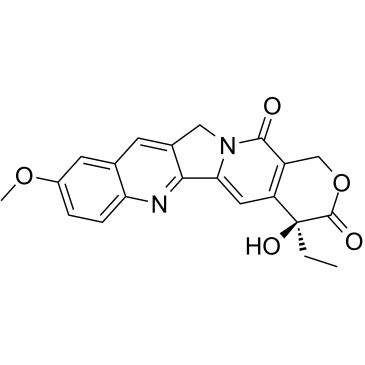
Physicochemical Properties
| Molecular Formula | C21H18N2O5 |
| Molecular Weight | 378.3780 |
| Exact Mass | 378.121 |
| CAS # | 19685-10-0 |
| PubChem CID | 97283 |
| Appearance | White to yellow solid powder |
| Density | 1.5±0.1 g/cm3 |
| Boiling Point | 773.1±60.0 °C at 760 mmHg |
| Flash Point | 421.4±32.9 °C |
| Vapour Pressure | 0.0±2.8 mmHg at 25°C |
| Index of Refraction | 1.723 |
| LogP | 1.69 |
| Hydrogen Bond Donor Count | 1 |
| Hydrogen Bond Acceptor Count | 6 |
| Rotatable Bond Count | 2 |
| Heavy Atom Count | 28 |
| Complexity | 790 |
| Defined Atom Stereocenter Count | 1 |
| SMILES | CC[C@@]1(C2=C(COC1=O)C(=O)N3CC4=C(C3=C2)N=C5C=CC(=CC5=C4)OC)O |
| InChi Key | KLFJSYOEEYWQMR-NRFANRHFSA-N |
| InChi Code | InChI=1S/C21H18N2O5/c1-3-21(26)15-8-17-18-12(6-11-7-13(27-2)4-5-16(11)22-18)9-23(17)19(24)14(15)10-28-20(21)25/h4-8,26H,3,9-10H2,1-2H3/t21-/m0/s1 |
| Chemical Name | (19S)-19-ethyl-19-hydroxy-7-methoxy-17-oxa-3,13-diazapentacyclo[11.8.0.02,11.04,9.015,20]henicosa-1(21),2(11),3,5,7,9,15(20)-heptaene-14,18-dione |
| HS Tariff Code | 2934.99.9001 |
| Storage |
Powder-20°C 3 years 4°C 2 years In solvent -80°C 6 months -20°C 1 month Note: This product requires protection from light (avoid light exposure) during transportation and storage. |
| Shipping Condition | Room temperature (This product is stable at ambient temperature for a few days during ordinary shipping and time spent in Customs) |
Biological Activity
| Animal Protocol |
1. Experimental animals: Male Wistar rats were selected as the experimental subjects for the pharmacokinetic study of 10-Methoxycamptothecin and its metabolite 10-hydroxycamptothecin 2. Administration mode: 10-Methoxycamptothecin was administered to rats via intravenous injection for subsequent plasma drug concentration detection and pharmacokinetic analysis[1] |
| ADME/Pharmacokinetics |
1. Metabolic characteristics: 10-Methoxycamptothecin can be metabolized in rat plasma, and its major metabolite was confirmed to be 10-hydroxycamptothecin through HPLC/photodiode array detection (PDA) and LC-MS/MS analysis[1] 2. Detection-related pharmacokinetic supporting parameters: A validated RP-HPLC method with fluorescence detection was applied to determine the concentrations of 10-Methoxycamptothecin and its metabolite in rat plasma after intravenous administration; the calibration curves of 10-Methoxycamptothecin were linear (r² > 0.999) over the concentration ranges of 1.25–20 ng/mL and 20–320 ng/mL, the lower limit of quantification (LLOQ) for 10-Methoxycamptothecin with 0.1 mL plasma was 1.25 ng/mL, the accuracy of the detection method for 10-Methoxycamptothecin was 92.24–113.90%, the intra- and inter-day precision (RSD%) were ≤10.05%, and the mean recoveries of 10-Methoxycamptothecin at concentrations of 2.5 ng/mL, 40 ng/mL and 160 ng/mL were 95.09±3.94%, 98.67±1.40% and 95.65±2.15% respectively[1] |
| References |
[1]. Development and validation of a RP-HPLC method with fluorescence detection for simultaneous determination of 10-methoxycamptothecin and its metabolite 10-hydroxycamptothecin in rat plasma. J Chromatogr B Analyt Technol Biomed Life Sci. 2012 Aug 15;903:81-7. |
| Additional Infomation |
10-Methoxycamptothecin has been reported in Camellia sinensis, Perilla frutescens, and other organisms with data available. 1. 10-Methoxycamptothecin is a natural bioactive derivative of camptothecin (CPT) isolated from Camptotheca acuminata, and it has been confirmed to possess high anti-cancer properties[1] |
Solubility Data
| Solubility (In Vitro) | DMSO : ~8.33 mg/mL (~22.01 mM) |
| Solubility (In Vivo) |
Solubility in Formulation 1: 0.83 mg/mL (2.19 mM) in 10% DMSO + 40% PEG300 + 5% Tween80 + 45% Saline (add these co-solvents sequentially from left to right, and one by one), suspension solution; with sonication. For example, if 1 mL of working solution is to be prepared, you can add 100 μL of 8.3 mg/mL clear DMSO stock solution to 400 μL of PEG300 and mix evenly; then add 50 μL of Tween-80 to the above solution and mix evenly; then add 450 μL of normal saline to adjust the volume to 1 mL. Preparation of saline: Dissolve 0.9 g of sodium chloride in 100 mL ddH₂ O to obtain a clear solution. Solubility in Formulation 2: ≥ 0.83 mg/mL (2.19 mM) (saturation unknown) in 10% DMSO + 90% (20% SBE-β-CD in Saline) (add these co-solvents sequentially from left to right, and one by one), clear solution. For example, if 1 mL of working solution is to be prepared, you can add 100 μL of 8.3 mg/mL clear DMSO stock solution to 900 μL of 20% SBE-β-CD physiological saline solution and mix evenly. Preparation of 20% SBE-β-CD in Saline (4°C,1 week): Dissolve 2 g SBE-β-CD in 10 mL saline to obtain a clear solution. Solubility in Formulation 3: ≥ 0.83 mg/mL (2.19 mM) (saturation unknown) in 10% DMSO + 90% Corn Oil (add these co-solvents sequentially from left to right, and one by one), clear solution. For example, if 1 mL of working solution is to be prepared, you can add 100 μL of 8.3 mg/mL clear DMSO stock solution to 900 μL of corn oil and mix evenly. (Please use freshly prepared in vivo formulations for optimal results.) |
| Preparing Stock Solutions | 1 mg | 5 mg | 10 mg | |
| 1 mM | 2.6428 mL | 13.2142 mL | 26.4285 mL | |
| 5 mM | 0.5286 mL | 2.6428 mL | 5.2857 mL | |
| 10 mM | 0.2643 mL | 1.3214 mL | 2.6428 mL |