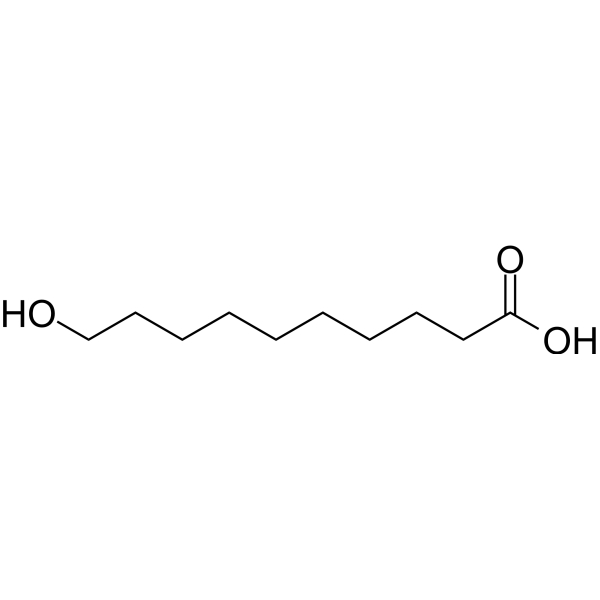
Physicochemical Properties
| Molecular Formula | C10H20O3 |
| Molecular Weight | 188.2640 |
| Exact Mass | 188.141 |
| CAS # | 1679-53-4 |
| PubChem CID | 74300 |
| Appearance | White to off-white solid powder |
| Density | 1.0±0.1 g/cm3 |
| Boiling Point | 330.8±15.0 °C at 760 mmHg |
| Melting Point | 75-77 °C(lit.) |
| Flash Point | 168.1±16.9 °C |
| Vapour Pressure | 0.0±1.6 mmHg at 25°C |
| Index of Refraction | 1.466 |
| LogP | 1.96 |
| Hydrogen Bond Donor Count | 2 |
| Hydrogen Bond Acceptor Count | 3 |
| Rotatable Bond Count | 9 |
| Heavy Atom Count | 13 |
| Complexity | 123 |
| Defined Atom Stereocenter Count | 0 |
| InChi Key | YJCJVMMDTBEITC-UHFFFAOYSA-N |
| InChi Code | InChI=1S/C10H20O3/c11-9-7-5-3-1-2-4-6-8-10(12)13/h11H,1-9H2,(H,12,13) |
| Chemical Name | 10-hydroxydecanoic acid |
| HS Tariff Code | 2934.99.9001 |
| Storage |
Powder-20°C 3 years 4°C 2 years In solvent -80°C 6 months -20°C 1 month |
| Shipping Condition | Room temperature (This product is stable at ambient temperature for a few days during ordinary shipping and time spent in Customs) |
Biological Activity
| ln Vitro |
10-Hydroxydecanoic acid significantly and dose-dependently inhibited lipopolysaccharide (LPS)-induced nitric oxide (NO) production in RAW264 murine macrophages, with inhibition observed at concentrations between 0.5 and 5 mM over a 24-hour period.[1] 10-Hydroxydecanoic acid (5 mM) inhibited LPS-induced NO production in a time-dependent manner over 8 to 24 hours.[1] 10-Hydroxydecanoic acid (5 mM) did not affect LPS-induced production of tumor necrosis factor-α (TNF-α) or interleukin-6 (IL-6).[1] 10-Hydroxydecanoic acid markedly decreased LPS-induced iNOS mRNA expression, as shown by semi-quantitative RT-PCR, with peak inhibition observed at 12 hours post-stimulation.[1] 10-Hydroxydecanoic acid significantly and dose-dependently inhibited LPS-induced activation of the iNOS gene promoter in a luciferase reporter assay.[1] 10-Hydroxydecanoic acid did not decrease LPS-induced mRNA expression of various cytokines and chemokines, including TNF-α, IL-6, IP-10, MCP-1, MIP-1α, and MIP-2.[1] 10-Hydroxydecanoic acid (2–5 mM) significantly inhibited LPS-induced activation of an interferon-stimulated response element (ISRE)-dependent reporter gene but did not affect NF-κB-dependent reporter gene activation.[1] 10-Hydroxydecanoic acid (5 mM) did not reduce, and even slightly increased, LPS-induced interferon-β (IFN-β) mRNA expression.[1] 10-Hydroxydecanoic acid (5 mM) abolished NO production induced by recombinant IFN-β stimulation.[1] 10-Hydroxydecanoic acid (5 mM) did not affect LPS-induced phosphorylation of STAT1 at Tyr701 and Ser727 or STAT2 at Tyr689 but markedly inhibited the de novo synthesis of interferon regulatory factor-1 (IRF-1) protein.[1] 10-Hydroxydecanoic acid (5 mM) did not inhibit the increase in total IRF-1 mRNA levels after LPS stimulation but significantly decreased the level of IRF-1 mRNA present in the polysomal (actively translating) fraction.[1] 10-Hydroxydecanoic acid (5 mM) also decreased the polysomal mRNA level of IP-10 but not of TNF-α, IFN-β, MCP-1, or MIP-1α.[1] 10-Hydroxydecanoic acid (5 mM) inhibited LPS-induced phosphorylation of Akt at Ser473.[1] 10-Hydroxydecanoic acid (5 mM) inhibited LPS-induced hyperphosphorylation of 4E-BP1 (decrease in γ isoform, increase in β isoform) and reduced phosphorylation at Ser65, Thr70, and Thr37/46 residues.[1] |
| Cell Assay |
For nitrite determination (a measure of NO production), RAW264 cells were seeded in 96-well plates. Cells were preincubated with or without various concentrations of 10-Hydroxydecanoic acid for 30 minutes, followed by stimulation with LPS (100 ng/mL) or IFN-β for indicated periods (up to 24 hours). The culture supernatant was then mixed with an equal volume of Griess reagent. The nitrite concentration was determined by measuring absorbance at 540 nm.[1] For semi-quantitative RT-PCR analysis of gene expression, RAW264 cells were cultured in multi-well plates, pretreated with or without 5 mM 10-Hydroxydecanoic acid for 30 minutes, and then stimulated with LPS for various time periods. Total RNA was extracted, reverse transcribed into cDNA, and amplified using gene-specific primers. PCR products were analyzed by agarose gel electrophoresis with ethidium bromide staining. Hypoxanthine phosphoribosyltransferase (HPRT) was used as a housekeeping control.[1] For reporter gene assays, RAW264 cells seeded in 96-well plates were transfected with luciferase reporter constructs (piNOS-luc1974, pISRE-TA-luc, or pNF-κB-TA-luc) along with a control Renilla luciferase plasmid. After 24 hours, cells were pretreated with 10-Hydroxydecanoic acid for 30 minutes and then stimulated with LPS for another 24 hours. Cells were lysed, and luciferase activities were measured using a dual-luciferase assay system. Firefly luciferase activity was normalized to Renilla luciferase activity.[1] For immunoblotting (Western blot) analysis, RAW264 cells were pretreated with or without 5 mM 10-Hydroxydecanoic acid for 30 minutes and stimulated with LPS for indicated time points. Cells were harvested and lysed. Cytoplasmic proteins were separated by SDS-PAGE, transferred to a membrane, and probed with specific primary antibodies against target proteins (e.g., phospho-STAT1, STAT1, phospho-STAT2, STAT2, IRF-1, phospho-Akt, total 4E-BP1, phospho-4E-BP1 at specific residues). Detection was performed using horseradish peroxidase-conjugated secondary antibodies and a chemiluminescent substrate.[1] For polysome fractionation analysis, RAW264 cells were pretreated with or without 5 mM 10-Hydroxydecanoic acid for 30 minutes and stimulated with LPS for 3 hours. Cells were then treated briefly with cycloheximide to freeze ribosomes. Lysates were prepared and layered onto a continuous sucrose density gradient (20–50%). After ultracentrifugation, fractions were collected while monitoring absorbance at 260 nm. Polysome-containing fractions were pooled, and RNA was extracted for subsequent RT-PCR analysis to assess mRNA levels in the actively translating pool.[1] |
| References |
[1]. Inhibitory effect of 10-hydroxydecanoic acid on lipopolysaccharide-induced nitric oxide production via translational downregulation of interferon regulatory factor-1 in RAW264 murine macrophages. Biomed Res. 2013 Aug;34(4):205-14. |
| Additional Infomation |
10-hydroxycapric acid is a 10-carbon, omega-hydroxy fatty acid, shown to be the preferred hydroxylation product (together with the 9-OH isomer) of capric acid in biosystems, and used as a standard in lipid assays; reported to have cytotoxic effects. It is a straight-chain saturated fatty acid and an omega-hydroxy-medium-chain fatty acid. It is functionally related to a decanoic acid. It is a conjugate acid of a 10-hydroxycaprate. 10-Hydroxydecanoic acid has been reported in Trypanosoma brucei with data available. 10-Hydroxydecanoic acid is a saturated medium-chain fatty acid and a major lipid component of royal jelly, present at high concentrations (>100 mM).[1] The study was motivated by the structural similarity of 10-Hydroxydecanoic acid to 10-hydroxy-trans-2-decenoic acid (10H2DA), another royal jelly component previously shown to have anti-inflammatory effects.[1] 10-Hydroxydecanoic acid inhibits LPS-induced NO production by downregulating the translation of IRF-1 mRNA, without affecting its total mRNA levels. This translational inhibition is associated with the suppression of the Akt/4E-BP1 signaling pathway.[1] The mechanism involves inhibition of LPS-induced phosphorylation of Akt and subsequent hyperphosphorylation/inactivation of the translation repressor 4E-BP1, leading to enhanced binding of 4E-BP1 to eIF4E and suppression of cap-dependent translation of specific mRNAs like IRF-1 and IP-10.[1] This translational downregulation of IRF-1 leads to reduced activation of the iNOS gene promoter (via ISRE) and ultimately decreased NO production.[1] The study proposes a novel anti-inflammatory mechanism for 10-Hydroxydecanoic acid based on gene-specific translational inhibition rather than transcriptional regulation.[1] 10-Hydroxydecanoic acid is suggested as a potential immunomodulatory candidate, particularly for conditions influenced by IRF-1-dependent genes and interferon-stimulated genes.[1] |
Solubility Data
| Solubility (In Vitro) |
DMSO : ~50 mg/mL (~265.59 mM) H2O : < 0.1 mg/mL |
| Solubility (In Vivo) |
Solubility in Formulation 1: ≥ 1.25 mg/mL (6.64 mM) (saturation unknown) in 10% DMSO + 40% PEG300 + 5% Tween80 + 45% Saline (add these co-solvents sequentially from left to right, and one by one), clear solution. For example, if 1 mL of working solution is to be prepared, you can add 100 μL of 12.5 mg/mL clear DMSO stock solution to 400 μL PEG300 and mix evenly; then add 50 μL Tween-80 to the above solution and mix evenly; then add 450 μL normal saline to adjust the volume to 1 mL. Preparation of saline: Dissolve 0.9 g of sodium chloride in 100 mL ddH₂ O to obtain a clear solution. Solubility in Formulation 2: ≥ 1.25 mg/mL (6.64 mM) (saturation unknown) in 10% DMSO + 90% (20% SBE-β-CD in Saline) (add these co-solvents sequentially from left to right, and one by one), clear solution. For example, if 1 mL of working solution is to be prepared, you can add 100 μL of 12.5 mg/mL clear DMSO stock solution to 900 μL of 20% SBE-β-CD physiological saline solution and mix evenly. Preparation of 20% SBE-β-CD in Saline (4°C,1 week): Dissolve 2 g SBE-β-CD in 10 mL saline to obtain a clear solution. Solubility in Formulation 3: ≥ 1.25 mg/mL (6.64 mM) (saturation unknown) in 10% DMSO + 90% Corn Oil (add these co-solvents sequentially from left to right, and one by one), clear solution. For example, if 1 mL of working solution is to be prepared, you can add 100 μL of 12.5 mg/mL clear DMSO stock solution to 900 μL of corn oil and mix evenly. (Please use freshly prepared in vivo formulations for optimal results.) |
| Preparing Stock Solutions | 1 mg | 5 mg | 10 mg | |
| 1 mM | 5.3118 mL | 26.5590 mL | 53.1180 mL | |
| 5 mM | 1.0624 mL | 5.3118 mL | 10.6236 mL | |
| 10 mM | 0.5312 mL | 2.6559 mL | 5.3118 mL |