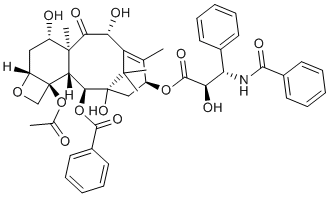
10-Deacetyltaxol (also called 10-Deacetylpaclitaxel), the 10-deacetylated form of paclitaxel, is a taxane analogue and impurity of Paclitaxel extracted from Taxus wallichiana Zucc with anticancer activities. It functions as a disruptor, inhibitor, and stabilizer of microtubules.
Physicochemical Properties
| Molecular Formula | C₄₅H₄₉NO₁₃ |
| Molecular Weight | 811.87 |
| Exact Mass | 811.32 |
| CAS # | 78432-77-6 |
| Related CAS # | 78432-77-6 |
| PubChem CID | 155831 |
| Appearance | White to off-white solid powder |
| Density | 1.4±0.1 g/cm3 |
| Boiling Point | 959.5±65.0 °C at 760 mmHg |
| Melting Point | 182-184ºC |
| Flash Point | 534.1±34.3 °C |
| Vapour Pressure | 0.0±0.3 mmHg at 25°C |
| Index of Refraction | 1.652 |
| LogP | 6.74 |
| Hydrogen Bond Donor Count | 5 |
| Hydrogen Bond Acceptor Count | 13 |
| Rotatable Bond Count | 12 |
| Heavy Atom Count | 59 |
| Complexity | 1680 |
| Defined Atom Stereocenter Count | 11 |
| SMILES | O1C([H])([H])[C@@]2([C@@]1([H])C([H])([H])[C@]([H])([C@@]1(C([H])([H])[H])C([C@]([H])(C3=C(C([H])([H])[H])[C@]([H])(C([H])([H])[C@](C3(C([H])([H])[H])C([H])([H])[H])([C@]([H])([C@]21[H])OC(C1C([H])=C([H])C([H])=C([H])C=1[H])=O)O[H])OC([C@@]([H])([C@]([H])(C1C([H])=C([H])C([H])=C([H])C=1[H])N([H])C(C1C([H])=C([H])C([H])=C([H])C=1[H])=O)O[H])=O)O[H])=O)O[H])OC(C([H])([H])[H])=O |
| InChi Key | TYLVGQKNNUHXIP-MHHARFCSSA-N |
| InChi Code | InChI=1S/C45H49NO13/c1-24-29(57-41(54)35(50)33(26-15-9-6-10-16-26)46-39(52)27-17-11-7-12-18-27)22-45(55)38(58-40(53)28-19-13-8-14-20-28)36-43(5,37(51)34(49)32(24)42(45,3)4)30(48)21-31-44(36,23-56-31)59-25(2)47/h6-20,29-31,33-36,38,48-50,55H,21-23H2,1-5H3,(H,46,52)/t29-,30-,31+,33-,34+,35+,36-,38-,43+,44-,45+/m0/s1 |
| Chemical Name | [(1S,2S,3R,4S,7R,9S,10S,12R,15S)-4-acetyloxy-15-[(2R,3S)-3-benzamido-2-hydroxy-3-phenylpropanoyl]oxy-1,9,12-trihydroxy-10,14,17,17-tetramethyl-11-oxo-6-oxatetracyclo[11.3.1.03,10.04,7]heptadec-13-en-2-yl] benzoate |
| Synonyms | 10-Deacetylpaclitaxel; 10-Deacetyltaxol; 10-Desacetyl Paclitaxel; 10-Deacetylpaclitaxel; 10-deacetyl-paclitaxel; 10-Desacetyltaxol; B77R96LJLK; 10-Deacetyltaxol |
| HS Tariff Code | 2934.99.9001 |
| Storage |
Powder-20°C 3 years 4°C 2 years In solvent -80°C 6 months -20°C 1 month |
| Shipping Condition | Room temperature (This product is stable at ambient temperature for a few days during ordinary shipping and time spent in Customs) |
Biological Activity
| Targets | Tubulin; impurity of taxol |
| ln Vitro | Activity-guided, chromatographic fractionation for a polar extract of Taxus wallichiana Zucc. (originally identified as Cephalotaxus mannii Hook.) resulted in the isolation of three new KB cytotoxic taxane derivatives. Nmr and ms spectral analyses permitted their characterization as 19-hydroxybaccatin III (3), 10-deacetylcephalomannine (4), and 10-deacetyltaxol (5). The latter two compounds, which are also active against PS leukemia in vivo, were observed to be especially labile, each forming equilibrium mixtures with their cytotoxic C-7 epimers (9, 10)[1]. |
| Cell Assay | The cytotoxic effects of taxol, 10-deacetyltaxol, and cephalomannine at concentrations of 0.1 mug/ml to 10.0 mug/ml for one and 24 hours exposure were determined in two human glioblastoma multiforme and two neuroblastoma cell lines using the MTT method. The neuroblastoma cell lines were established from previously treated patients, while the glioblastomas were from untreated patients. There was a proportionate concentration-toxicity relationship for all four cell lines. The neuroblastoma SK-N-FI was consistently the most resistant to all three drugs. The order of potency after a one hour exposure was taxol, 10-deacetyltaxol and cephalomannine. Cephalomannine contained 1.5% taxol impurity and 10-deacetyltaxol, 4.5% taxol hence the contribution of taxol to these substances' toxic effects was minimal. We conclude that tumors of the central and peripheral nervous system are sensitive to 10-deacetyltaxol and cephalomannine and these drugs are less toxic than taxol but remain within a therapeutic range[3]. |
| References |
[1]. 19-Hydroxybaccatin III, 10-deacetylcephalomannine, and 10-deacetyltaxol: new antitumor taxanes from Taxus wallichiana. J Nat Prod. 1981 May-Jun;44(3):312-9. [2]. Process for the preparation of taxol and 10-deacetyltaxol. US4857653A. [3]. Cephalomannine and 10-deacetyltaxol cytotoxicity in human glial and neuroblastoma cell-lines. Int J Oncol. 1993 Feb;2(2):297-9. |
| Additional Infomation |
Deacetyltaxol is a taxane diterpenoid. 10-Deacetyltaxol has been reported in Taxus cuspidata, Corylus avellana, and other organisms with data available. 10-Deacetyltaxol is an analog of paclitaxel with antineoplastic activity. 10-Deacetyltaxol binds to and stabilizes the resulting microtubules, thereby inhibiting microtubule disassembly which results in cell- cycle arrest at the G2/M phase and apoptosis. |
Solubility Data
| Solubility (In Vitro) | DMSO: 27~125 mg/mL (33.3~154 mM) |
| Solubility (In Vivo) |
Solubility in Formulation 1: ≥ 6.25 mg/mL (7.70 mM) (saturation unknown) in 10% DMSO + 40% PEG300 + 5% Tween80 + 45% Saline (add these co-solvents sequentially from left to right, and one by one), clear solution. For example, if 1 mL of working solution is to be prepared, you can add 100 μL of 62.5 mg/mL clear DMSO stock solution to 400 μL PEG300 and mix evenly; then add 50 μL Tween-80 to the above solution and mix evenly; then add 450 μL normal saline to adjust the volume to 1 mL. Preparation of saline: Dissolve 0.9 g of sodium chloride in 100 mL ddH₂ O to obtain a clear solution. Solubility in Formulation 2: ≥ 6.25 mg/mL (7.70 mM) (saturation unknown) in 10% DMSO + 90% Corn Oil (add these co-solvents sequentially from left to right, and one by one), clear solution. For example, if 1 mL of working solution is to be prepared, you can add 100 μL of 62.5 mg/mL clear DMSO stock solution to 900 μL corn oil and mix evenly. (Please use freshly prepared in vivo formulations for optimal results.) |
| Preparing Stock Solutions | 1 mg | 5 mg | 10 mg | |
| 1 mM | 1.2317 mL | 6.1586 mL | 12.3172 mL | |
| 5 mM | 0.2463 mL | 1.2317 mL | 2.4634 mL | |
| 10 mM | 0.1232 mL | 0.6159 mL | 1.2317 mL |