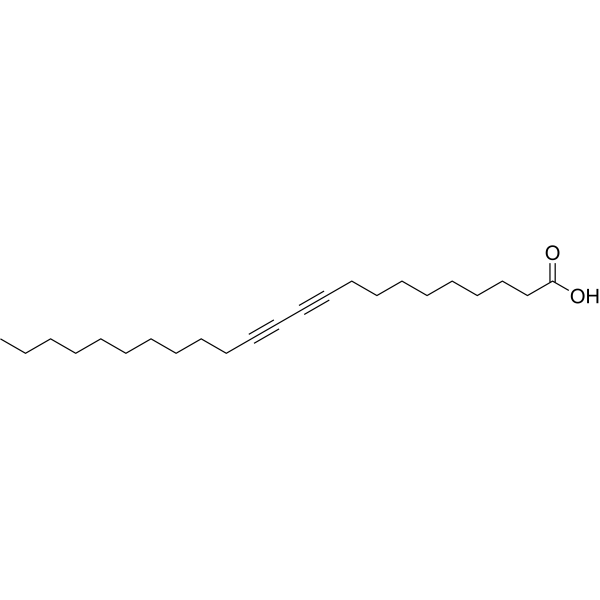
Physicochemical Properties
| Molecular Formula | C₂₃H₃₈O₂ |
| Molecular Weight | 346.55 |
| Exact Mass | 346.287 |
| CAS # | 66990-30-5 |
| Related CAS # | 66990-31-6 |
| PubChem CID | 538457 |
| Appearance | White to off-white solid powder |
| Density | 0.9±0.1 g/cm3 |
| Boiling Point | 498.8±28.0 °C at 760 mmHg |
| Melting Point | 56-60 °C |
| Flash Point | 236.0±18.7 °C |
| Vapour Pressure | 0.0±2.7 mmHg at 25°C |
| Index of Refraction | 1.487 |
| LogP | 9.17 |
| Hydrogen Bond Donor Count | 1 |
| Hydrogen Bond Acceptor Count | 2 |
| Rotatable Bond Count | 17 |
| Heavy Atom Count | 25 |
| Complexity | 438 |
| Defined Atom Stereocenter Count | 0 |
| InChi Key | DIEDVCMBPCRJFQ-UHFFFAOYSA-N |
| InChi Code | InChI=1S/C23H38O2/c1-2-3-4-5-6-7-8-9-10-11-12-13-14-15-16-17-18-19-20-21-22-23(24)25/h2-10,15-22H2,1H3,(H,24,25) |
| Chemical Name | tricosa-10,12-diynoic acid |
| Synonyms | 10,12Tricosadiynoic acid; 10,12 Tricosadiynoic acid |
| HS Tariff Code | 2934.99.9001 |
| Storage |
Powder-20°C 3 years 4°C 2 years In solvent -80°C 6 months -20°C 1 month Note: (1). This product requires protection from light (avoid light exposure) during transportation and storage.(2). Please store this product in a sealed and protected environment (e.g. under nitrogen), avoid exposure to moisture. |
| Shipping Condition | Room temperature (This product is stable at ambient temperature for a few days during ordinary shipping and time spent in Customs) |
Biological Activity
| ln Vitro | 10,12-eicosadiynoic acid-CoA quickly and in a concentration- and time-dependent manner suppresses ACOX1 activity. Following a 5-minute interaction with 10 equivalents of 10,12-eicosadoyl-CoA, the use of free 10,12-eicosadoyl-CoA as the substrate in the form of CoA thioester was the sole way to reduce the activity of ACOX1 by over 95%. ACOX1 activity is inhibited when it is active. It is irreversible for 10,12-tricosacardioic acid-CoA to block ACOX1. 680 nm and 3.18 min 1 are the computed kinetic parameters, KI and kinact, respectively [1]. The precursor of 10,12-Tricosadiynoic Acid-CoA is 10,12-Tricosadiynoic Acid. Once within the cell, peroxisomal very long chain polyester-CoA synthase (VLACS) transforms it into 10,12-tricosadinoic acid. In vivo, ACOX1 is inhibited by carbomynoic acid-CoA[1]. The activation of long-chain foamy coenzyme A oxidase 1 (ACOX1) by 10,12-diosadiynoic acid (500 nM) protects against Sirt5 siRNA removal [2]. |
| ln Vivo | 10,12-Docosinoic acid (100 μg/kg; oral gavage; daily; 8 weeks; male Wistar rats) stimulates the SIRT1-AMPK (adenosine 5′-monophosphate-activated protein kinase) pathway and multiplies Food-activated receptor α elevates cardiac hypertrophic oxidation (FAO) and diminishes hydrogen peroxide accumulation aided by high-fat diet, consequently lowering insulin and triglyceride levels and hepatic fetal ROS content [1]. 10,12-Dietary codonomycin acid (0 mg/kg, 37.5 mg/kg, 75 mg/kg, and 150 mg/kg) had no effect on weight gain, but it dramatically decreased the amount of peroxisomes in the liver. β-Oxidoperoxisomes β-oxisomes show higher levels of blood lipids, peroxidation products, and alanine transferase activity, and they also significantly lower superoxide dismutation. |
| Animal Protocol |
Animal/Disease Models: Male Wistar rats (210-230 g) High-fat diet feeding [1] Doses: 100 μg/kg Route of Administration: po (oral gavage); leaf activity of enzymes and catalase [3]. Daily; Results for 8 consecutive weeks: High-fat diet-fed rats had diminished accumulation of hydrogen peroxide, thereby Dramatically reducing liver lipid and ROS content, reducing weight gain, and lowering serum triglyceride and insulin levels. |
| References |
[1]. Specific Inhibition of Acyl-CoA Oxidase-1 by an Acetylenic Acid Improves Hepatic Lipid and Reactive Oxygen Species (ROS) Metabolism in Rats Fed a High Fat Diet. J Biol Chem. 2017 Mar 3;292(9):3800-3809. [2]. Sirtuin 5 Regulates Proximal Tubule Fatty Acid Oxidation to Protect against AKI. J Am Soc Nephrol. 2019 Dec;30(12):2384-2398. [3]. Impaired peroxisomal fat oxidation induces hepatic lipid accumulation and oxidative damage in Nile tilapia. Fish Physiol Biochem. 2020 Aug;46(4):1229-1242. |
| Additional Infomation | 10,12-tricosadiynoic acid is a very long-chain fatty acid. |
Solubility Data
| Solubility (In Vitro) | DMSO : ~100 mg/mL (~288.56 mM) |
| Solubility (In Vivo) |
Solubility in Formulation 1: 5 mg/mL (14.43 mM) in 10% DMSO + 40% PEG300 + 5% Tween80 + 45% Saline (add these co-solvents sequentially from left to right, and one by one), suspension solution; with sonication. For example, if 1 mL of working solution is to be prepared, you can add 100 μL of 50.0 mg/mL clear DMSO stock solution to 400 μL PEG300 and mix evenly; then add 50 μL Tween-80 to the above solution and mix evenly; then add 450 μL normal saline to adjust the volume to 1 mL. Preparation of saline: Dissolve 0.9 g of sodium chloride in 100 mL ddH₂ O to obtain a clear solution. Solubility in Formulation 2: 5 mg/mL (14.43 mM) in 10% DMSO + 90% (20% SBE-β-CD in Saline) (add these co-solvents sequentially from left to right, and one by one), suspension solution; with ultrasonication. For example, if 1 mL of working solution is to be prepared, you can add 100 μL of 50.0 mg/mL clear DMSO stock solution to 900 μL of 20% SBE-β-CD physiological saline solution and mix evenly. Preparation of 20% SBE-β-CD in Saline (4°C,1 week): Dissolve 2 g SBE-β-CD in 10 mL saline to obtain a clear solution. Solubility in Formulation 3: ≥ 5 mg/mL (14.43 mM) (saturation unknown) in 10% DMSO + 90% Corn Oil (add these co-solvents sequentially from left to right, and one by one), clear solution. For example, if 1 mL of working solution is to be prepared, you can add 100 μL of 50.0 mg/mL clear DMSO stock solution to 900 μL of corn oil and mix evenly. (Please use freshly prepared in vivo formulations for optimal results.) |
| Preparing Stock Solutions | 1 mg | 5 mg | 10 mg | |
| 1 mM | 2.8856 mL | 14.4279 mL | 28.8559 mL | |
| 5 mM | 0.5771 mL | 2.8856 mL | 5.7712 mL | |
| 10 mM | 0.2886 mL | 1.4428 mL | 2.8856 mL |