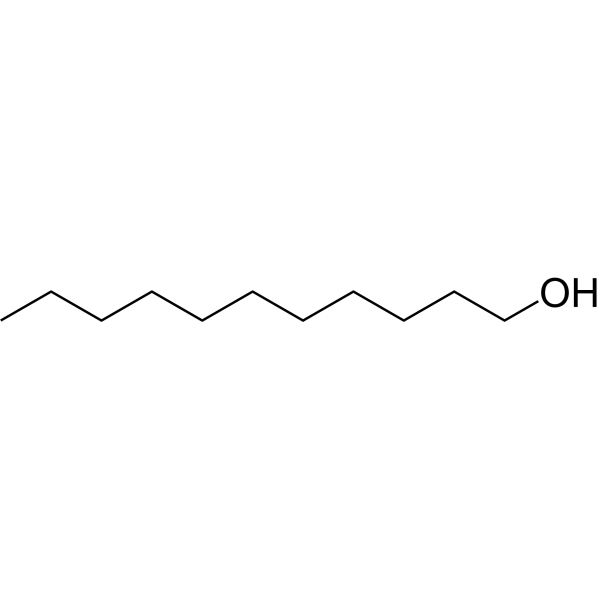
Physicochemical Properties
| Molecular Formula | C₁₁H₂₄O |
| Molecular Weight | 172.31 |
| Exact Mass | 172.182 |
| CAS # | 112-42-5 |
| Related CAS # | 1-Undecanol-d23;349553-88-4;1-Undecanol-d4;1219803-47-0 |
| PubChem CID | 8184 |
| Appearance | Colorless liquid |
| Density | 0.8±0.1 g/cm3 |
| Boiling Point | 243.2±3.0 °C at 760 mmHg |
| Melting Point | 11 °C(lit.) |
| Flash Point | 109.0±4.6 °C |
| Vapour Pressure | 0.0±1.1 mmHg at 25°C |
| Index of Refraction | 1.438 |
| LogP | 4.59 |
| Hydrogen Bond Donor Count | 1 |
| Hydrogen Bond Acceptor Count | 1 |
| Rotatable Bond Count | 9 |
| Heavy Atom Count | 12 |
| Complexity | 71.4 |
| Defined Atom Stereocenter Count | 0 |
| SMILES | O([H])C([H])([H])C([H])([H])C([H])([H])C([H])([H])C([H])([H])C([H])([H])C([H])([H])C([H])([H])C([H])([H])C([H])([H])C([H])([H])[H] |
| InChi Key | KJIOQYGWTQBHNH-UHFFFAOYSA-N |
| InChi Code | InChI=1S/C11H24O/c1-2-3-4-5-6-7-8-9-10-11-12/h12H,2-11H2,1H3 |
| Chemical Name | undecan-1-ol |
| Synonyms | 1Undecanol; 1 Undecanol |
| HS Tariff Code | 2934.99.9001 |
| Storage |
Powder-20°C 3 years 4°C 2 years In solvent -80°C 6 months -20°C 1 month |
| Shipping Condition | Room temperature (This product is stable at ambient temperature for a few days during ordinary shipping and time spent in Customs) |
Biological Activity
| Toxicity/Toxicokinetics |
Interactions ALCOHOL-INDUCED NUTRITIONAL ENCEPHALOMALACIA IN STARTING CHICKS COULD BE COMPLETELY PREVENTED BY DIETARY SUPPLEMENTATION OF D,L-ALPHA-TOCOPHERYL ACETATE. WITH USE OF SURFACTANTS EG TWEEN 80, ALCOHOL EMULSIONS WERE PHYTOTOXIC ONLY TO YOUNG MERISTEMATIC TISSUE. WITHOUT THE SURFACANT, C11 ALCOHOLS & ESTERS SHOWED NONSELECtIVE TISSUE KILL. Non-Human Toxicity Values LD50 Rabbit dermal >5g/kg /From table/ LD50 Rat oral 3000 mg/kg LD50 Guinea pig dermal >20 g/kg |
| References |
[1]. Bacterial oxidation of 2-tridecanone to 1-undecanol. J Bacteriol. 1967 Feb;93(2):649-55. |
| Additional Infomation |
1-undecanol appears as a water-white liquid with a mild odor. Flash point 250 °F. Slightly soluble in water. Considered a marine pollutant by DOT. Immediate steps should be taken to limit its spread to the environment. As a liquid it can easily penetrate the soil and contaminate groundwater or streams. Mildly irritating to both the eyes and skin. Undecan-1-ol is a primary alcohol that is undecane substituted by a hydroxy group at position 1. It has a role as a plant metabolite and a flavouring agent. It is a primary alcohol and an undecanol. 1-Undecanol has been reported in Leea guineensis, Pelargonium endlicherianum, and other organisms with data available. Undecanol is a metabolite found in or produced by Saccharomyces cerevisiae. Mechanism of Action ... Undecanol was the most potent fungicide followed by decanol. The time-kill curve study showed that undecanol was fungicidal against S. cerevisiae at any growth stages was not influenced by pH values. The alcohols tested inhibited glucose-induced acidification by inhibiting the plasma membrane H(+)-ATPase. The primary antifungal action of amphipathic medium-chain (C(9)-C(12)) alkanols comes mainly from their ability as nonionic surfactants to disrupt the native membrane-associated function of the integral proteins. |
Solubility Data
| Solubility (In Vitro) | DMSO : ~100 mg/mL (~580.35 mM) |
| Solubility (In Vivo) |
Solubility in Formulation 1: ≥ 4.55 mg/mL (26.41 mM) (saturation unknown) in 10% DMSO + 40% PEG300 + 5% Tween80 + 45% Saline (add these co-solvents sequentially from left to right, and one by one), clear solution. For example, if 1 mL of working solution is to be prepared, you can add 100 μL of 45.5 mg/mL clear DMSO stock solution to 400 μL PEG300 and mix evenly; then add 50 μL Tween-80 to the above solution and mix evenly; then add 450 μL normal saline to adjust the volume to 1 mL. Preparation of saline: Dissolve 0.9 g of sodium chloride in 100 mL ddH₂ O to obtain a clear solution. Solubility in Formulation 2: ≥ 2.5 mg/mL (14.51 mM) (saturation unknown) in 10% DMSO + 90% (20% SBE-β-CD in Saline) (add these co-solvents sequentially from left to right, and one by one), clear solution. For example, if 1 mL of working solution is to be prepared, you can add 100 μL of 25.0 mg/mL clear DMSO stock solution to 900 μL of 20% SBE-β-CD physiological saline solution and mix evenly. Preparation of 20% SBE-β-CD in Saline (4°C,1 week): Dissolve 2 g SBE-β-CD in 10 mL saline to obtain a clear solution. Solubility in Formulation 3: ≥ 2.5 mg/mL (14.51 mM) (saturation unknown) in 10% DMSO + 90% Corn Oil (add these co-solvents sequentially from left to right, and one by one), clear solution. For example, if 1 mL of working solution is to be prepared, you can add 100 μL of 25.0 mg/mL clear DMSO stock solution to 900 μL of corn oil and mix evenly. (Please use freshly prepared in vivo formulations for optimal results.) |
| Preparing Stock Solutions | 1 mg | 5 mg | 10 mg | |
| 1 mM | 5.8035 mL | 29.0175 mL | 58.0349 mL | |
| 5 mM | 1.1607 mL | 5.8035 mL | 11.6070 mL | |
| 10 mM | 0.5803 mL | 2.9017 mL | 5.8035 mL |