Physicochemical Properties
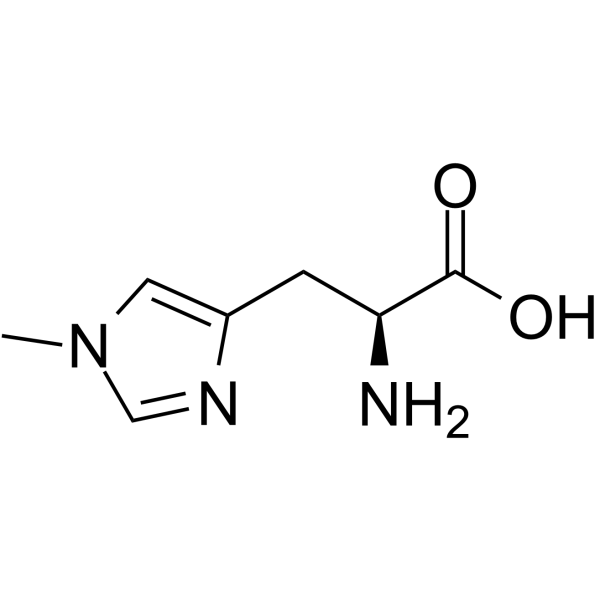
| Molecular Formula | C7H11N3O2 |
| Molecular Weight | 169.18114 |
| Exact Mass | 169.085 |
| CAS # | 332-80-9 |
| PubChem CID | 92105 |
| Appearance | White to off-white solid powder |
| Density | 1.4±0.1 g/cm3 |
| Boiling Point | 415.0±35.0 °C at 760 mmHg |
| Melting Point | ~240 °C (dec.)(lit.) |
| Flash Point | 204.8±25.9 °C |
| Vapour Pressure | 0.0±1.0 mmHg at 25°C |
| Index of Refraction | 1.613 |
| LogP | -1.31 |
| Hydrogen Bond Donor Count | 2 |
| Hydrogen Bond Acceptor Count | 4 |
| Rotatable Bond Count | 3 |
| Heavy Atom Count | 12 |
| Complexity | 174 |
| Defined Atom Stereocenter Count | 1 |
| SMILES | CN1C=C(N=C1)C[C@@H](C(=O)O)N |
| InChi Key | BRMWTNUJHUMWMS-LURJTMIESA-N |
| InChi Code | InChI=1S/C7H11N3O2/c1-10-3-5(9-4-10)2-6(8)7(11)12/h3-4,6H,2,8H2,1H3,(H,11,12)/t6-/m0/s1 |
| Chemical Name | (2S)-2-amino-3-(1-methylimidazol-4-yl)propanoic acid |
| HS Tariff Code | 2934.99.9001 |
| Storage |
Powder-20°C 3 years 4°C 2 years In solvent -80°C 6 months -20°C 1 month |
| Shipping Condition | Room temperature (This product is stable at ambient temperature for a few days during ordinary shipping and time spent in Customs) |
Biological Activity
| Animal Protocol | - Male rats were utilized for the study. Rats were fed diets supplemented with meats from different sources (beef, pork, chicken) or exogenous 3-methylhistidine. Urine samples were continuously collected for 24-72 hours post-feeding, acidified immediately, and stored at -20°C for subsequent analysis. 1-Methyl-L-histidine in urine was quantified using chromatographic techniques to verify its excretion as a marker of exogenous intake [1] |
| ADME/Pharmacokinetics | - 1-Methyl-L-histidine is a urinary excretion metabolite serving as a qualitative indicator of exogenous 3-methylhistidine intake. After oral ingestion of exogenous 3-methylhistidine or meats from various sources (beef, pork, chicken), 1-Methyl-L-histidine is excreted in urine without significant metabolic transformation. It is detectable in urine within 24 hours of intake, and its presence specifically confirms the ingestion of exogenous 3-methylhistidine-containing proteins [1] |
| References |
[1]. Urinary excretion of 1-methylhistidine: a qualitative indicator of exogenous 3-methylhistidine and intake of meats from various sources. Metabolism. 1987 Dec;36(12):1175-84. |
| Additional Infomation |
N(tele)-methyl-L-histidine is a L-histidine derivative in which the methyl group is at N(tele)-position. It has a role as a human metabolite. It is a L-histidine derivative and a non-proteinogenic L-alpha-amino acid. It is a tautomer of a N(tele)-methyl-L-histidine zwitterion. 1-Methylhistidine is a metabolite found in or produced by Escherichia coli (strain K12, MG1655). 1-Methyl-L-histidine has been reported in Prunus domestica with data available. 1-Methylhistidine is a histidine derivative that has a methyl group bound to the nitrogen at position 1 and results from the metabolism of the dipeptide anserine. Urinary levels of 1-methylhistidine may be indicative of myofibrillar protein degradation or a high protein diet. - 1-Methyl-L-histidine is a naturally occurring methylated histidine derivative [1] - It is a specific qualitative biomarker for exogenous 3-methylhistidine intake and meat consumption (beef, pork, chicken), as it is not endogenously synthesized in mammals. Its urinary excretion directly reflects the ingestion of proteins rich in 3-methylhistidine [1] |
Solubility Data
| Solubility (In Vitro) | H2O : ~125 mg/mL (~738.86 mM) |
| Solubility (In Vivo) |
Solubility in Formulation 1: 100 mg/mL (591.09 mM) in PBS (add these co-solvents sequentially from left to right, and one by one), clear solution; with sonication. (Please use freshly prepared in vivo formulations for optimal results.) |
| Preparing Stock Solutions | 1 mg | 5 mg | 10 mg | |
| 1 mM | 5.9109 mL | 29.5543 mL | 59.1086 mL | |
| 5 mM | 1.1822 mL | 5.9109 mL | 11.8217 mL | |
| 10 mM | 0.5911 mL | 2.9554 mL | 5.9109 mL |