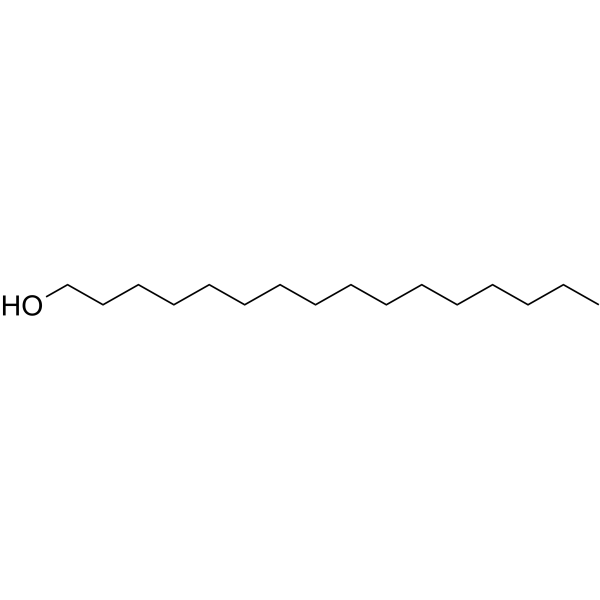
Physicochemical Properties
| Molecular Formula | C16H34O |
| Molecular Weight | 242.4406 |
| Exact Mass | 242.26 |
| CAS # | 36653-82-4 |
| Related CAS # | 1-Hexadecanol-d5;1219799-18-4;1-Hexadecanol-d4;1398065-49-0;1-Hexadecanol-d31;203633-15-2;1-Hexadecanol-d33;284474-73-3;1-Hexadecanol-d3;75736-52-6 |
| PubChem CID | 2682 |
| Appearance | White to off-white solid powder |
| Density | 0.8±0.1 g/cm3 |
| Boiling Point | 310.9±5.0 °C at 760 mmHg |
| Melting Point | 49-51 °C |
| Flash Point | 135.0±0.0 °C |
| Vapour Pressure | 0.0±1.5 mmHg at 25°C |
| Index of Refraction | 1.448 |
| LogP | 7.25 |
| Hydrogen Bond Donor Count | 1 |
| Hydrogen Bond Acceptor Count | 1 |
| Rotatable Bond Count | 14 |
| Heavy Atom Count | 17 |
| Complexity | 123 |
| Defined Atom Stereocenter Count | 0 |
| InChi Key | BXWNKGSJHAJOGX-UHFFFAOYSA-N |
| InChi Code | InChI=1S/C16H34O/c1-2-3-4-5-6-7-8-9-10-11-12-13-14-15-16-17/h17H,2-16H2,1H3 |
| Chemical Name | hexadecan-1-ol |
| HS Tariff Code | 2934.99.9001 |
| Storage |
Powder-20°C 3 years 4°C 2 years In solvent -80°C 6 months -20°C 1 month Note: This product requires protection from light (avoid light exposure) during transportation and storage. |
| Shipping Condition | Room temperature (This product is stable at ambient temperature for a few days during ordinary shipping and time spent in Customs) |
Biological Activity
| ln Vitro |
1. Role as a precursor for antiproliferative sophorolipids: - 1-Hexadecanol (cetyl alcohol) was used as a fatty acid precursor to synthesize novel sophorolipids (C16-SL) via microbial fermentation [1] - The derived C16-SL showed dose-dependent antiproliferative activity against HeLa cells, with an IC₅₀ value of 125 μM after 48 h treatment; 1-Hexadecanol alone did not exhibit direct antiproliferative activity at tested concentrations (up to 200 μM) [1] 2. Apoptosis induction by C16-SL (derived from 1-Hexadecanol): - Treatment with C16-SL (150 μM, 24 h) increased the apoptotic rate of HeLa cells to 42.3% (vs. 2.1% in control) as detected by Annexin V-FITC/PI staining [1] - DAPI staining showed chromatin condensation and nuclear fragmentation in HeLa cells treated with C16-SL, which was attributed to the precursor 1-Hexadecanol’s structural contribution to the sophorolipid’s activity [1] 3. Cell morphological changes: - HeLa cells treated with C16-SL (100 μM, 24 h) showed shrinkage, loss of adherence, and formation of apoptotic bodies; 1-Hexadecanol alone did not cause such changes [1] |
| Cell Assay |
1. HeLa cell culture and proliferation assay (for C16-SL, derived from 1-Hexadecanol): - HeLa cells were cultured in DMEM medium supplemented with 10% fetal bovine serum (FBS) and antibiotics, maintained at 37°C in a 5% CO₂ incubator [1] - Cells (5×10³ cells/well) were seeded in 96-well plates and treated with C16-SL (0-200 μM, synthesized using 1-Hexadecanol as precursor) for 24-72 h; 1-Hexadecanol alone (0-200 μM) was used as a control [1] - MTT solution (5 mg/ml) was added (20 μl/well) and incubated for 4 h; formazan crystals were dissolved in DMSO, and absorbance was measured at 570 nm to calculate cell viability and IC₅₀ [1] 2. Apoptosis detection (Annexin V-FITC/PI staining): - HeLa cells (1×10⁶ cells/ml) were treated with C16-SL (150 μM) for 24 h; 1-Hexadecanol (150 μM) was used as a control [1] - Cells were harvested, washed with PBS, stained with Annexin V-FITC and PI for 15 min in the dark, and analyzed by flow cytometry to determine apoptotic rates [1] 3. DAPI staining for nuclear morphology: - Treated HeLa cells were fixed with 4% paraformaldehyde for 15 min, washed with PBS, and stained with DAPI (1 μg/ml) for 10 min [1] - Nuclear changes (chromatin condensation, fragmentation) were observed under a fluorescence microscope, with 1-Hexadecanol-treated cells showing no abnormal nuclear morphology [1] |
| ADME/Pharmacokinetics |
Absorption, Distribution and Excretion Following ingestion at a dose level of 2.0 g/kg in rats, cetyl alcohol was partly absorbed. Administration of 0.2 mg cetyl alcohol in rat by stomach tube indicated good absorption as 63-96 % of radiolabeled cetyl alcohol was detected in the lymph. About 15% of total cetyl alcohol was unchanged during its passage through the mucosal cells of the small intestine but mostly underwent oxidation to palmitic acid. The extent of absorption was reported to be 26% in poultry. Following ingestion at a dose level of 2.0 g/kg in rats, about 20% of the dose was recovered as unchanged molecule in the feces. This may be due to the interconvertibility of fatty acids and alcohols, resulting in the conversion of palmitic acid to cetyl alcohol during its passage through the intestinal mucosal cells into the intestinal lumen. In rats, cetyl Alcohol was also excreted in the urine as conjugated glucuronic acid and as expired carbon dioxide. Following ingestion at a dose level of 2.0 g/kg bw /in rats/, 1-hexadecanone is partly absorbed and metabolized, about 20% of the dose being recovered unchanged in the feces. Metabolism / Metabolites Following ingestion at a dose level of 2.0 g/kg in rats, cetyl alcohol was partly metabolized to palmitic acid. After administration of 0.2 mg cetyl alcohol in rat by stomach tube, cetyl alcohol was mostly oxidized to palmitic acid and incorporated into triglycerides and phospholipids during its passage through the mucosal cells of the small intestine. Cetyl alcohol is oxidized in rats to the corresponding fatty acid, palmitic acid. The primary aliphatic alcohols undergo two general reactions in vivo, namely oxidation to carboxylic acids and direct conjugation with glucuronic acid. The first reaction proceeds with the intermediate formation of an aldehyde, and the carboxylic acid from this may be either oxidized completely to carbon dioxide or excreted as such or combined with glucuronic acid as an ester glucuronide. The extent to which as alcohol undergoes the second reaction, i.e. direct conjugation to an ether glucuronide, appears to depend upon the speed of the first reaction, for alcohols which are rapidly oxidized from very little ether glucuronide unless given in high doses. |
| Toxicity/Toxicokinetics |
Toxicity Data LCLo (rat) = 2,220 mg/m3/6h Interactions ... Chymotrypsin showed loss of activity in the presence of triethanolamine stearate, glyceryl tripalmitate and cetyl alcohol within 30 min. Non-Human Toxicity Values LD50 Guinea pig dermal < 10 g/kg LD50 Rat oral 5 g/kg LD50 Rat ip 1600 mg/kg LD50 Mouse oral 3200 mg/kg LD50 Mouse ip 1600 mg/kg - Toxicity of C16-SL (derived from 1-Hexadecanol) on normal cells: C16-SL (200 μM) showed low cytotoxicity on Vero cells (normal African green monkey kidney cells), with a cell viability of 81.2% (vs. 32.5% for HeLa cells) [1] |
| References |
[1]. Anti-proliferative effect of novel primary cetyl alcohol derived sophorolipids against human cervical cancer cells HeLa. PLoS One. 2017 Apr 18;12(4):e0174241. [2]. Peroxisome-driven ether-linked phospholipids biosynthesis is essential for ferroptosis. Cell Death Differ. 2021 Aug;28(8):2536-2551. |
| Additional Infomation |
Hexadecan-1-ol is a long-chain primary fatty alcohol that is hexadecane substituted by a hydroxy group at position 1. It has a role as a human metabolite, an algal metabolite, a plant metabolite and a flavouring agent. It is a long-chain primary fatty alcohol and a hexadecanol. Cetyl alcohol, also known as 1-hexadecanol or n-hexadecyl alcohol, is a 16-C fatty alcohol with the chemical formula CH3(CH2)15OH. It can be produced from the reduction of palmitic acid. Cetyl alcohol is present in a waxy white powder or flake form at room temperature, and is insoluble in water and soluble in alcohols and oils. Discovered by Chevrenl in 1913, cetyl alcohol is one of the oldest known long-chain alcohol. It may be contained in cosmetic and personal care products such as shampoos, creams and lotions. Mainly it is used as an opacifier, emulsifier, and thickening agent that alter the thickness of the liquid, and increase and stabilize the foaming capacity. Due to its water-binding property, cetyl alcohol is commonly used as an emollient that prevents drying and chapping of the skin. According to the FDA Code of Federal Regulations, cetyl alcohol is a safe synthetic fatty acid in food and in the synthesis of food components under the condition that it contain not less than 98 percent of total alcohols and not less than 94 percent of straight chain alcohols. Cetyl alcohol is also listed in the OTC ingredient list as a skin protectant for skin irritations caused by poison ivy, oak, sumac, and insect bites or stings. Cetyl alcohol is reported to be a mild skin or eye irritant. 1-Hexadecanol has been reported in Camellia sinensis, Angelica gigas, and other organisms with data available. Cetyl Alcohol is a synthetic, solid, fatty alcohol and nonionic surfactant. Cetyl alcohol is used as an emulsifying agent in pharmaceutical preparations. Cetyl alcohol, also known as 1-hexadecanol and palmityl alcohol, is a solid organic compound and a member of the alcohol class of compounds. Its chemical formula is CH3(CH2)15OH. At room temperature, cetyl alcohol takes the form of a waxy white solid or flakes. It belongs to the group of fatty alcohols. With the demise of commercial whaling, cetyl alcohol is no longer primarily produced from whale oil, but instead either as an end-product of the petroleum industry, or produced from vegetable oils such as palm oil and coconut oil. Production of cetyl alcohol from palm oil gives rise to one of its alternative names, palmityl alcohol. See also: Cetyl alcohol; colfosceril palmitate; tyloxapol (component of); Moringa oleifera leaf oil (part of); Alcohols, C14-18 (annotation moved to) ... View More ... Drug Indication No therapeutic indications in medicinal products. Indicated to be used as an indirect additive in food contact substances, or an ingredient in commercial or cosmetic products. Mechanism of Action Cetyl alcohol has hydrating properties that makes it a suitable emulsifier and stabilizer in pharmaceutical formulations. It is also present in washable ointment base due to its dispersant abilities and stabilizing properties. Potential antimicrobial activity of cetyl alcohol may be due to a change in cell membrane permeability that either blocks absorption of essential nutrients and induction of outward diffusion vital cellular components. This proposed mechanism of action is thought to be similar for other long-chain aliphatic alcohols with same antimicrobial activity, such as myristyl alcohol and behenyl alcohol. Therapeutic Uses A synthetic surfactant (Exosurf), and its non-surface-active components tyloxapol and cetyl alcohol, can function as antioxidants, and their in vivo instillation is associated with decreased hyperoxic injury in rats. Pharmacodynamics Cetyl alcohol exhibits skin protect properties against skin irritations caused by bites, rashes and stings. The inhibitory action of cetyl alcohol against the growth of _Mycoplasma gallisepticum_ and _Mycopiasma pneumoniae_ has been reported. 1. Chemical background of 1-Hexadecanol: - 1-Hexadecanol (cetyl alcohol) is a saturated fatty alcohol with 16 carbon atoms, commonly used as a precursor in the synthesis of lipids and surfactants [1] 2. Synthesis of C16-SL using 1-Hexadecanol: - 1-Hexadecanol was added to a microbial culture (Candida bombicola) as a carbon source, fermented for 120 h at 30°C, and the resulting sophorolipids (C16-SL) were purified via solvent extraction and column chromatography [1] 3. Mechanism of C16-SL (derived from 1-Hexadecanol): - C16-SL induced apoptosis in HeLa cells possibly by disrupting the cell membrane and activating apoptotic signaling pathways; 1-Hexadecanol itself did not trigger such mechanisms [1] |
Solubility Data
| Solubility (In Vitro) | DMSO : ~10 mg/mL (~41.25 mM) |
| Solubility (In Vivo) |
Solubility in Formulation 1: 1 mg/mL (4.12 mM) in 10% DMSO + 40% PEG300 + 5% Tween80 + 45% Saline (add these co-solvents sequentially from left to right, and one by one), suspension solution; with sonication. For example, if 1 mL of working solution is to be prepared, you can add 100 μL of 10.0 mg/mL clear DMSO stock solution to 400 μL of PEG300 and mix evenly; then add 50 μL of Tween-80 to the above solution and mix evenly; then add 450 μL of normal saline to adjust the volume to 1 mL. Preparation of saline: Dissolve 0.9 g of sodium chloride in 100 mL ddH₂ O to obtain a clear solution. Solubility in Formulation 2: ≥ 1 mg/mL (4.12 mM) (saturation unknown) in 10% DMSO + 90% Corn Oil (add these co-solvents sequentially from left to right, and one by one), clear solution. For example, if 1 mL of working solution is to be prepared, you can add 100 μL of 10.0 mg/mL clear DMSO stock solution to 900 μL of corn oil and mix evenly. (Please use freshly prepared in vivo formulations for optimal results.) |
| Preparing Stock Solutions | 1 mg | 5 mg | 10 mg | |
| 1 mM | 4.1247 mL | 20.6237 mL | 41.2473 mL | |
| 5 mM | 0.8249 mL | 4.1247 mL | 8.2495 mL | |
| 10 mM | 0.4125 mL | 2.0624 mL | 4.1247 mL |