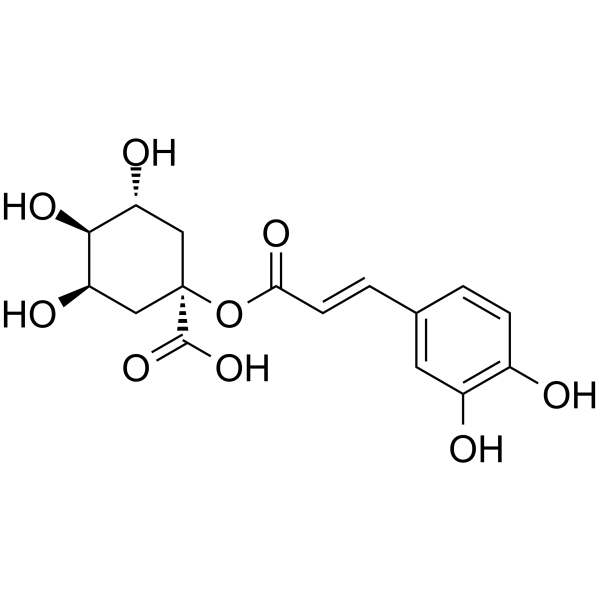
Physicochemical Properties
| Molecular Formula | C16H18O9 |
| Molecular Weight | 354.31 |
| Exact Mass | 354.095 |
| CAS # | 1241-87-8 |
| PubChem CID | 10155076 |
| Appearance | White to off-white solid powder |
| Density | 1.7±0.1 g/cm3 |
| Boiling Point | 636.2±55.0 °C at 760 mmHg |
| Flash Point | 234.5±25.0 °C |
| Vapour Pressure | 0.0±2.0 mmHg at 25°C |
| Index of Refraction | 1.690 |
| LogP | 0.06 |
| Hydrogen Bond Donor Count | 6 |
| Hydrogen Bond Acceptor Count | 9 |
| Rotatable Bond Count | 5 |
| Heavy Atom Count | 25 |
| Complexity | 520 |
| Defined Atom Stereocenter Count | 2 |
| SMILES | C1[C@H](C([C@@H](CC1(C(=O)O)OC(=O)/C=C/C2=CC(=C(C=C2)O)O)O)O)O |
| InChi Key | GWTUHAXUUFROTF-AVXJPILUSA-N |
| InChi Code | InChI=1S/C16H18O9/c17-9-3-1-8(5-10(9)18)2-4-13(21)25-16(15(23)24)6-11(19)14(22)12(20)7-16/h1-5,11-12,14,17-20,22H,6-7H2,(H,23,24)/b4-2+/t11-,12-,14?,16?/m1/s1 |
| Chemical Name | (3R,5R)-1-[(E)-3-(3,4-dihydroxyphenyl)prop-2-enoyl]oxy-3,4,5-trihydroxycyclohexane-1-carboxylic acid |
| HS Tariff Code | 2934.99.9001 |
| Storage |
Powder-20°C 3 years 4°C 2 years In solvent -80°C 6 months -20°C 1 month Note: This product requires protection from light (avoid light exposure) during transportation and storage. |
| Shipping Condition | Room temperature (This product is stable at ambient temperature for a few days during ordinary shipping and time spent in Customs) |
Biological Activity
| Targets |
Nuclear factor-kappaB (NF-κB) precursor protein p105 (Rel homology domain). Molecular docking predicted a binding energy of -11.15 Kcal/mol and an inhibition constant (Ki) of 0.007 μM. [1] The study suggests potential targets related to the anti-hyperuricemic and anti-gout effects of Gnaphalium pensylvanicum extract, which is rich in caffeoylquinic acid derivatives including 1-caffeoylquinic acid. Mentioned targets include renal urate transporters (URAT1, GLUT9, OAT1) and the enzyme xanthine oxidase (XO). However, no specific IC50, Ki, or EC50 values for 1-Caffeoylquinic acid against these targets were provided in this study. [2] PD-1/PD-L1 pathway (competitive inhibitor) Binding affinity (KD) to PD-1: 12.4 μM (1.24 × 10⁻⁵ M) IC₅₀ for inhibition of PD-1/PD-L1 interaction: 87.28 μM[3] |
| ln Vitro |
1-Caffeoylquinic acid (1-CQA) was identified as a PD-1/PD-L1 inhibitor using surface plasmon resonance (SPR) technology[3] It binds to PD-1 with a dissociation constant (KD) of 12.4 μM, but no binding to PD-L1 was detected (ND)[3] In a competition assay, it inhibited the PD-1/PD-L1 interaction with an IC₅₀ of 87.28 μM[3] The maximum inhibition rate of 1-CQA on PD-1/PD-L1 interaction was determined, and it showed a dose-dependent inhibitory effect in SPR competition assays[3] It is one of the four mono-CQAs (along with 3-CQA, 4-CQA, and 5-CQA) selected as potential small-molecule inhibitors of the PD-1/PD-L1 pathway[3] |
| ln Vivo |
The study evaluated the effects of Gnaphalium pensylvanicum extract (GPE), which contains 1-Caffeoylquinic acid as one of its components, in animal models. The extract (at doses of 100, 200, and 400 mg/kg/day, intragastrically) significantly reduced serum uric acid levels in potassium oxonate-induced hyperuricemic mice in a dose-dependent manner. [2] The extract (at the same doses) also inhibited liver xanthine oxidase (XO) activity in hyperuricemic mice. [2] In hyperuricemic mice, the extract downregulated the protein expression of renal mURAT1 and mGLUT9 and upregulated mOAT1 expression, as determined by Western blot. [2] The extract (at doses of 100, 200, and 400 mg/kg/day, intragastrically) significantly reduced paw swelling in monosodium urate (MSU) crystal-induced acute gouty arthritis in mice. [2] The extract reduced serum levels of pro-inflammatory cytokines TNF-α and IL-1β in MSU crystal-induced mice. [2] Note: These effects are attributed to the whole extract containing caffeoylquinic acid derivatives, not to isolated 1-Caffeoylquinic acid. [2] |
| Enzyme Assay |
Surface plasmon resonance (SPR) was used to study the binding and competitive inhibition of 1-CQA against PD-1/PD-L1[3] Recombinant human PD-1 and PD-L1 extracellular domains were immobilized on a CM5 sensor chip via amine coupling[3] For protein-protein interaction, PD-1 was flowed over immobilized PD-L1 to determine their affinity (KD = 0.17 μM)[3] For small-molecule binding, 1-CQA was diluted in PBS-P buffer at concentrations ranging from 0.98 μM to 500 μM and flowed over immobilized PD-1 at 30 μL/min with 60 s contact time and 150 s dissociation time[3] The equilibrium dissociation constant (KD) was calculated using kinetic models in the SPR evaluation software[3] For competition assays, 1-CQA was incubated with 392 nM PD-1 for 15 min before injection over immobilized PD-L1[3] Concentrations of 1-CQA ranged from 1.25 to 200 μM in the competition experiment[3] The inhibition curve was fitted to calculate the IC₅₀ value[3] |
| Animal Protocol |
Hyperuricemia Model: Male Kun-Ming mice were induced with hyperuricemia by intraperitoneal injection of potassium oxonate (PO, 300 mg/kg). Gnaphalium pensylvanicum extract (GPE) containing caffeoylquinic acid derivatives was administered intragastrically at doses of 100, 200, and 400 mg/kg/day, dissolved in 0.5% DMSO and physiological saline, for 6 days prior to and on the day of PO induction. [2] Acute Gouty Arthritis Model: Male ICR mice were induced by hypodermic injection of 0.1 mL (10 mg) MSU crystal suspension into the right foot pad. GPE was administered intragastrically at doses of 100, 200, and 400 mg/kg/day, dissolved in 0.5% DMSO and physiological saline, once daily for 7 days prior to and 1 day after MSU injection. [2] |
| References |
[1]. Dietary phytochemicals as potent chemotherapeutic agents against breast cancer: Inhibition of NF-κB pathway via molecular interactions in rel homology domain of its precursor protein p105. Pharmacogn Mag. 2013 Jan;9(33):51-7. [2]. Caffeoylquinic acid derivatives rich extract from Gnaphalium pensylvanicum willd. Ameliorates hyperuricemia and acute gouty arthritis in animal model. BMC Complement Altern Med. 2017 Jun 17;17(1):320. [3]. PD-1/PD-L1 inhibitor screening of caffeoylquinic acid compounds using surface plasmon resonance spectroscopy. Anal Biochem. 2018 Apr 15;547:52-56. |
| Additional Infomation |
1-O-caffeoylquinic acid is an alkyl caffeate ester obtained by the formal condensation of the carboxy group of trans-caffeic acid with the 1-hydroxy group of (-)-quinic acid. It has a role as a Camellia sinensis metabolite, a NF-kappaB inhibitor, an antineoplastic agent and an antioxidant. It is a quinic acid and an alkyl caffeate ester. It is functionally related to a trans-caffeic acid. It derives from a hydride of a (-)-quinic acid. 1-Caffeoylquinic acid has been reported in Erigeron breviscapus, Embelia schimperi, and Lonicera japonica with data available. 1-Caffeoylquinic acid is a dietary phytochemical sourced from quince (Cydonia oblonga). [1] In this computational study, 1-Caffeoylquinic acid was identified as a potent inhibitor of the NF-κB precursor protein p105 through molecular docking simulations. It was predicted to bind within the Rel homology (RH) domain of p105, which is critical for DNA binding and dimerization. The interaction involved hydrophobic contacts with amino acid residues ARG59, GLY69, HIS67, ARG57, GLY68, PRO65, GLY141, PHE56, and VAL115, with hydrogen bonds formed specifically with HIS67 and ARG59. [1] The study suggests that by binding to the RH domain of p105, 1-Caffeoylquinic acid may potentially hinder the dimerization of its processed form p50 and/or obstruct the DNA-binding ability of functional NF-κB dimers, thereby inhibiting the expression of genes involved in tumor growth and metastasis, particularly in the context of breast cancer. [1] 1-Caffeoylquinic acid was identified as one of the main caffeoylquinic acid derivatives present in Gnaphalium pensylvanicum extract (GPE) using UPLC-ESI-MS/MS analysis. [2] The study hypothesizes that the anti-hyperuricemic and anti-gouty arthritis effects of GPE may be partially attributed to its content of caffeoylquinic acid derivatives, including 1-Caffeoylquinic acid, through mechanisms involving inhibition of xanthine oxidase, modulation of renal urate transporters (URAT1, GLUT9, OAT1), and reduction of pro-inflammatory cytokines (TNF-α, IL-1β). [2] The plant Gnaphalium pensylvanicum is used in traditional Chinese medicine for anti-inflammatory purposes and rheumatism arthritis. [2] 1-Caffeoylquinic acid is a natural product belonging to the caffeoylquinic acid family[3] It was screened as a small-molecule inhibitor of the PD-1/PD-L1 immune checkpoint pathway using SPR technology[3] It exhibited competitive inhibition against PD-1/PD-L1 interaction, although its IC₅₀ was higher than some reported peptide-based inhibitors[3] The study suggests that natural products like 1-CQA may serve as a source for developing PD-1/PD-L1 targeted cancer immunotherapies[3] Further validation in cellular and animal models is recommended to confirm its efficacy[3] |
Solubility Data
| Solubility (In Vitro) | DMSO : ~250 mg/mL (~705.60 mM) |
| Solubility (In Vivo) |
Note: Listed below are some common formulations that may be used to formulate products with low water solubility (e.g. < 1 mg/mL), you may test these formulations using a minute amount of products to avoid loss of samples. Injection Formulations (e.g. IP/IV/IM/SC) Injection Formulation 1: DMSO : Tween 80: Saline = 10 : 5 : 85 (i.e. 100 μL DMSO stock solution → 50 μL Tween 80 → 850 μL Saline) *Preparation of saline: Dissolve 0.9 g of sodium chloride in 100 mL ddH ₂ O to obtain a clear solution. Injection Formulation 2: DMSO : PEG300 :Tween 80 : Saline = 10 : 40 : 5 : 45 (i.e. 100 μL DMSO → 400 μLPEG300 → 50 μL Tween 80 → 450 μL Saline) Injection Formulation 3: DMSO : Corn oil = 10 : 90 (i.e. 100 μL DMSO → 900 μL Corn oil) Example: Take the Injection Formulation 3 (DMSO : Corn oil = 10 : 90) as an example, if 1 mL of 2.5 mg/mL working solution is to be prepared, you can take 100 μL 25 mg/mL DMSO stock solution and add to 900 μL corn oil, mix well to obtain a clear or suspension solution (2.5 mg/mL, ready for use in animals). Injection Formulation 4: DMSO : 20% SBE-β-CD in saline = 10 : 90 [i.e. 100 μL DMSO → 900 μL (20% SBE-β-CD in saline)] *Preparation of 20% SBE-β-CD in Saline (4°C,1 week): Dissolve 2 g SBE-β-CD in 10 mL saline to obtain a clear solution. Injection Formulation 5: 2-Hydroxypropyl-β-cyclodextrin : Saline = 50 : 50 (i.e. 500 μL 2-Hydroxypropyl-β-cyclodextrin → 500 μL Saline) Injection Formulation 6: DMSO : PEG300 : castor oil : Saline = 5 : 10 : 20 : 65 (i.e. 50 μL DMSO → 100 μLPEG300 → 200 μL castor oil → 650 μL Saline) Injection Formulation 7: Ethanol : Cremophor : Saline = 10: 10 : 80 (i.e. 100 μL Ethanol → 100 μL Cremophor → 800 μL Saline) Injection Formulation 8: Dissolve in Cremophor/Ethanol (50 : 50), then diluted by Saline Injection Formulation 9: EtOH : Corn oil = 10 : 90 (i.e. 100 μL EtOH → 900 μL Corn oil) Injection Formulation 10: EtOH : PEG300:Tween 80 : Saline = 10 : 40 : 5 : 45 (i.e. 100 μL EtOH → 400 μLPEG300 → 50 μL Tween 80 → 450 μL Saline) Oral Formulations Oral Formulation 1: Suspend in 0.5% CMC Na (carboxymethylcellulose sodium) Oral Formulation 2: Suspend in 0.5% Carboxymethyl cellulose Example: Take the Oral Formulation 1 (Suspend in 0.5% CMC Na) as an example, if 100 mL of 2.5 mg/mL working solution is to be prepared, you can first prepare 0.5% CMC Na solution by measuring 0.5 g CMC Na and dissolve it in 100 mL ddH2O to obtain a clear solution; then add 250 mg of the product to 100 mL 0.5% CMC Na solution, to make the suspension solution (2.5 mg/mL, ready for use in animals). Oral Formulation 3: Dissolved in PEG400 Oral Formulation 4: Suspend in 0.2% Carboxymethyl cellulose Oral Formulation 5: Dissolve in 0.25% Tween 80 and 0.5% Carboxymethyl cellulose Oral Formulation 6: Mixing with food powders Note: Please be aware that the above formulations are for reference only. InvivoChem strongly recommends customers to read literature methods/protocols carefully before determining which formulation you should use for in vivo studies, as different compounds have different solubility properties and have to be formulated differently. (Please use freshly prepared in vivo formulations for optimal results.) |
| Preparing Stock Solutions | 1 mg | 5 mg | 10 mg | |
| 1 mM | 2.8224 mL | 14.1119 mL | 28.2239 mL | |
| 5 mM | 0.5645 mL | 2.8224 mL | 5.6448 mL | |
| 10 mM | 0.2822 mL | 1.4112 mL | 2.8224 mL |