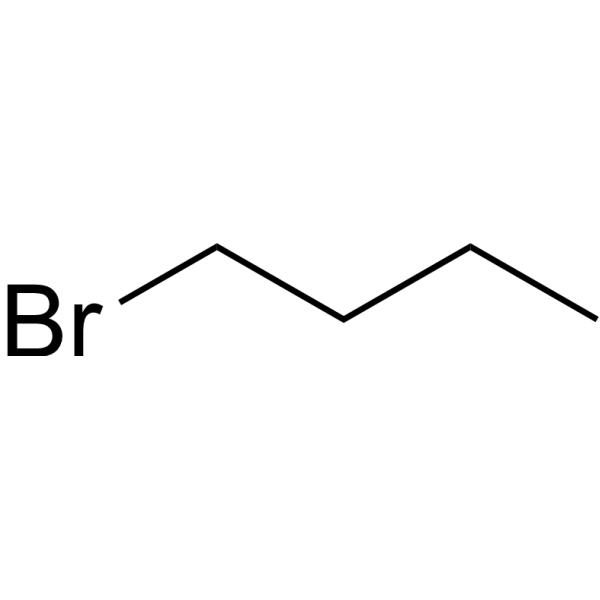
Physicochemical Properties
| Molecular Formula | C4H9BR |
| Molecular Weight | 137.02 |
| Exact Mass | 135.988 |
| CAS # | 109-65-9 |
| PubChem CID | 8002 |
| Appearance | Colorless to pale straw-colored liquid |
| Density | 1.3±0.1 g/cm3 |
| Boiling Point | 101.6±3.0 °C at 760 mmHg |
| Melting Point | -112 °C |
| Flash Point | 23.9±0.0 °C |
| Vapour Pressure | 40.3±0.2 mmHg at 25°C |
| Index of Refraction | 1.439 |
| LogP | 2.74 |
| Hydrogen Bond Donor Count | 0 |
| Hydrogen Bond Acceptor Count | 0 |
| Rotatable Bond Count | 2 |
| Heavy Atom Count | 5 |
| Complexity | 13.1 |
| Defined Atom Stereocenter Count | 0 |
| InChi Key | MPPPKRYCTPRNTB-UHFFFAOYSA-N |
| InChi Code | InChI=1S/C4H9Br/c1-2-3-4-5/h2-4H2,1H3 |
| Chemical Name | 1-bromobutane |
| HS Tariff Code | 2934.99.9001 |
| Storage |
Powder-20°C 3 years 4°C 2 years In solvent -80°C 6 months -20°C 1 month |
| Shipping Condition | Room temperature (This product is stable at ambient temperature for a few days during ordinary shipping and time spent in Customs) |
Biological Activity
| ADME/Pharmacokinetics |
Absorption, Distribution and Excretion /n-Butyl bromide administered orally (at the LD50) was deposited mainly in the brain, liver, and perirenal cellular system, and excreted primarily by the lungs./ Metabolism / Metabolites The hydrolysis of inorganic bromine in the liver following treatment with brominated hydrocarbons was studied. White-mice were administered ...n-butyl-bromide by inhalation in concentrations of 0.75-25 mmol/mL for up to 60 minutes. ...Concentrations of inorganic bromide in the liver were higher in animals that inhaled saturated, brominated hydrocarbons /(including n-butyl bromide)/ than in those that inhaled the unsaturated compounds. The degree of hydrolysis was also higher with the saturated compounds than with the unsaturated compounds. /It was concluded/ that liver tissue damage is probably caused directly by the brominated hydrocarbons rather than by hydrobromic-acid since this acid is released very slowly during hydrolysis. Rabbits and rats dosed with 1-bromobutane excrete in urine, in addition to butylmercapturic acid, (2-hydroxybutyl)mercapturic acid, (3-hydroxybutyl)mercapturic acid and 3-(butylthio)lactic acid. Although both species excrete both the hydroxybutylmercapturic acids, only traces of the 2-isomer are excreted by the rabbit. The 3-isomer has been isolated from rabbit urine as the dicyclohexylammonium salt. 3-(Butylthio)lactic acid is formed more readily in the rabbit; only traces are excreted by the rat. Traces of the sulphoxide of butylmercapturic acid have been found in rat urine but not in rabbit urine. In the rabbit about 14% and in the rat about 22% of the dose of 1-bromobutane is excreted in the form of the hydroxymercapturic acids. Slices of rat liver incubated with S-butylcysteine or butylmercapturic acid form both (2-hydroxybutyl)mercapturic acid and (3-hydroxybutyl)mercapturic acid, but only the 3-hydroxy acid is formed by slices of rabbit liver. S-Butylglutathione, S-butylcysteinylglycine and S-butylcysteine are excreted in bile by rats dosed with 1-bromobutane. Rabbits and rats dosed with 1,2-epoxybutane excrete (2-hydroxybutyl)mercapturic acid to the extent of about 4% and 11% of the dose respectively. The following have been synthesized: N-acetyl-S-(2-hydroxybutyl)-l-cysteine [(2-hydroxybutyl)mercapturic acid] and N-acetyl-S-(3-hydroxybutyl)-l-cysteine [(3-hydroxybutyl)mercapturic acid] isolated as dicyclohexylammonium salts, N-toluene-p-sulphonyl-S-(2-hydroxybutyl)-l-cysteine, S-butylglutathione and N-acetyl-S-butylcysteinyl-glycine ethyl ester. Rabbits and rats dosed with 1-bromobutane excrete in urine, in addition to butylmercapturic acid, (2-hydroxybutyl)mercapturic acid, (3-hydroxybutyl)mercapturic acid and 3-(butylthio)lactic acid. In the rabbit about 14% and in the rat about 22% of the dose of 1-bromobutane is excreted in the form of the hydroxymercapturic acids. 1-bromobutane also forms glutathione conjugates. Three kinds of GSH conjugates, including S-butyl GSH, S-butyl cysteine, and (hydroxybutyl)mercapturic acid, have been identified in mice livers after oral dosing with 375-1500 mg/kg of the compound. |
| Toxicity/Toxicokinetics |
Toxicity Summary 1-bromobutane reacts quickly with hepatic glutathione (GSH) leading to its rapid depletion. This can cause liver damage and has been shown to increase serum levels of alanine aminotransferase and aspartate aminotransferase. Hepatic contents of thiobarbituric acid reactive substances can also be significantly increased. Splenic GSH levels can also be significantly reduced by single treatment with 1-bromobutane. S-Butyl GSH conjugates were detected in spleen from 6 hr after treatment. Oral 1-bromobutane significantly suppressed the antibody response to a T-dependent antigen and the production of splenic intracellular interlukin-2. Toxicity Data LC50 (rat) = 47,000 mg/m3/2h LD50: 2761 mg/kg (Oral Rat) (A549) LC50: 237 g/m3 over 30 minutes (Inhalation, Rat) (T14) Non-Human Toxicity Values LD50 Mouse ip 6.68 g/kg LD50 Rat ip 4.45 g/kg LC50 Mouse inhalation 237 g/cu m/30 min LD50 Rat (Sprague Dawley, male) oral 2761 mg/kg LD50 Rat (Sprague Dawley, female) oral 3161 mg/kg |
| References |
[1]. Biochemical reagents[M]//Methods of Enzymatic Analysis. Academic Press, 1965: 967-1037. |
| Additional Infomation |
1-bromobutane appears as a clear colorless liquid. Flash point 65 °F. Denser than water and insoluble in water. Vapors heavier than air. 1-Bromobutane is a colorless liquid that is insoluble in water, but soluble in ethanol and diethyl ether. As a primary haloalkane, it is especially prone to SN2 type reactions. It is commonly used as an alkylating agent, or in combination with magnesium metal in dry ether (Grignard reagent) to form carbon-carbon bonds. It can be used as a cleaning agent, an agent for chemical synthesis or as a solvent for extractions. It is highly flammable. |
Solubility Data
| Solubility (In Vitro) | May dissolve in DMSO (in most cases), if not, try other solvents such as H2O, Ethanol, or DMF with a minute amount of products to avoid loss of samples |
| Solubility (In Vivo) |
Note: Listed below are some common formulations that may be used to formulate products with low water solubility (e.g. < 1 mg/mL), you may test these formulations using a minute amount of products to avoid loss of samples. Injection Formulations (e.g. IP/IV/IM/SC) Injection Formulation 1: DMSO : Tween 80: Saline = 10 : 5 : 85 (i.e. 100 μL DMSO stock solution → 50 μL Tween 80 → 850 μL Saline) *Preparation of saline: Dissolve 0.9 g of sodium chloride in 100 mL ddH ₂ O to obtain a clear solution. Injection Formulation 2: DMSO : PEG300 :Tween 80 : Saline = 10 : 40 : 5 : 45 (i.e. 100 μL DMSO → 400 μLPEG300 → 50 μL Tween 80 → 450 μL Saline) Injection Formulation 3: DMSO : Corn oil = 10 : 90 (i.e. 100 μL DMSO → 900 μL Corn oil) Example: Take the Injection Formulation 3 (DMSO : Corn oil = 10 : 90) as an example, if 1 mL of 2.5 mg/mL working solution is to be prepared, you can take 100 μL 25 mg/mL DMSO stock solution and add to 900 μL corn oil, mix well to obtain a clear or suspension solution (2.5 mg/mL, ready for use in animals). Injection Formulation 4: DMSO : 20% SBE-β-CD in saline = 10 : 90 [i.e. 100 μL DMSO → 900 μL (20% SBE-β-CD in saline)] *Preparation of 20% SBE-β-CD in Saline (4°C,1 week): Dissolve 2 g SBE-β-CD in 10 mL saline to obtain a clear solution. Injection Formulation 5: 2-Hydroxypropyl-β-cyclodextrin : Saline = 50 : 50 (i.e. 500 μL 2-Hydroxypropyl-β-cyclodextrin → 500 μL Saline) Injection Formulation 6: DMSO : PEG300 : castor oil : Saline = 5 : 10 : 20 : 65 (i.e. 50 μL DMSO → 100 μLPEG300 → 200 μL castor oil → 650 μL Saline) Injection Formulation 7: Ethanol : Cremophor : Saline = 10: 10 : 80 (i.e. 100 μL Ethanol → 100 μL Cremophor → 800 μL Saline) Injection Formulation 8: Dissolve in Cremophor/Ethanol (50 : 50), then diluted by Saline Injection Formulation 9: EtOH : Corn oil = 10 : 90 (i.e. 100 μL EtOH → 900 μL Corn oil) Injection Formulation 10: EtOH : PEG300:Tween 80 : Saline = 10 : 40 : 5 : 45 (i.e. 100 μL EtOH → 400 μLPEG300 → 50 μL Tween 80 → 450 μL Saline) Oral Formulations Oral Formulation 1: Suspend in 0.5% CMC Na (carboxymethylcellulose sodium) Oral Formulation 2: Suspend in 0.5% Carboxymethyl cellulose Example: Take the Oral Formulation 1 (Suspend in 0.5% CMC Na) as an example, if 100 mL of 2.5 mg/mL working solution is to be prepared, you can first prepare 0.5% CMC Na solution by measuring 0.5 g CMC Na and dissolve it in 100 mL ddH2O to obtain a clear solution; then add 250 mg of the product to 100 mL 0.5% CMC Na solution, to make the suspension solution (2.5 mg/mL, ready for use in animals). Oral Formulation 3: Dissolved in PEG400 Oral Formulation 4: Suspend in 0.2% Carboxymethyl cellulose Oral Formulation 5: Dissolve in 0.25% Tween 80 and 0.5% Carboxymethyl cellulose Oral Formulation 6: Mixing with food powders Note: Please be aware that the above formulations are for reference only. InvivoChem strongly recommends customers to read literature methods/protocols carefully before determining which formulation you should use for in vivo studies, as different compounds have different solubility properties and have to be formulated differently. (Please use freshly prepared in vivo formulations for optimal results.) |
| Preparing Stock Solutions | 1 mg | 5 mg | 10 mg | |
| 1 mM | 7.2982 mL | 36.4910 mL | 72.9820 mL | |
| 5 mM | 1.4596 mL | 7.2982 mL | 14.5964 mL | |
| 10 mM | 0.7298 mL | 3.6491 mL | 7.2982 mL |