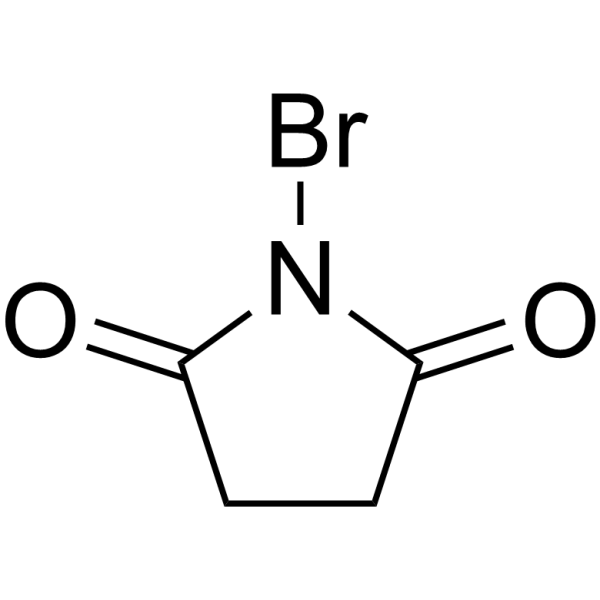
Physicochemical Properties
| Molecular Formula | C4H4BRNO2 |
| Molecular Weight | 177.98 |
| Exact Mass | 176.942 |
| CAS # | 128-08-5 |
| PubChem CID | 67184 |
| Appearance |
Orthorhombic bisphenoidal crystals Crystals from benzene Solid at 20 °C and 1031 hPa; powder |
| Density | 2.0±0.1 g/cm3 |
| Boiling Point | 221.4±23.0 °C at 760 mmHg |
| Melting Point | 175-180 °C (dec.)(lit.) |
| Flash Point | 87.7±22.6 °C |
| Vapour Pressure | 0.1±0.4 mmHg at 25°C |
| Index of Refraction | 1.606 |
| LogP | -0.7 |
| Hydrogen Bond Donor Count | 0 |
| Hydrogen Bond Acceptor Count | 2 |
| Rotatable Bond Count | 0 |
| Heavy Atom Count | 8 |
| Complexity | 129 |
| Defined Atom Stereocenter Count | 0 |
| SMILES | BrN1C(C([H])([H])C([H])([H])C1=O)=O |
| InChi Key | PCLIMKBDDGJMGD-UHFFFAOYSA-N |
| InChi Code | InChI=1S/C4H4BrNO2/c5-6-3(7)1-2-4(6)8/h1-2H2 |
| Chemical Name | 1-bromopyrrolidine-2,5-dione |
| Synonyms | Bromosuccinimide |
| HS Tariff Code | 2934.99.9001 |
| Storage |
Powder-20°C 3 years 4°C 2 years In solvent -80°C 6 months -20°C 1 month |
| Shipping Condition | Room temperature (This product is stable at ambient temperature for a few days during ordinary shipping and time spent in Customs) |
Biological Activity
| ADME/Pharmacokinetics |
Metabolism / Metabolites Bromine is mainly absorbed via inhalation, but may also enter the body through dermal contact. Bromine salts can be ingested. Due to its reactivity, bromine quickly forms bromide and may be deposited in the tissues, displacing other halogens. (L626) |
| Toxicity/Toxicokinetics |
Toxicity Summary IDENTIFICATION AND USE: N-Bromosuccinimide is a versatile brominating agent. It is a known protein reagent able to modify amino acids and proteins, resulting in oxidation of tryptophan, tyrosine and histidine residues, as well as sulfhydryl, alcohol and phenol groups. These properties make it a suitable reagent to selectively block certain amino acid residues in biochemistry, and also permit the histochemical detection of proteins by oxidative deamination followed by the Schiff reaction. HUMAN STUDIES: N-bromosuccinimide causes skin irritation (red skin on arms). ANIMAL STUDIES: N-bromosuccinimide was sensitizing in mice treated with concentrations of 2.5, 5 or 10% w/w on three consecutive days, by open application on the ears. N-bromosuccinimide was tested in a mouse lymphoma L5178Y TK+/- assay with and without metabolic activation at a concentration range of 20 to 210 ug/mL. The results without metabolic activation were equivocal and those with metabolic activation were negative. Organobromide compounds such as n-Bromosuccinimide are strong alkylating agents. Consequently they can readily modify free thiols (cysteines), methionines as well as tryptophan and histidine residues on the surfaces of proteins leading to the disruption of enzyme, transporter or membrane functions. One of the most probable protein targets is the TRPA1 ion channel that is expressed in sensory nerves (trigeminal nerve) of the eyes, nose, mouth and lungs Interactions N-Bromosuccinimide (NBS) is a known protein reagent able to modify amino acids and proteins, resulting in oxidation of tryptophan, tyrosine and histidine residues, as well as sulfhydryl, alcohol and phenol groups. These properties make NBS a suitable reagent to selectively block certain amino acid residues in biochemistry, and also permit the histochemical detection of proteins by oxidative deamination followed by the Schiff reaction. In this paper we show that, under ultraviolet excitation, NBS selectively reveals the cytoplasmic granules of mammalian eosinophils and chicken heterophils, rendering considerable white--blue fluorescence, in a remarkable fluorogenic reaction which rapidly increases at the beginning of the observation. This emission slightly decays afterwards and then remains almost stable still yielding a high level of emission after 10 min of continuous excitation. Possible mechanisms underlying these results are discussed and we propose NBS as a very suitable fluorogenic reagent for the microscopical detection and analysis of proteins. Non-Human Toxicity Values LD50 Rat oral >2000 mg/kg bw |
| References |
[1]. Biochemical reagents[M]//Methods of Enzymatic Analysis. Academic Press, 1965: 967-1037. |
| Additional Infomation |
N-bromosuccinimide is a five-membered cyclic dicarboximide compound having a bromo substituent on the nitrogen atom. It has a role as a reagent. It is a dicarboximide, a pyrrolidinone and an organobromine compound. It is functionally related to a succinimide. n-Bromosuccinimide (NBS) is a organobromide compound used in a variety of bromination reactions for chemical synthesis. It can be used to donate bromine to alkenes, to allylic or benzyl compounds, to carbonyl-containing compounds as well as aromatic compounds such as phenols, anilines, and various aromatic heterocycles. NBS will decompose over time giving off bromine. Pure NBS is white, but it is often found to be off-white or brown colored by bromine. NBS can be used as a protein modification agent that targets tryptophan and histidine residues. A brominating agent that replaces hydrogen atoms in benzylic or allylic positions. It is used in the oxidation of secondary alcohols to ketones and in controlled low-energy brominations. (From Miall's Dictionary of Chemistry, 5th ed; Hawley's Condensed Chemical Dictionary, 12th ed,). |
Solubility Data
| Solubility (In Vitro) | DMSO : ≥ 200 mg/mL (1123.72 mM) |
| Solubility (In Vivo) |
Note: Listed below are some common formulations that may be used to formulate products with low water solubility (e.g. < 1 mg/mL), you may test these formulations using a minute amount of products to avoid loss of samples. Injection Formulations (e.g. IP/IV/IM/SC) Injection Formulation 1: DMSO : Tween 80: Saline = 10 : 5 : 85 (i.e. 100 μL DMSO stock solution → 50 μL Tween 80 → 850 μL Saline) *Preparation of saline: Dissolve 0.9 g of sodium chloride in 100 mL ddH ₂ O to obtain a clear solution. Injection Formulation 2: DMSO : PEG300 :Tween 80 : Saline = 10 : 40 : 5 : 45 (i.e. 100 μL DMSO → 400 μLPEG300 → 50 μL Tween 80 → 450 μL Saline) Injection Formulation 3: DMSO : Corn oil = 10 : 90 (i.e. 100 μL DMSO → 900 μL Corn oil) Example: Take the Injection Formulation 3 (DMSO : Corn oil = 10 : 90) as an example, if 1 mL of 2.5 mg/mL working solution is to be prepared, you can take 100 μL 25 mg/mL DMSO stock solution and add to 900 μL corn oil, mix well to obtain a clear or suspension solution (2.5 mg/mL, ready for use in animals). Injection Formulation 4: DMSO : 20% SBE-β-CD in saline = 10 : 90 [i.e. 100 μL DMSO → 900 μL (20% SBE-β-CD in saline)] *Preparation of 20% SBE-β-CD in Saline (4°C,1 week): Dissolve 2 g SBE-β-CD in 10 mL saline to obtain a clear solution. Injection Formulation 5: 2-Hydroxypropyl-β-cyclodextrin : Saline = 50 : 50 (i.e. 500 μL 2-Hydroxypropyl-β-cyclodextrin → 500 μL Saline) Injection Formulation 6: DMSO : PEG300 : castor oil : Saline = 5 : 10 : 20 : 65 (i.e. 50 μL DMSO → 100 μLPEG300 → 200 μL castor oil → 650 μL Saline) Injection Formulation 7: Ethanol : Cremophor : Saline = 10: 10 : 80 (i.e. 100 μL Ethanol → 100 μL Cremophor → 800 μL Saline) Injection Formulation 8: Dissolve in Cremophor/Ethanol (50 : 50), then diluted by Saline Injection Formulation 9: EtOH : Corn oil = 10 : 90 (i.e. 100 μL EtOH → 900 μL Corn oil) Injection Formulation 10: EtOH : PEG300:Tween 80 : Saline = 10 : 40 : 5 : 45 (i.e. 100 μL EtOH → 400 μLPEG300 → 50 μL Tween 80 → 450 μL Saline) Oral Formulations Oral Formulation 1: Suspend in 0.5% CMC Na (carboxymethylcellulose sodium) Oral Formulation 2: Suspend in 0.5% Carboxymethyl cellulose Example: Take the Oral Formulation 1 (Suspend in 0.5% CMC Na) as an example, if 100 mL of 2.5 mg/mL working solution is to be prepared, you can first prepare 0.5% CMC Na solution by measuring 0.5 g CMC Na and dissolve it in 100 mL ddH2O to obtain a clear solution; then add 250 mg of the product to 100 mL 0.5% CMC Na solution, to make the suspension solution (2.5 mg/mL, ready for use in animals). Oral Formulation 3: Dissolved in PEG400 Oral Formulation 4: Suspend in 0.2% Carboxymethyl cellulose Oral Formulation 5: Dissolve in 0.25% Tween 80 and 0.5% Carboxymethyl cellulose Oral Formulation 6: Mixing with food powders Note: Please be aware that the above formulations are for reference only. InvivoChem strongly recommends customers to read literature methods/protocols carefully before determining which formulation you should use for in vivo studies, as different compounds have different solubility properties and have to be formulated differently. (Please use freshly prepared in vivo formulations for optimal results.) |
| Preparing Stock Solutions | 1 mg | 5 mg | 10 mg | |
| 1 mM | 5.6186 mL | 28.0930 mL | 56.1861 mL | |
| 5 mM | 1.1237 mL | 5.6186 mL | 11.2372 mL | |
| 10 mM | 0.5619 mL | 2.8093 mL | 5.6186 mL |