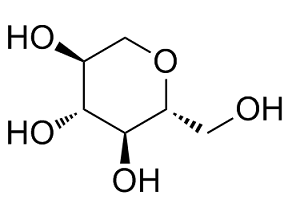
1,5-Anhydro-D-sorbitol, a cyclic polyol, is a short-term marker for glycemic control and also a metabolic product of 1,5 anhydro-D-fructose. 1,5-Anhydro-D-sorbitol is used as a reference in analytical procedures that assess the metabolism of 1,5 anhydro-D-fructose, a food supplement with potential benefits as an antioxidant, antimicrobial, and antidiabetic agent.
Physicochemical Properties
| Molecular Formula | C6H12O5 |
| Molecular Weight | 164.15648 |
| Exact Mass | 164.068 |
| CAS # | 154-58-5 |
| PubChem CID | 64960 |
| Appearance | White to off-white solid powder |
| Density | 1.533 g/cm3 |
| Boiling Point | 376.8ºC at 760 mmHg |
| Melting Point | 142-143ºC |
| Flash Point | 181.7ºC |
| Index of Refraction | 1.581 |
| LogP | -2.1 |
| Hydrogen Bond Donor Count | 4 |
| Hydrogen Bond Acceptor Count | 5 |
| Rotatable Bond Count | 1 |
| Heavy Atom Count | 11 |
| Complexity | 128 |
| Defined Atom Stereocenter Count | 4 |
| SMILES | C1[C@@H]([C@H]([C@@H]([C@H](O1)CO)O)O)O |
| InChi Key | MPCAJMNYNOGXPB-SLPGGIOYSA-N |
| InChi Code | InChI=1S/C6H12O5/c7-1-4-6(10)5(9)3(8)2-11-4/h3-10H,1-2H2/t3-,4+,5+,6+/m0/s1 |
| Chemical Name | (2R,3S,4R,5S)-2-(hydroxymethyl)oxane-3,4,5-triol |
| HS Tariff Code | 2934.99.9001 |
| Storage |
Powder-20°C 3 years 4°C 2 years In solvent -80°C 6 months -20°C 1 month |
| Shipping Condition | Room temperature (This product is stable at ambient temperature for a few days during ordinary shipping and time spent in Customs) |
Biological Activity
| ln Vitro | 1,5-Anhydrosorbitol can show that metabolite scores place people at a higher risk of developing diabetes or insulin resistance, and so coronary heart disease (CHD)[1]. |
| References |
[1]. A metabolomic profile is associated with the risk of incident coronary heart disease. Am Heart J. 2014 Jul;168(1):45-52.e7. |
| Additional Infomation |
1,5-anhydro-D-glucitol is an anhydro sugar of D-glucitol. It has a role as a human metabolite. It is functionally related to a D-glucitol. 1,5-Anhydro-D-glucitol has been reported in Polygala tenuifolia, Medicago sativa, and other organisms with data available. 1,5-Anhydrosorbitol is identified as a short-term marker for glycemic control.[1] In this prospective case-cohort study, proton nuclear magnetic resonance (1H-NMR) spectroscopy was used to profile metabolites in plasma/serum. Signals representing 1,5-Anhydrosorbitol (at 3.267 ppm, 3.342 ppm, 3.876 ppm, and 3.974 ppm) were among the 100 signals quantified. A subset of 13 1H-NMR signals, selected by least absolute shrinkage and selection operator (LASSO) regression for optimal prediction of incident coronary heart disease (CHD), included a signal from 1,5-Anhydrosorbitol. This metabolite score, which also included signals representing lipids, glucose, valine, ornithine, glutamate, creatinine, glycoproteins, and citrate, was associated with incident CHD independent of traditional risk factors (hazard ratio 1.50 per standard deviation increase). The authors suggest that the presence of 1,5-Anhydrosorbitol and glucose in the score may indicate individuals at higher risk for developing diabetes or insulin resistance, thereby increasing CHD risk.[1] |
Solubility Data
| Solubility (In Vitro) | H2O : ~50 mg/mL (~304.58 mM) |
| Solubility (In Vivo) |
Solubility in Formulation 1: 50 mg/mL (304.58 mM) in PBS (add these co-solvents sequentially from left to right, and one by one), clear solution; with sonication. (Please use freshly prepared in vivo formulations for optimal results.) |
| Preparing Stock Solutions | 1 mg | 5 mg | 10 mg | |
| 1 mM | 6.0916 mL | 30.4581 mL | 60.9162 mL | |
| 5 mM | 1.2183 mL | 6.0916 mL | 12.1832 mL | |
| 10 mM | 0.6092 mL | 3.0458 mL | 6.0916 mL |