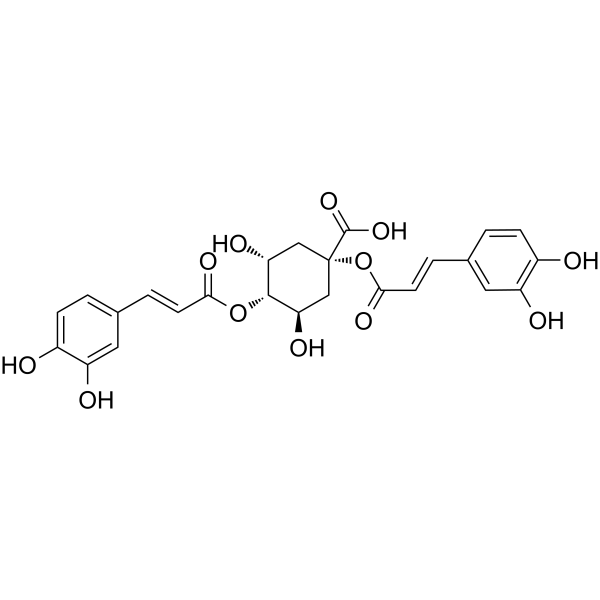
Physicochemical Properties
| Molecular Formula | C25H24O12 |
| Molecular Weight | 516.4509 |
| Exact Mass | 516.126 |
| CAS # | 1182-34-9 |
| PubChem CID | 5316647 |
| Appearance | White to off-white solid powder |
| Density | 1.6±0.1 g/cm3 |
| Boiling Point | 819.9±65.0 °C at 760 mmHg |
| Melting Point | 225-227ºC |
| Flash Point | 278.1±27.8 °C |
| Vapour Pressure | 0.0±3.1 mmHg at 25°C |
| Index of Refraction | 1.719 |
| LogP | 1.99 |
| Hydrogen Bond Donor Count | 7 |
| Hydrogen Bond Acceptor Count | 12 |
| Rotatable Bond Count | 9 |
| Heavy Atom Count | 37 |
| Complexity | 873 |
| Defined Atom Stereocenter Count | 0 |
| SMILES | C1C(C(C(CC1(C(=O)O)OC(=O)/C=C/C2=CC(=C(C=C2)O)O)O)OC(=O)/C=C/C3=CC(=C(C=C3)O)O)O |
| InChi Key | IYXQRCXQQWUFQV-FCXRPNKRSA-N |
| InChi Code | InChI=1S/C25H24O12/c26-15-5-1-13(9-17(15)28)3-7-21(32)36-23-19(30)11-25(24(34)35,12-20(23)31)37-22(33)8-4-14-2-6-16(27)18(29)10-14/h1-10,19-20,23,26-31H,11-12H2,(H,34,35)/b7-3+,8-4+ |
| Chemical Name | 1,4-bis[[(E)-3-(3,4-dihydroxyphenyl)prop-2-enoyl]oxy]-3,5-dihydroxycyclohexane-1-carboxylic acid |
| HS Tariff Code | 2934.99.9001 |
| Storage |
Powder-20°C 3 years 4°C 2 years In solvent -80°C 6 months -20°C 1 month Note: Please store this product in a sealed and protected environment (e.g. under nitrogen), avoid exposure to moisture and light. |
| Shipping Condition | Room temperature (This product is stable at ambient temperature for a few days during ordinary shipping and time spent in Customs) |
Biological Activity
| Targets |
Tumor necrosis factor-alpha (TNF-α) pathway (inhibitor) [1] |
| ln Vitro |
In the murine macrophage cell line RAW 264.7 stimulated with lipopolysaccharide (LPS, 1 µg/mL), 1,4-Dicaffeoylquinic acid (at concentrations of 6.25, 12.5, 25, and 50 µM) significantly inhibited the production of TNF-α in a dose-dependent manner. [1] The inhibitory effect on TNF-α production was statistically significant (P < 0.01 compared to LPS-treated cells). [1] 1,4-Dicaffeoylquinic acid did not show a significant inhibitory effect on LPS-stimulated interleukin-6 (IL-6) production in RAW 264.7 cells at the tested concentrations. [1] |
| Cell Assay |
Cytotoxicity Assay: The cytotoxicity of 1,4-Dicaffeoylquinic acid was evaluated in RAW 264.7 cells using a Cell Counting Kit-8 (CCK-8) assay. Cells were seeded in 96-well plates and treated with various concentrations (0, 6.25, 12.5, 25, 50, or 100 µM) of the compound for 24 hours. CCK-8 solution was then added, and cells were incubated for an additional 4 hours. Absorbance was measured at 450 nm using a microplate reader. Cell viability was calculated as a percentage relative to untreated controls. No significant cytotoxicity was observed at concentrations up to 50 µM. [1] Cytokine and Prostaglandin Measurement Assay: RAW 264.7 cells were plated in 24-well plates at a density of 2.4 x 10⁴ cells per well and incubated for 24 hours. Cells were pre-treated with various concentrations (6.25, 12.5, 25, 50 µM) of 1,4-Dicaffeoylquinic acid for 4 hours prior to stimulation with LPS (1 µg/mL). After an additional 20 hours of incubation, cell culture supernatants were collected. The concentrations of TNF-α, IL-6, and PGE₂ in the supernatants were measured using specific enzyme-linked immunosorbent assay (ELISA) kits according to the manufacturers' instructions. [1] |
| Toxicity/Toxicokinetics | In the cytotoxicity assay using RAW 264.7 cells, 1,4-Dicaffeoylquinic acid did not show significant cytotoxicity at concentrations up to 50 µM after 24 hours of treatment. A marked reduction in cell viability was observed at 100 µM. [1] |
| References |
[1]. Phytochemical Analysis on Quantification and the Inhibitory Effects on Inflammatory Responses from the Fruit of Xanthii fructus. Pharmacogn Mag. 2015 Oct;11(Suppl 4):S585-91. |
| Additional Infomation |
1,4-Dicaffeylquinic acid has been reported in Echinacea angustifolia, Artemisia carvifolia, and other organisms with data available. 1,4-Dicaffeoylquinic acid is one of the nine phenylpropanoid marker compounds identified in the 70% ethanol extract of Xanthii Fructus (the fruit of Xanthium strumarium L.). [1] In the analyzed Xanthii Fructus extract sample, the concentration of 1,4-Dicaffeoylquinic acid was determined to be 1.20 mg/g (mean, with a relative standard deviation of 1.43%). [1] The study suggests that different marker compounds from Xanthii Fructus, including 1,4-Dicaffeoylquinic acid, exert anti-inflammatory activity by targeting different inflammation-related pathways (e.g., TNF-α pathway). [1] |
Solubility Data
| Solubility (In Vitro) | DMSO : ~100 mg/mL (~193.63 mM) |
| Solubility (In Vivo) |
Solubility in Formulation 1: ≥ 2.5 mg/mL (4.84 mM) (saturation unknown) in 10% DMSO + 40% PEG300 + 5% Tween80 + 45% Saline (add these co-solvents sequentially from left to right, and one by one), clear solution. For example, if 1 mL of working solution is to be prepared, you can add 100 μL of 25.0 mg/mL clear DMSO stock solution to 400 μL PEG300 and mix evenly; then add 50 μL Tween-80 to the above solution and mix evenly; then add 450 μL normal saline to adjust the volume to 1 mL. Preparation of saline: Dissolve 0.9 g of sodium chloride in 100 mL ddH₂ O to obtain a clear solution. Solubility in Formulation 2: 2.5 mg/mL (4.84 mM) in 10% DMSO + 90% (20% SBE-β-CD in Saline) (add these co-solvents sequentially from left to right, and one by one), suspension solution; with ultrasonication. For example, if 1 mL of working solution is to be prepared, you can add 100 μL of 25.0 mg/mL clear DMSO stock solution to 900 μL of 20% SBE-β-CD physiological saline solution and mix evenly. Preparation of 20% SBE-β-CD in Saline (4°C,1 week): Dissolve 2 g SBE-β-CD in 10 mL saline to obtain a clear solution. Solubility in Formulation 3: ≥ 2.5 mg/mL (4.84 mM) (saturation unknown) in 10% DMSO + 90% Corn Oil (add these co-solvents sequentially from left to right, and one by one), clear solution. For example, if 1 mL of working solution is to be prepared, you can add 100 μL of 25.0 mg/mL clear DMSO stock solution to 900 μL of corn oil and mix evenly. (Please use freshly prepared in vivo formulations for optimal results.) |
| Preparing Stock Solutions | 1 mg | 5 mg | 10 mg | |
| 1 mM | 1.9363 mL | 9.6815 mL | 19.3630 mL | |
| 5 mM | 0.3873 mL | 1.9363 mL | 3.8726 mL | |
| 10 mM | 0.1936 mL | 0.9681 mL | 1.9363 mL |