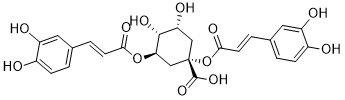
Physicochemical Properties
| Molecular Formula | C25H24O12 |
| Molecular Weight | 516.4509 |
| Exact Mass | 516.126 |
| CAS # | 19870-46-3 |
| Related CAS # | Cynarin;30964-13-7 |
| PubChem CID | 6474640 |
| Appearance | White to yellow solid powder |
| Density | 1.6±0.1 g/cm3 |
| Boiling Point | 819.9±65.0 °C at 760 mmHg |
| Flash Point | 278.1±27.8 °C |
| Vapour Pressure | 0.0±3.1 mmHg at 25°C |
| Index of Refraction | 1.719 |
| LogP | 1.64 |
| Hydrogen Bond Donor Count | 7 |
| Hydrogen Bond Acceptor Count | 12 |
| Rotatable Bond Count | 9 |
| Heavy Atom Count | 37 |
| Complexity | 887 |
| Defined Atom Stereocenter Count | 4 |
| SMILES | O(C(/C(/[H])=C(\[H])/C1C([H])=C([H])C(=C(C=1[H])O[H])O[H])=O)[C@@]1(C(=O)O[H])C([H])([H])[C@]([H])([C@]([H])([C@@]([H])(C1([H])[H])OC(/C(/[H])=C(\[H])/C1C([H])=C([H])C(=C(C=1[H])O[H])O[H])=O)O[H])O[H] |
| InChi Key | YDDUMTOHNYZQPO-PSEXTPKNSA-N |
| InChi Code | InChI=1S/C25H24O12/c26-15-5-1-13(9-17(15)28)3-7-21(31)36-20-12-25(24(34)35,11-19(30)23(20)33)37-22(32)8-4-14-2-6-16(27)18(29)10-14/h1-10,19-20,23,26-30,33H,11-12H2,(H,34,35)/b7-3+,8-4+/t19-,20-,23-,25+/m1/s1 |
| Chemical Name | (1S,3R,4R,5R)-1,3-bis[[(E)-3-(3,4-dihydroxyphenyl)prop-2-enoyl]oxy]-4,5-dihydroxycyclohexane-1-carboxylic acid |
| HS Tariff Code | 2934.99.9001 |
| Storage |
Powder-20°C 3 years 4°C 2 years In solvent -80°C 6 months -20°C 1 month |
| Shipping Condition | Room temperature (This product is stable at ambient temperature for a few days during ordinary shipping and time spent in Customs) |
Biological Activity
| ln Vitro | In neurons, it has been demonstrated that 1,3-Dicaffeoylquinic Acid increases neuronal cell viability against Aβ(42) toxicity in a concentration-dependent manner. While stimulating its upstream tyrosine kinase A (Trk A), 1,3-dicaffeoylquinic acid activates extracellular regulated protein kinase 1/2 (Erk1/2) and phosphoinositide 3-kinase (PI3K)/Akt. The augmentation of inactivating phosphorylation of glycogen synthase kinase 3β (GSK3β) and the control of the expression of apoptosis-related protein Bcl-2/Bax are linked to the anti-apoptotic potential of 1,3-dicaffeoylquinic acid [2]. In OGD/reperfusion injury, 1,3-dicaffeoylquinic acid (10 μM, 20 μM, 50 μM, and 100 μM) can prevent GSH consumption and greatly increase cell viability prior to OGD/reperfusion. In OGD/reperfusion-treated astrocytes, 1,3-dicaffeoylquinic acid causes Nrf2 nuclear translocation and raises GCL activity; however, this effect is lost in Nrf2 siRNA-transfected cells [3]. |
| ln Vivo | In Wistar rats, 1-O-ABL and 1,3-dicaffeoylquinic acid (32.0 mg/kg, orally) are absorbed very quickly. 1-O-ABL and 1,3-dicaffeoylquinic acid have maximal plasma concentrations of 19.1 ± 6.9 ng/mL and 44.5 ± 7.1 ng/mL, respectively [1]. |
| References |
[1]. An LC-MS/MS method for simultaneous determination of 1,5-dicaffeoylquinic acid and 1-O-acetylbritannilactone in rat plasma and its application to a pharmacokinetic study. [2]. 1,5-dicaffeoylquinic acid protects primary neurons from amyloid β 1-42-induced apoptosis via PI3K/Akt signaling pathway. Chin Med J (Engl). 2011 Sep;124(17):2628-35. [3]. 1, 5-Dicaffeoylquinic acid-mediated glutathione synthesis through activation of Nrf2 protects against OGD/reperfusion-induced oxidative stress in astrocytes. Brain Res. 2010 Aug 6;1347:142-8. |
| Additional Infomation | 1,3-Dicaffeoylquinic acid has been reported in Mikania hirsutissima, Aster indicus, and other organisms with data available. |
Solubility Data
| Solubility (In Vitro) | DMSO : ~100 mg/mL (~193.63 mM) |
| Solubility (In Vivo) |
Solubility in Formulation 1: ≥ 2.5 mg/mL (4.84 mM) (saturation unknown) in 10% DMSO + 40% PEG300 + 5% Tween80 + 45% Saline (add these co-solvents sequentially from left to right, and one by one), clear solution. For example, if 1 mL of working solution is to be prepared, you can add 100 μL of 25.0 mg/mL clear DMSO stock solution to 400 μL PEG300 and mix evenly; then add 50 μL Tween-80 to the above solution and mix evenly; then add 450 μL normal saline to adjust the volume to 1 mL. Preparation of saline: Dissolve 0.9 g of sodium chloride in 100 mL ddH₂ O to obtain a clear solution. Solubility in Formulation 2: ≥ 2.5 mg/mL (4.84 mM) (saturation unknown) in 10% DMSO + 90% (20% SBE-β-CD in Saline) (add these co-solvents sequentially from left to right, and one by one), clear solution. For example, if 1 mL of working solution is to be prepared, you can add 100 μL of 25.0 mg/mL clear DMSO stock solution to 900 μL of 20% SBE-β-CD physiological saline solution and mix evenly. Preparation of 20% SBE-β-CD in Saline (4°C,1 week): Dissolve 2 g SBE-β-CD in 10 mL saline to obtain a clear solution. Solubility in Formulation 3: ≥ 2.5 mg/mL (4.84 mM) (saturation unknown) in 10% DMSO + 90% Corn Oil (add these co-solvents sequentially from left to right, and one by one), clear solution. For example, if 1 mL of working solution is to be prepared, you can add 100 μL of 25.0 mg/mL clear DMSO stock solution to 900 μL of corn oil and mix evenly. (Please use freshly prepared in vivo formulations for optimal results.) |
| Preparing Stock Solutions | 1 mg | 5 mg | 10 mg | |
| 1 mM | 1.9363 mL | 9.6815 mL | 19.3630 mL | |
| 5 mM | 0.3873 mL | 1.9363 mL | 3.8726 mL | |
| 10 mM | 0.1936 mL | 0.9681 mL | 1.9363 mL |