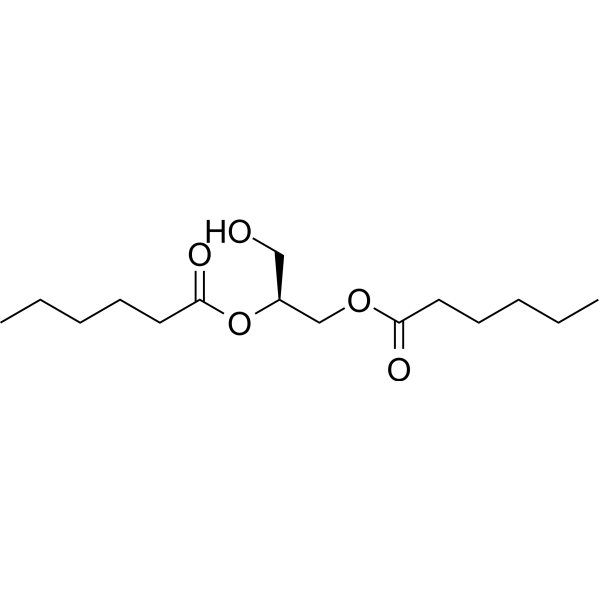
Physicochemical Properties
| Molecular Formula | C15H28O5 |
| Molecular Weight | 288.38 |
| Exact Mass | 288.193 |
| CAS # | 30403-47-5 |
| PubChem CID | 152222 |
| Appearance | To be determined |
| Density | 1.0±0.1 g/cm3 |
| Boiling Point | 372.0±9.0 °C at 760 mmHg |
| Flash Point | 123.7±12.2 °C |
| Vapour Pressure | 0.0±1.9 mmHg at 25°C |
| Index of Refraction | 1.457 |
| LogP | 3.72 |
| Hydrogen Bond Donor Count | 1 |
| Hydrogen Bond Acceptor Count | 5 |
| Rotatable Bond Count | 14 |
| Heavy Atom Count | 20 |
| Complexity | 265 |
| Defined Atom Stereocenter Count | 0 |
| SMILES | CCCCCC(=O)OC[C@H](CO)OC(=O)CCCCC |
| InChi Key | DRUFTGMQJWWIOL-ZDUSSCGKSA-N |
| InChi Code | InChI=1S/C15H28O5/c1-3-5-7-9-14(17)19-12-13(11-16)20-15(18)10-8-6-4-2/h13,16H,3-12H2,1-2H3/t13-/m0/s1 |
| Chemical Name | [(2S)-2-hexanoyloxy-3-hydroxypropyl] hexanoate |
| HS Tariff Code | 2917190090 |
| Storage |
Powder-20°C 3 years 4°C 2 years In solvent -80°C 6 months -20°C 1 month |
| Shipping Condition | Room temperature (This product is stable at ambient temperature for a few days during ordinary shipping and time spent in Customs) |
Biological Activity
| ln Vitro | Although the biological activities of 1,2-Dihexanoyl-sn-glycerol have not been well characterized, it is expected to behave similarly to 1,2-dioctanoyl-sn-glycerol [1,2]. |
| Enzyme Assay | Diacylglycerol kinases (DGKs) catalyze the ATP-dependent phosphorylation of diacylglycerols to generate phosphatidic acid and have been investigated in prokaryotic and eukaryotic organisms. Recently, a protein that is significantly similar to human DGK-theta, DGKA, was identified in Dictyostelium discoideum. It has been shown to possess DGK activity when assayed using a medium-chain diacylglycerol, 1,2-dioctanoyl-sn-glycerol (DiC8). A complete understanding of DGK catalytic and regulatory mechanisms, as well as physiological roles, requires an understanding of its biochemical and kinetic properties. This report presents an analysis of these properties for DGKA. The enzyme catalyzes the phosphorylation of DiC8, and another medium-chain DAG, DiC6 (1,2-dihexanoyl-sn-glycerol), in a Michaelis-Menten manner. Interestingly, the kinetics of DGKA using physiologically relevant long-chain DAGs was dependent on substrate surface concentration and the detergent that was used. DGKA displayed Michaelis-Menten kinetics with respect to bulk substrate concentration (1,2-dioleoyl-sn-glycerol) in octyl glucoside mixed micelles when the surface substrate concentration was at or below 3.5 mol %. At higher surface concentrations, however, there was a sigmoidal relationship between the initial velocity and bulk substrate concentration. In contrast, DGKA displayed sigmoidal kinetics with respect to bulk substrate concentrations at all surface concentrations in Triton X-100 mixed micelles. Finally, we show the catalytic activity of DGKA was significantly enhanced by phosphatidylserine (PS) and phosphatidic acid (PA) [1]. |
| Cell Assay | The human sperm acrosome reaction (AR) occurs via the activation of at least two signal transduction pathways. The purpose of this investigation was to characterize two of the pathways, the protein kinase A (PKA) and C (PKC) pathways, and determine whether pathway "crosstalk" occurs between them in eliciting the AR in capacitated spermatozoa. Stimulators of each pathway were tested in a dose-dependent manner. ARmax, ED50, and delta ARmax (%ARmax-%ARcontrol) values were calculated. The PKA pathway stimulators forskolin and dibutyryl cyclic AMP (dbcAMP) induced an ARmax at 1.0 microM and 1.0 mM, respectively. The ED50 and delta ARmax values were: 0.01 microM and 17% for forskolin and 0.069 mM and 13% for dbcAMP. Two stimulator types of the PKC pathway were tested: synthetic diacylglycerols (DG) and a phorbol diester. 1,2-dioleoyl-sn-glycerol and 1,2-dioctanoyl-sn-glycerol, analogues of the PKC-activating second messenger DG, each induced an ARmax at 50 microM. The ED50 and delta AR max values were: 33 microM and 24% for 1,2-dioleoyl and 34.8 microM and 34% for 1,2-dioctanoyl. 4 beta-Phorbol-12,13-didecanoate, a PKC stimulator, induced an ARmax at 0.1 microM. The ED50 and delta ARmax were 0.021 microM and 26%. An inhibitor of each kinase was added at the end of the capacitation period and prior to stimulation by inducers at their ARmax dose. KT5720, a PKA inhibitor, caused a dose-dependent reduction of the forskolin and dbcAMP-induced AR. Calphostin C, a PKC inhibitor, prevented stimulation of the AR by 1,2-dioleoyl and 4 beta-phorbol-12,13-didecanoate. To investigate pathway "crosstalk," the following experiments were conducted: (1) stimulators of each pathway were combined and tested at the ARmax and ED50 concentrations for each; (2) spermatozoa were pretreated with a kinase inhibitor and then stimulated using an alternative pathway stimulator; and (3) a PKA or PKC inhibitor and a combination of PKA and PKC stimulators, at ED50 concentrations, were tested. The results for (1) indicate an additive AR response of ED50 concentrations but not for ARmax doses. The results for (2) demonstrate that a kinase inhibitor for one pathway prevents induction of the AR by a stimulator of the alternative pathway. Finally, the results for (3) show that a kinase inhibitor for one pathway prevents induction of the AR by the combined use of separate pathway stimulators. When taken collectively, the present results suggest a convergent mechanism of crosstalk between the PKA and PKC pathways leading to the human sperm AR [2]. |
| References |
[1]. Ostroski, M., Tu-Sekine, B., and Raben, D.M. Analysis of a novel diacylglycerol kinase from Dictyostelium discoideum: DGKA. Biochemistry 44(30), 10199-10207 (2005). [2]. Doherty, C.M., Tarchala, S.M., Radwanska, E., et al. Characterization of two second messenger pathways and their interactions in eliciting the human sperm acrosome reaction. J. Androl. 16(1), 36-46 (1995). |
| Additional Infomation | 1,2-dihexanoylglycerol is a 1,2-diglyceride. |
Solubility Data
| Solubility (In Vitro) |
DMSO: ~7 mg/ml PBS (pH 7.2): ~0.25 mg/ml DMF: ~20 mg/ml Ethanol: >50 mg/ml |
| Solubility (In Vivo) |
Note: Listed below are some common formulations that may be used to formulate products with low water solubility (e.g. < 1 mg/mL), you may test these formulations using a minute amount of products to avoid loss of samples. Injection Formulations (e.g. IP/IV/IM/SC) Injection Formulation 1: DMSO : Tween 80: Saline = 10 : 5 : 85 (i.e. 100 μL DMSO stock solution → 50 μL Tween 80 → 850 μL Saline) *Preparation of saline: Dissolve 0.9 g of sodium chloride in 100 mL ddH ₂ O to obtain a clear solution. Injection Formulation 2: DMSO : PEG300 :Tween 80 : Saline = 10 : 40 : 5 : 45 (i.e. 100 μL DMSO → 400 μLPEG300 → 50 μL Tween 80 → 450 μL Saline) Injection Formulation 3: DMSO : Corn oil = 10 : 90 (i.e. 100 μL DMSO → 900 μL Corn oil) Example: Take the Injection Formulation 3 (DMSO : Corn oil = 10 : 90) as an example, if 1 mL of 2.5 mg/mL working solution is to be prepared, you can take 100 μL 25 mg/mL DMSO stock solution and add to 900 μL corn oil, mix well to obtain a clear or suspension solution (2.5 mg/mL, ready for use in animals). Injection Formulation 4: DMSO : 20% SBE-β-CD in saline = 10 : 90 [i.e. 100 μL DMSO → 900 μL (20% SBE-β-CD in saline)] *Preparation of 20% SBE-β-CD in Saline (4°C,1 week): Dissolve 2 g SBE-β-CD in 10 mL saline to obtain a clear solution. Injection Formulation 5: 2-Hydroxypropyl-β-cyclodextrin : Saline = 50 : 50 (i.e. 500 μL 2-Hydroxypropyl-β-cyclodextrin → 500 μL Saline) Injection Formulation 6: DMSO : PEG300 : castor oil : Saline = 5 : 10 : 20 : 65 (i.e. 50 μL DMSO → 100 μLPEG300 → 200 μL castor oil → 650 μL Saline) Injection Formulation 7: Ethanol : Cremophor : Saline = 10: 10 : 80 (i.e. 100 μL Ethanol → 100 μL Cremophor → 800 μL Saline) Injection Formulation 8: Dissolve in Cremophor/Ethanol (50 : 50), then diluted by Saline Injection Formulation 9: EtOH : Corn oil = 10 : 90 (i.e. 100 μL EtOH → 900 μL Corn oil) Injection Formulation 10: EtOH : PEG300:Tween 80 : Saline = 10 : 40 : 5 : 45 (i.e. 100 μL EtOH → 400 μLPEG300 → 50 μL Tween 80 → 450 μL Saline) Oral Formulations Oral Formulation 1: Suspend in 0.5% CMC Na (carboxymethylcellulose sodium) Oral Formulation 2: Suspend in 0.5% Carboxymethyl cellulose Example: Take the Oral Formulation 1 (Suspend in 0.5% CMC Na) as an example, if 100 mL of 2.5 mg/mL working solution is to be prepared, you can first prepare 0.5% CMC Na solution by measuring 0.5 g CMC Na and dissolve it in 100 mL ddH2O to obtain a clear solution; then add 250 mg of the product to 100 mL 0.5% CMC Na solution, to make the suspension solution (2.5 mg/mL, ready for use in animals). Oral Formulation 3: Dissolved in PEG400 Oral Formulation 4: Suspend in 0.2% Carboxymethyl cellulose Oral Formulation 5: Dissolve in 0.25% Tween 80 and 0.5% Carboxymethyl cellulose Oral Formulation 6: Mixing with food powders Note: Please be aware that the above formulations are for reference only. InvivoChem strongly recommends customers to read literature methods/protocols carefully before determining which formulation you should use for in vivo studies, as different compounds have different solubility properties and have to be formulated differently. (Please use freshly prepared in vivo formulations for optimal results.) |
| Preparing Stock Solutions | 1 mg | 5 mg | 10 mg | |
| 1 mM | 3.4676 mL | 17.3382 mL | 34.6765 mL | |
| 5 mM | 0.6935 mL | 3.4676 mL | 6.9353 mL | |
| 10 mM | 0.3468 mL | 1.7338 mL | 3.4676 mL |