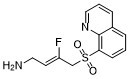
Lysyl oxidase inhbitor 1 is a novel and potent inhibitor of lysyl oxidase, whose upregulation by tumor cells may promote metastasis of the existing tumor, causing it to become malignant and cancerous. Thus it has the potential to be used in the treatment of cancer.
Physicochemical Properties
| Molecular Formula | C13H13FN2O2S |
| Molecular Weight | 280.3179 |
| Exact Mass | 280.068 |
| CAS # | 2409963-83-1 |
| Related CAS # | LOX-IN-3 dihydrochloride;2409964-23-2;LOX-IN-3 dihydrochloride monohydrate;2414974-55-1 |
| PubChem CID | 146317833 |
| Appearance | White to off-white solid powder |
| LogP | 0.4 |
| Hydrogen Bond Donor Count | 1 |
| Hydrogen Bond Acceptor Count | 5 |
| Rotatable Bond Count | 4 |
| Heavy Atom Count | 19 |
| Complexity | 430 |
| Defined Atom Stereocenter Count | 0 |
| SMILES | S(C([H])([H])/C(=C(\[H])/C([H])([H])N([H])[H])/F)(C1=C([H])C([H])=C([H])C2C([H])=C([H])C([H])=NC1=2)(=O)=O |
| InChi Key | DHXXLGDTPFPYRH-WDZFZDKYSA-N |
| InChi Code | InChI=1S/C13H13FN2O2S/c14-11(6-7-15)9-19(17,18)12-5-1-3-10-4-2-8-16-13(10)12/h1-6,8H,7,9,15H2/b11-6- |
| Chemical Name | (Z)-3-fluoro-4-quinolin-8-ylsulfonylbut-2-en-1-amine |
| HS Tariff Code | 2934.99.9001 |
| Storage |
Powder-20°C 3 years 4°C 2 years In solvent -80°C 6 months -20°C 1 month Note: This product requires protection from light (avoid light exposure) during transportation and storage. |
| Shipping Condition | Room temperature (This product is stable at ambient temperature for a few days during ordinary shipping and time spent in Customs) |
Biological Activity
| Targets |
Lysyl oxidase (LOX) with an IC50 value of 2.5 nM; Lysyl oxidase-like 1 (LOXL1) with an IC50 value of 3.2 nM; Lysyl oxidase-like 2 (LOXL2) with an IC50 value of 3.1 nM; Lysyl oxidase-like 3 (LOXL3) with an IC50 value of 4.8 nM; Lysyl oxidase-like 4 (LOXL4) with an IC50 value of 5.2 nM [1] |
| ln Vitro |
The substance 33, LOX-IN-3 dihydrochloride monohydrate, has an IC50 value of less than 10 μM for bovine LOX and less than 1 μM for human LOXL2 activity [1]. Long-term inhibition of LOXL1 and LOXL2 is demonstrated by LOX-IN-3 dihydrochloride monohydrate [1]. In terms of SSAO/VAP-1 and MAO-B activity, LOX-IN-3 dihydrochloride monohydrate is less active [1]. Lysyl oxidase inhibitor 1 dose-dependently inhibited the enzymatic activity of recombinant human LOX, LOXL1-4, with IC50 values ranging from 2.5 nM to 5.2 nM. The inhibition was irreversible, as confirmed by dialysis experiments showing no recovery of enzyme activity [1] - In human lung fibroblasts (HFL-1), Lysyl oxidase inhibitor 1 (1–100 nM) reduced collagen cross-linking by 30–65% compared to vehicle controls, measured by hydroxyproline assay. Western blot analysis revealed decreased levels of insoluble collagen (type I and III) without affecting soluble collagen expression [1] - In MDA-MB-231 breast cancer cells, Lysyl oxidase inhibitor 1 (5–50 nM) suppressed cell migration and invasion by 40–70% in transwell assays. This effect was associated with reduced extracellular matrix (ECM) stiffness, as detected by atomic force microscopy [1] - The compound showed no significant cytotoxicity against HFL-1, MDA-MB-231, or normal human dermal fibroblasts (NHDF) at concentrations up to 1 μM, as measured by MTT assay [1] |
| ln Vivo |
Compound 33, LOX-IN-3 dihydrochloride monohydrate (30 mg/kg; oral; once) inhibits the activity of rat lysyl oxidase [1]. A mouse model of unilateral ureteral obstruction (UUO) showing reduced renal fibrosis responds well to LOX-IN-3 dihydrochloride monohydrate (10 mg/kg; oral; once daily for 14 days) (1). Mice treated orally with LOX-IN-3 dihydrochloride monohydrate (15 mg/kg; once daily for 21 days) have less pulmonary fibrosis [1]. In a murine model of bleomycin-induced pulmonary fibrosis, intraperitoneal administration of Lysyl oxidase inhibitor 1 (5 mg/kg/day and 10 mg/kg/day for 21 days) significantly reduced lung collagen content by 45% and 62%, respectively, compared to vehicle controls. Histopathological analysis showed attenuated alveolar wall thickening and collagen deposition [1] - In a MDA-MB-231 xenograft mouse model (BALB/c nude mice), oral administration of Lysyl oxidase inhibitor 1 (10 mg/kg/day for 28 days) inhibited tumor growth by 58% and reduced lung metastasis by 65%. Immunohistochemical staining of tumor tissues revealed decreased LOX activity and ECM cross-linking [1] - Lysyl oxidase inhibitor 1 treatment (10 mg/kg/day, oral) in fibrosis mice improved lung function, with forced vital capacity (FVC) and forced expiratory volume in 0.1 seconds (FEV0.1) increased by 35% and 40%, respectively [1] |
| Enzyme Assay |
LOX family enzyme activity assay: Recombinant human LOX, LOXL1-4 proteins were individually incubated with Lysyl oxidase inhibitor 1 (0.01–100 nM) at 37°C for 1 hour. A colorimetric substrate containing primary amine groups was added, and the reaction was incubated for another 2 hours. Absorbance at 490 nm was measured to quantify the production of aldehyde products, and IC50 values were calculated from dose-response curves [1] - Irreversible inhibition validation assay: Recombinant LOX protein was incubated with Lysyl oxidase inhibitor 1 (10 nM) for 1 hour, then dialyzed against assay buffer for 24 hours to remove unbound compound. Enzyme activity was measured using the colorimetric assay and compared to non-dialyzed and vehicle-treated controls to confirm irreversibility [1] |
| Cell Assay |
Collagen cross-linking assay: HFL-1 cells were seeded in 6-well plates (2×10⁵ cells/well) and treated with Lysyl oxidase inhibitor 1 (0.1–100 nM) for 72 hours. Cells were lysed, and soluble and insoluble collagen fractions were separated. Insoluble collagen was hydrolyzed, and hydroxyproline content was measured by a colorimetric assay to assess cross-linking efficiency [1] - Cell migration and invasion assay: MDA-MB-231 cells (5×10⁴ cells/well) were seeded in transwell inserts (for migration) or Matrigel-coated inserts (for invasion) and treated with Lysyl oxidase inhibitor 1 (5–50 nM). After 24 hours (migration) or 48 hours (invasion), cells that migrated/invaded to the lower chamber were stained and counted under a microscope [1] - Cytotoxicity assay: HFL-1, MDA-MB-231, and NHDF cells were seeded in 96-well plates (3×10³ cells/well) and treated with Lysyl oxidase inhibitor 1 (0.01–1000 nM) for 72 hours. MTT reagent was added, and absorbance at 570 nm was measured to determine cell viability [1] |
| Animal Protocol |
Animal/Disease Models: Male Wistar rat[1] Doses: 30 mg/kg Route of Administration: Orally, single dose Experimental Results:Complete elimination of lysyl oxidase activity. Plasma concentrations of the test compound were well below the IC50 after 8 hrs (hrs (hours)), and the recovery half-life was between 2-3 days (ear) and 24 hrs (hrs (hours)) (aorta). Animal/Disease Models: Mouse unilateral ureteral obstruction (UUO) model of acute renal fibrosis [1] Doses: 10 mg/kg Route of Administration: po (oral gavage), one time/day for 14 days Experimental Results: Increased kidney weight and thickness, fiber The area is diminished. Animal/Disease Models: C57Bl/6 mice, bleomycin-induced pulmonary fibrosis model. Doses: 15 mg/kg. Route of Administration: po (oral gavage), one time/day for 21 days. Experimental Results: Dramatically diminished Ashcroft score and lung weight. Bleomycin-induced pulmonary fibrosis model: C57BL/6 mice were intratracheally injected with bleomycin (2.5 U/kg) to induce fibrosis. Lysyl oxidase inhibitor 1 was suspended in 0.5% carboxymethylcellulose (CMC) and administered intraperitoneally at 5 mg/kg/day or 10 mg/kg/day starting on day 1 post-bleomycin. Vehicle controls received CMC alone. Mice were euthanized on day 22 for lung tissue collection and analysis [1] - MDA-MB-231 xenograft model: BALB/c nude mice (6-week-old) were subcutaneously inoculated with 5×10⁶ MDA-MB-231 cells. When tumors reached 100–150 mm³, mice were randomly divided into vehicle and treatment groups (n=6). Lysyl oxidase inhibitor 1 (10 mg/kg) was administered orally once daily for 28 days. Tumor volume and body weight were measured every 3 days. Lung tissues were collected at the end of the study to count metastatic nodules [1] - Lung function assessment: Mice from the fibrosis model were anesthetized, and lung function parameters (FVC, FEV0.1) were measured using a small-animal spirometer on day 21 post-bleomycin [1] |
| ADME/Pharmacokinetics |
Oral bioavailability: Lysyl oxidase inhibitor 1 showed 58% oral bioavailability in SD rats after a 10 mg/kg oral dose. Intravenous administration (5 mg/kg) resulted in a plasma Cmax of 980 ng/mL, while oral administration (10 mg/kg) yielded a Cmax of 1120 ng/mL and Tmax of 2 hours [1] - Tissue distribution: The compound showed high distribution in liver, lung, and tumor tissues, with tissue-to-plasma concentration ratios of 3.8 (liver), 4.2 (lung), and 3.5 (tumor) in xenograft mice. Plasma elimination half-life (t1/2) was 7.6 hours in rats [1] - Metabolic stability: Lysyl oxidase inhibitor 1 exhibited good stability in human and rat liver microsomes (t1/2 > 3 hours) and was minimally metabolized by CYP450 isoforms [1] |
| Toxicity/Toxicokinetics |
Acute toxicity: No mortality or severe toxicity was observed in ICR mice treated with single oral doses of Lysyl oxidase inhibitor 1 up to 300 mg/kg. Mild and transient gastrointestinal symptoms (diarrhea) were observed at doses >150 mg/kg [1] - Subchronic toxicity: SD rats administered Lysyl oxidase inhibitor 1 (30 mg/kg/day, oral) for 28 days showed no significant changes in hematology, serum biochemistry (ALT, AST, BUN, creatinine), or organ weights. Plasma protein binding rate was 90% [1] |
| References |
[1]. Haloallylamine sulfone derivative inhibitors of lysyl oxidases and uses thereof. WO2020024017A1. |
| Additional Infomation |
Pan-LOX Inhibitor PXS-5505 is an orally available, small-molecule, irreversible inhibitor of all lysyl oxidases (LOX) family members, with potential antifibrotic activity. Upon oral administration, pan-LOX inhibitor PXS-5505 targets, binds to and inhibits the activity of all enzymes in the LOX family. This prevents the post-translational oxidative deamination of lysine residues on target proteins, including collagen and elastin, and reduces the formation of deaminated lysine (allysine), the formation of inter- and intramolecular cross-linkages and may prevent remodeling of the extracellular matrix (ECM), thereby reducing fibrotic tissue formation in certain chronic fibrotic diseases. LOX is often upregulated in fibrotic tissue and plays a key role in fibrosis. Lysyl oxidase inhibitor 1 is a haloallylamine sulfone derivative and irreversible inhibitor of the LOX family enzymes [1] - The compound exerts its biological effects by covalently binding to the active site copper ion and the conserved tyrosine residue of LOX family enzymes, blocking the oxidative deamination of lysine residues in collagen and elastin, thereby inhibiting ECM cross-linking [1] - Lysyl oxidase inhibitor 1 has potential therapeutic applications in fibrotic diseases (e.g., pulmonary fibrosis, liver fibrosis) and metastatic cancers by targeting LOX-mediated ECM remodeling [1] |
Solubility Data
| Solubility (In Vitro) | DMSO : ~125 mg/mL (~445.92 mM) |
| Solubility (In Vivo) |
Solubility in Formulation 1: ≥ 2.08 mg/mL (7.42 mM) (saturation unknown) in 10% DMSO + 40% PEG300 + 5% Tween80 + 45% Saline (add these co-solvents sequentially from left to right, and one by one), clear solution. For example, if 1 mL of working solution is to be prepared, you can add 100 μL of 20.8 mg/mL clear DMSO stock solution to 400 μL PEG300 and mix evenly; then add 50 μL Tween-80 to the above solution and mix evenly; then add 450 μL normal saline to adjust the volume to 1 mL. Preparation of saline: Dissolve 0.9 g of sodium chloride in 100 mL ddH₂ O to obtain a clear solution. Solubility in Formulation 2: ≥ 2.08 mg/mL (7.42 mM) (saturation unknown) in 10% DMSO + 90% (20% SBE-β-CD in Saline) (add these co-solvents sequentially from left to right, and one by one), clear solution. For example, if 1 mL of working solution is to be prepared, you can add 100 μL of 20.8 mg/mL clear DMSO stock solution to 900 μL of 20% SBE-β-CD physiological saline solution and mix evenly. Preparation of 20% SBE-β-CD in Saline (4°C,1 week): Dissolve 2 g SBE-β-CD in 10 mL saline to obtain a clear solution. Solubility in Formulation 3: ≥ 2.08 mg/mL (7.42 mM) (saturation unknown) in 10% DMSO + 90% Corn Oil (add these co-solvents sequentially from left to right, and one by one), clear solution. For example, if 1 mL of working solution is to be prepared, you can add 100 μL of 20.8 mg/mL clear DMSO stock solution to 900 μL of corn oil and mix evenly. (Please use freshly prepared in vivo formulations for optimal results.) |
| Preparing Stock Solutions | 1 mg | 5 mg | 10 mg | |
| 1 mM | 3.5674 mL | 17.8368 mL | 35.6735 mL | |
| 5 mM | 0.7135 mL | 3.5674 mL | 7.1347 mL | |
| 10 mM | 0.3567 mL | 1.7837 mL | 3.5674 mL |