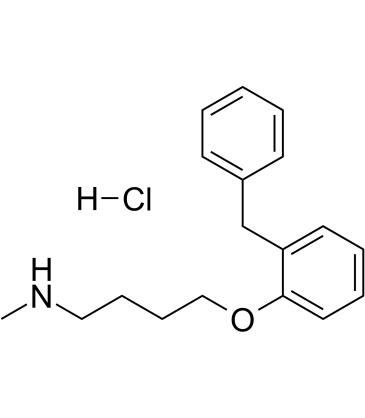
Physicochemical Properties
| Molecular Formula | C18H24CLNO |
| Molecular Weight | 305.846 |
| Exact Mass | 305.155 |
| Elemental Analysis | C, 70.69; H, 7.91; Cl, 11.59; N, 4.58; O, 5.23 |
| CAS # | 62232-46-6 |
| Related CAS # | Bifemelane;90293-01-9 |
| PubChem CID | 6917789 |
| Appearance | White to yellow solid powder |
| Boiling Point | 395.4ºC at 760 mmHg |
| Melting Point | 117-121°C |
| Flash Point | 169.2ºC |
| LogP | 4.848 |
| Hydrogen Bond Donor Count | 2 |
| Hydrogen Bond Acceptor Count | 2 |
| Rotatable Bond Count | 8 |
| Heavy Atom Count | 21 |
| Complexity | 238 |
| Defined Atom Stereocenter Count | 0 |
| SMILES | CNCCCCOC1=CC=CC=C1CC2=CC=CC=C2.Cl |
| InChi Key | MEAHDXWXNNDSAK-UHFFFAOYSA-N |
| InChi Code | InChI=1S/C18H23NO.ClH/c1-19-13-7-8-14-20-18-12-6-5-11-17(18)15-16-9-3-2-4-10-16;/h2-6,9-12,19H,7-8,13-15H2,1H3;1H |
| Chemical Name | 4-(2-benzylphenoxy)-N-methylbutan-1-amine hydrochloride |
| Synonyms | MCI-2016 MCI 2016 MCI2016Bifemelane Bifemelanum Bifemelane HCl |
| HS Tariff Code | 2934.99.9001 |
| Storage |
Powder-20°C 3 years 4°C 2 years In solvent -80°C 6 months -20°C 1 month Note: Please store this product in a sealed and protected environment (e.g. under nitrogen), avoid exposure to moisture and light. |
| Shipping Condition | Room temperature (This product is stable at ambient temperature for a few days during ordinary shipping and time spent in Customs) |
Biological Activity
| Targets | MAO-A (Ki = 4.2 μM); MAO-B (Ki = 46 μM) |
| ln Vitro | In human brain synaptosomes and human liver mitochondria, bifemelane inhibits MAO-A in a dose-dependent manner with Kis values of 4.2±0.2 and 14.1±0.7 μM, respectively [1]. In human brain synaptosomes and human liver mitochondria, bifemelane inhibits MAO-B activity in a dose-dependent manner with Kis values of 46.0±3.6 and 65.2±7.0 μM, respectively [1]. |
| ln Vivo | Bifemelane (20-80 mg/kg; intraperitoneal injection) decreases exploratory activity in the open field test in a dose-dependent manner [3]. In the forced swim test, Bifemelane (20-80 mg/kg; intraperitoneal injection) shortens the immobility period [3], however the dose dependence is not evident and the maximum dosage of 20 mg/kg has been attained. |
| Enzyme Assay | 4-(O-Benzylphenoxy)-N-methylbutylamine (Bifemelane, BP-N-methylbutylamine), a new psychotropic drug, was found to inhibit monoamine oxidase (MAO) in human brain synaptosomes. It inhibited type A MAO (MAO-A) competitively and type B (MAO-B) noncompetitively. BP-N-methylbutylamine had a much higher affinity to MAO-A than an amine substrate, kynuramine, and it was a more potent inhibitor of MAO-A than of MAO-B. The Ki values of MAO-A and -B were determined to be 4.20 and 46.0 microM, respectively, while the Km values of MAO-A and -B with kynuramine were 44.1 and 90.0 microM, respectively. The inhibition of MAO-A and -B by BP-N-methylbutylamine was found to be reversible by dialysis of the incubation mixture. MAO-A in human placental and liver mitochondria and in a rat clonal pheochromocytoma cell line, PC12h, was inhibited competitively by BP-N-methylbutylamine, while MAO-B in human liver mitochondria was inhibited noncompetitively, as in human brain synaptosomes. BP-N-methylbutylamine was not oxidized by MAO-A and -B. The effects of other BP-N-methylalkylamines, such as BP-N-methylethylamine, -propylamine, and -pentanylamine, on MAO activity were examined. BP-N-methylbutylamine was the most potent inhibitor of MAO-A, and BP-N-methylethylamine and -propylamine inhibited MAO-B competitively, whereas BP-N-methylbutylamine and -pentanylamine inhibited it noncompetitively. Inhibition of these BP-N-methylalkylamines on MAO-A and -B is discussed in relation to their chemical structure[1]. |
| Animal Protocol |
Animal/Disease Models: Wistar male rats (230-270 g) Reserpine-induced hypothermia [3] Doses: 20, 40, 80 mg/kg Route of Administration: Single intraperitoneal (ip) injection Experimental Results: Reserpine-induced hypothermia If it is too low, the maximum temperature will be diminished by 10℃. |
| References |
[1]. 4-(O-benzylphenoxy)-N-methylbutylamine (bifemelane) and other 4-(O-benzylphenoxy)-N-methylalkylamines as new inhibitors of type A and B monoamine oxidase. J Neurochem. 1988 Jan; 50(1): 243-7. [2]. The emergence of new antidepressants for clinical use: Agomelatine paradox versus other novel agents. IBRO Rep. 2019 Jan 9; 6:95-110. [3]. Potential antidepressive properties of amantadine, memantine and bifemelane. Pharmacol Toxicol. 1993 Jun; 72(6): 394-7. |
| Additional Infomation | This study was designed with the rational aim of discussing the emerging antidepressant agents that are likely to bring positive landmark, tremendous improvement and significant impact to the management of patients with depression disorders. It also elaborates on the Agomelatine paradox vis-a-vis the other novel antidepressant agents. The emerging antidepressants are: selective monoamine oxidase inhibitors (MAOIs) such as bifemelane, pirlindole, toloxatone, selegiline, rasagiline and safinamide; serotonin-norepinephrine reuptake inhibitors (SNRIs) such as ansofaxine, nefopam and levomilnacipran; norepinephrine reuptake inhibitors (NRIs) such as Reboxetine, viloxazine, teniloxazine (also known as sulfoxazine or sufoxazine), and atomoxetine; Vilazodone (a serotonin 5-HT1A autoreceptor partial agonist with serotonin reuptake inhibition [SPARI]); Vortioxetine (a serotonin receptors antagonist with serotonin reuptake inhibition [SARI]); atypical antipsychotics such as olanzapine, quetiapine, risperidone, lurasidone, aripiprazole and brexpiprazole; N-methyl-d-aspartate (NMDA)-glutamatergic neurotransmission system blockers such as ketamine, CP-101,606 (traxoprodil), GLYX-13 (rapastinel), NRX-1074 (Apimostinel) and Riluzole. While Agomelatine (a melatonergic MT 1 and MT 2 receptors agonist and a selective serotonergic 5-HT 2B and 5-HT 2C receptors antagonist [MASSA]) remains a paradoxical agent that doesn't fit into any of the currently available classes of antidepressant agents and its pharmacological properties also deemed it unfit and inappropriate to be classified into another separate novel class of antidepressants contrary to the reports published in previous reference literatures. Lastly, this review remarkably advocates for the incorporation of the atypical antipsychotics and NMDA-glutamatergic ionoceptor blockers as new member classes of the antidepressant agents because of their clinically significant roles in the management of depression disorders[2]. |
Solubility Data
| Solubility (In Vitro) | DMSO : ~250 mg/mL (~817.42 mM) |
| Solubility (In Vivo) |
Solubility in Formulation 1: ≥ 2.08 mg/mL (6.80 mM) (saturation unknown) in 10% DMSO + 40% PEG300 + 5% Tween80 + 45% Saline (add these co-solvents sequentially from left to right, and one by one), clear solution. For example, if 1 mL of working solution is to be prepared, you can add 100 μL of 20.8 mg/mL clear DMSO stock solution to 400 μL PEG300 and mix evenly; then add 50 μL Tween-80 to the above solution and mix evenly; then add 450 μL normal saline to adjust the volume to 1 mL. Preparation of saline: Dissolve 0.9 g of sodium chloride in 100 mL ddH₂ O to obtain a clear solution. Solubility in Formulation 2: ≥ 2.08 mg/mL (6.80 mM) (saturation unknown) in 10% DMSO + 90% (20% SBE-β-CD in Saline) (add these co-solvents sequentially from left to right, and one by one), clear solution. For example, if 1 mL of working solution is to be prepared, you can add 100 μL of 20.8 mg/mL clear DMSO stock solution to 900 μL of 20% SBE-β-CD physiological saline solution and mix evenly. Preparation of 20% SBE-β-CD in Saline (4°C,1 week): Dissolve 2 g SBE-β-CD in 10 mL saline to obtain a clear solution. Solubility in Formulation 3: ≥ 2.08 mg/mL (6.80 mM) (saturation unknown) in 10% DMSO + 90% Corn Oil (add these co-solvents sequentially from left to right, and one by one), clear solution. For example, if 1 mL of working solution is to be prepared, you can add 100 μL of 20.8 mg/mL clear DMSO stock solution to 900 μL of corn oil and mix evenly. (Please use freshly prepared in vivo formulations for optimal results.) |
| Preparing Stock Solutions | 1 mg | 5 mg | 10 mg | |
| 1 mM | 3.2696 mL | 16.3479 mL | 32.6958 mL | |
| 5 mM | 0.6539 mL | 3.2696 mL | 6.5392 mL | |
| 10 mM | 0.3270 mL | 1.6348 mL | 3.2696 mL |